February 24, 2022

Our Favorite Homeschool Curriculum (So Far)


We are a secular homeschool family in the midst of our third full year of homeschooling and my kids are at two distinctly different ages (6 and 11). I don't use a single all-in-one curriculum because I don't want to put all my eggs in one basket. I choose what will work best for us in particular areas. Some of the programs and resources we use are things we've liked and stuck with since year one (our math curriculum for example), while in other areas I've made changes along the way, as I've gotten to know my kids, and the options out there, and as we've settled into our own unique homeschool rhythms. We purchase (and find free-- keep reading!) some programs and resources that are good and helpful and give some structure to our days. I also forego purchased curriculum in some areas and leave room to be creative and design our own units. One of the best things about homeschool is that if a program or approach isn't working well, you can always make a change-- even mid-year. 

Below are the programs and approaches we are using in our homeschool this year across academic areas. (If you're curious: my 2019 - 20/first year homeschooling curricula and thoughts are here, and 2020 - 21/year two curricula here.) 

Note: I currently have a 6-year-old/first grader and an 11-year-old/sixth grader. I use the resources listed below for both of them (at their respective levels), except where separate programs are noted.


Our Homeschool Curriculum 2021 - 22

Reading: No Purchased Curriculum or Planned Lessons or Assignments
I do not use a reading program in our homeschool (though I did our first year). Besides the fact that the one I love from my classroom days is really expensive, the fact is that my own two kids already live readerly lives and aren't at a point where they need daily, explicit lessons (here is a post about some tips and sources I used last year to help my daughter learn to read in the first place). They read a variety of things from graphic novels to online news, historical fiction to their latest favorite fiction series. They both pick up a book whenever they get a chance and disappear into it for long periods of time. They talk about what they read and they ask what new vocabulary means. They don't need reminders to read. Because of all this, I've learned I don't need to schedule or assign reading time officially. We read aloud to them both daily, and keep the house well stocked with fresh library books, and they take care of the rest.     


Writing: No Purchased Curriculum
We work on a certain genre of writing at a time in a unit of 6 or 8 weeks. For my youngest, I usually choose what that genre will be; for my oldest he has a lot of say and jointly plans out with me the types of writing he is interested in working on. Within the genre they're focusing on, they always choose their own topic. For example, my son is itching to write historical fiction next. I won't dictate the time period he needs to write about or the type of story it needs to be. But I will do some research so that I can inspire him with good models of historical fiction, and share some tips for doing that type of writing well. I love putting together a unit of study on a particular type of writing, and I don't need to have had experience with the type of writing myself to find good resources and give them a good learning experience. Last year my son had a blast with a unit on writing rap, and almost every year we write some poetry at some point. Every day they can always add to an existing piece or start a new one. For my youngest she is always welcome to draw first and write later or whichever order she prefers (here are some other tips for getting the youngest kids to write in the first place). After working on a genre for a while, they choose a "best" piece they're proudest of and revise it to make it even better. We always find a way to celebrate and share their writing, especially at the end of a unit.    


Math: Primary Mathematics
Primary Mathematics is part of Singapore Math. It is from Singapore (where students perform quite well in math) but there is a U.S. version that we use. It is challenging. It is mastery-based; you work with a concept until they really understand, or have mastered, it. (This is different from a spiraling math program, in which concepts are touched on briefly, repeatedly, and rotated throughout the year. I have used spiraling programs in the classroom and don't find them as effective.) There are a lot of reviews built in-- reviews after the end of a section, and also periodic cumulative reviews. Primary Mathematics encourages the parent/teacher to allow the student to get the answer using a variety of methods as long as they understand the concept. Primary Mathematics is inexpensive. There is a paperback teacher's guide, a textbook, and a workbook for each half of the school year (for example, "6A" for the first half of 6th grade and a "6B" for the second half). There are no colorful illustrations or bells and whistles as it seems many math programs have; instead, lessons and tasks get right to the point. There are only a few simple materials needed for the program (so few that our first year of homeschooling, because of a funny schedule on Wednesdays, my son and I were able to easily have math class in the car once a week). There are plenty of instructions included for simple math games we play, especially at the primary level, but essentially each day is a brief lesson, and then a couple of practice pages for kids to do on their own. My kids are performing well in math and this program is easy for me to work with as the teacher. This is our third year using it.

 
Science for my 6-year-old: Mystery Science (K-5)
We love Mystery Science. Check out this entire post about why we love it for details. Briefly: it is fun, it is aligned with national science standards, it is very affordable (around $70 for an entire homeschool family for the year), it requires minimal materials, it is online/video-based yet also hands-on. It is super engaging, age-appropriate, and teaches concepts in clever, simple ways that really stick. Science is my daughter's favorite subject. 

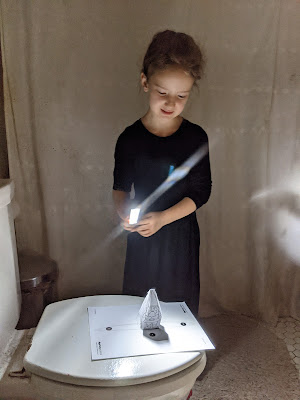
Here she is having so much fun figuring out how to make shadows longer or shorter or pointing in different directions as part of a unit on patterns in the sky. (Please excuse the fact that the pictures are taken in our bathroom, as we needed a dark room for the activity!) 


Science for my 11-year-old: Discovery Education Science Techbook (K-8)
Because we love Mystery Science (above) we were sad that my oldest outgrew it this year; it only goes through 5th grade so we had to find another source for 6th-grade lessons for him. We purchased a one-year subscription to Discovery Education Science Techbook through our free membership with the Homeschool Buyers Co-op for around $60. Science Techbook works in an online format. It was one of the few science options I found that was standards-based. There is a lot of technical vocabulary, tougher concepts, and higher-level skills expected as part of the activities-- all good things but it has been an adjustment from the accessible and super engaging Mystery Science he was used to (see above). Some units are quite long and I know we won't get "through" it all by the end of the year...but that happens sometimes in school as well as homeschool. Every time we finish a concept, I spend way too long trying to remember where to find the assessments, but we are learning our way around the interface and how it is organized. (One other note: since Science Techbook is for K - 8, I dabbled in some of the primary units with my youngest as well just to supplement her science, and I felt it was too much computer, paper-and-pencil, and video time, and it didn't feel age-appropriate and fun for younger kids. So I'd recommend it only for older kids.)

Looking at an Elodea leaf under a microscope as part of a unit on cells

The Core Knowledge Foundation is a non-profit that publishes educational books, materials, and entire units in many school subjects. We pick and choose from the social studies units exclusively (not other subject areas) and especially for my oldest. I scroll down the Core Knowledge web site where you can download curriculum for free, check the box that says "History & Geography," then check the grade level I am interested in and look at the units available. We don't do every unit listed, because there are a lot. This year W chose which topics he was most interested in, including some that happened to be listed under other grade levels. The units are each essentially a textbook, or mini textbook. There is a student reader and a teacher's guide. My son reads a couple of chapters at a time and then we discuss them, using the questions (and provided answers) in the teacher's guide as a basis. There are a few worksheets scattered across each unit that kids can do, but nothing that takes too much time. It's pretty straightforward, standard educational stuff. But each unit includes online resources, sites you can visit to visualize and extend the content from each chapter. There are virtual tours, links to primary sources, museum web sites, and YouTube videos. We find the online resources and activities that go with them really engaging and I find that part is what really makes things stick. We've found the Core Knowledge units to provide a strong, solid understanding of times in history and events that we've studied. 

W made his own illuminated choir book pages as part of a unit on medieval Europe
 
Those I've listed above (reading, writing, math, science, social studies) are the core subject areas that we do most days. Below are a few other areas of study that we do less frequently. 

Phonics for my 6-year-old: Mix of a Couple of Programs
My daughter is a strong reader and a good speller so she's internalized a lot of things that I would have taught consistently and daily in the classroom. So I just do a little focused practice with her about once a week to work with words and focus on some conventions (handwriting, punctuation, spacing). There are two books I bounce between when we do spelling/phonics work. One is Month-by-Month Phonics for First Grade, which has lots of fun activities to work with words and word patterns. The other is Words Their Way. (I wrote a post in more detail about how Words their Way works here.) It's a spelling approach that allows you to find your student's level using this guide. Once you find their level you know which book to purchase full of spelling lists of the types of words they need to work with. We copy a list of words, cut them out and she can sort them in various ways and notice characteristics of the different words and do activities with them.   


Grammar for my 11-year-old: Easy Grammar
This was recommended to me by a homeschool friend when I realized my then-fourth grader didn't know the parts of speech, and it has worked just fine for us. I only purchase one book, the Teacher Edition, because it includes the lesson information (which is very brief) and answer keys as well as the student pages; I copy them for my son to do. We don't do grammar daily, because he's a strong reader and writer and because there aren't many times someone is going to tell him to diagram a sentence in life or ask him to name the object of the preposition. But I think the basics are good to know and the exercises are quick and to the point. So once a week or so, I introduce a new concept and give him a few practice pages to do. It has worked well for us and cost very little time or money. 


Foreign Language: Duolingo and Dinolingo
Last year we tried Rosetta Stone when my son was just starting out with a foreign language (Greek was his choice). Partway through the year he switched to Duolingo and has stuck with it and likes it. It is online, and free! It is intended for ages 13 and up but my 11-year-old has done fine with it. Like all of these online language programs it seems, it doesn't actually teach most new vocabulary explicitly, but adds it into exercises where you have to guess at first, and then repeats it often until you catch on and get it right. 

My daughter had some fun with sign language last year but wanted to work on the same language as her brother so she does Greek now as well. I found Dinolingo as an age-appropriate, inexpensive option for younger kids. It is more visual, consistently using pictures or videos, and it is highly game-based so she loves it. I think she secretly likes doing Greek simply because it feels a little like she is getting away with playing a video game, but she does go around the house counting in Greek so I know some things are sinking in! 

~

So that is what we use for curriculum in each of the different areas in our homeschool. I hope this is helpful for any homeschoolers just starting out, or looking to change. I hope to share how we put it all together in our regular daily routine soon!

September 21, 2021

Homeschool Year Three: (Still) Finding our Rhythm


This summer, my youngest learned to swim. She can now keep herself afloat for a significant distance without a life jacket. I found myself thinking about the fact that swimming is a huge milestone, and we didn't teach her to do it. We gave tips, cheered, encouraged, but there was nothing we could do, no matter how much we wanted to, to make it happen. When she was ready and believed she could, she stayed afloat. 

I watched her process of learning to swim through a different lens because I had recently read How Children Learn, whose basic premise was: do less teaching and just let kids learn. There are so many things kids learn when they are ready, that we can only give support when they falter or when they ask-- like walking, and riding a bike. And not just physical things, but psychological/developmental growth, too, like getting over fears. (Early this summer, a friend of my son's released a crayfish into our swimming hole, and ever since, M has been clingy and nervous about where the "crab" was every time we went swimming, no matter how much we tried to reassure her that it wouldn't hurt her and had probably gone downstream by now. Yet when she was ready, it was in the space of a couple of days that she abruptly decided to stop worrying about the crayfish and learn to swim all at once.)

What about school, or "book learning?" Would my son have ever memorized all his state capitals like this-- on his own, when he was ready-- without my making him do it? Maybe, if he for some reason was inclined to do so, and maybe not...Then again, what does it really matter if he memorizes state capitals, and how long does that kind of learning last, anyway? 

I've often pondered how some kindergartners and first graders arrive at school already strong readers. But most of those same parents didn't sit down and teach them. All they did is live their literate lives, reading to their kids and talking to them, and those kids were interested enough and exposed enough to figure out reading for themselves. (As a sort of side note, this makes me think of the wild finding from the book Freakonomics that simply having a lot of books in a home-- not reading to your child every day-- correlates to a child's higher test scores in school.) 

With a lot of skills, especially when kids are young, it seems there comes a point that they want to do it enough, and are driven to try enough that they learn. How many things that we sit kids down and school them in over the years, could be learned naturally like this, when they are ready-- even quickly or all of a sudden, like my daughter's swimming?    

These are some of the big thoughts I had this summer as I anticipated our third year of homeschool. 

Then I read another book called Unschooled. This is a book that I had turned my nose up at in the past. But I was ready to see what this book was all about, even though I felt by reading it I was playing devil's advocate and it wasn't really written for the likes of me. 

But, it was another I needed to read. I don't agree with everything it said, but found myself aligned with the author and the points she was making so much more than I expected to. It made me think a lot about what an education is, versus schooling-- not one in the same. It made me think about how much freedom teachers and parents don't give kids, but maybe could: not license to do whatever they want, but freedom to make choices as long as they are respectful of others. It made me think again, more deeply than I had before, about how important it is to let kids follow their interests rather than adults always deciding for them what must be learned. It made me ponder the value of kids' time and how I want them to feel about their childhoods. 


These books, and especially Unschooled, were something of an awakening. I had had some of these ideas in the past, questioning the value of all the time kids spend on traditional schooling and on structured, scheduled activities, but I hadn't fully acknowledged all of them... 

As a teacher, I didn't see it as a big problem when families occasionally took kids out of school for family activities, even though it was formally frowned upon. I felt that an extra day with visiting grandparents from out of town or memories from a family vacation were probably more important for that child than my math or phonics lessons that particular week. 

As a working parent my son had almost no free time/down time/play time during the week. His after-school program had the kids sit and do homework immediately after giving them a snack-- and often not even actual homework, but random worksheets they photocopied to fill the time when the teachers hadn't assigned anything. I always wished instead that he could have gotten outside and burnt off steam at the end of the school day. There was so little time in his young life when he wasn't doing school and I never felt at peace with that. 

I loved when the school where I worked stopped assigning homework to all elementary students K - 5 (following guidance from research showing that it doesn't have a positive impact at that level)-- thereby doing a small part to give kids a little time in their day for other interests and for play. 

~

Two years ago, when we started homeschooling, I was doing school at home because that was comfortable and familiar. I had not set out then to "unschool" my child; I wanted him to be schooled better. I knew things about what I thought good education should be and I did those things. My teaching was consistent, it was sequential, I made sure to include everything that "should" be included for a then-4th grader, I had great programs to help do the job, we had a school-like schedule. But my view of education, and where I am as a teacher and a homeschool parent has changed. I've had a lot happen since-- a pandemic, beginning to homeschool two kids instead of one, learning the types of skills my particular kids needed to spend time practicing and those they simply didn't that we could skip, beginning to realize that the learning and the memories that have been most special and most lasting are the projects and all the other unique things we've done.  

Some time ago I started consciously trying to let my kids be in charge of the little, personal things and other decisions in their lives when possible, to help develop self-esteem and responsibility (inspired by other good books I'd read). But as homeschoolers, they have agency over more and more now. W sat with me and helped draft a list of the topics he really wants to study in history this year. They're both helping to select the types of writing they want to do. We've made pro and con lists together as we decided whether or not to register for various programs, classes, and other opportunities that have come up so far. I wanted to know their big wishes for the coming year. I always tell them that if our daily routine isn't working well, we can change it at any time to make it better.     

My son began his homeschool career in August of 2019 feeling different, and angry with me for changing his whole world. Now he's a big homeschool proponent; a child who speaks up about his education and his interests; a person whose skills, interests, and social world have expanded and diversified; who thanks me regularly for the choices I let him make and for the things we do. Seeing him being happier, seeing him literally learning how to learn and coming to care about his learning, are the biggest indicators that I am on the right track in my ongoing evolution as a homeschool parent. 

So, as we started off our new year, I had all of this in mind and also that:

I want to focus on their strengths more than their weaknesses. It is in working on something that drives them that they grow confidence, and get better at all things. I wonder if my son may be a writer, actor, comedian, animal trainer, or historian and my daughter a doctor, dancer, engineer, or musician-- or more likely something I haven't fathomed yet. I don't want to do anything to squash those current leanings of theirs, so I want to pay attention more to what feels important to them now and less to the learning sequences I've selected. I've seen that learning from interest sticks and can lead to so much more unique learning that I can't predict. I know I have to allow some big stretches of time for that.

I also know that we all benefit from some routine, and that there are some topics they may never set out to study on their own but that I want to make sure they get some regular practice in (such as math, writing).

...So my current way to make sense of all this is a homeschool schedule that is half days. I never thought I would be advocating a 4-hour school day! But half days aren't really half days; they're full days, only half scheduled with traditional school stuff. The morning is academics, mostly driven by me (albeit with their input wherever possible), while the afternoon is more driven by them and where I am test-driving the "unschooling" mentality. I wanted to give them the gift of time: a wide open afternoon every day for them to have the space to do what's important to them. 

Of course those empty afternoons quickly got sprinkled with activities: there's PE class at the local school a couple times a week, and instrument lessons, and now soccer in the evenings. It's easy to become overscheduled and I think it's a parental duty to intentionally say no to some things. But so far this schedule is working great. This schedule still allows big chunks of afternoon with which they get to decide what to do. Sometimes I offer up an art project or other activity, but in our first few weeks of school so far they have filled most afternoons with a great variety of things they've felt inspired to do-- M has crafted a birdfeeder and a train out of wood and wood glue literally all by herself, while W has fallen down rabbit holes of research into personal interests (never thought I would know so much about animal pelts, knife safety, and taxidermy...). They've both enjoyed hobbies, playing outside, reading, board games, hikes, play dates. I am not worried my kids won't learn during an unscheduled afternoon, because I know my kids. I'm always impressed by the things they dream up and accomplish when they are given uninterrupted time (and available support and resources from me as needed). The things they do don't need to have a clear, immediate purpose to me; I feel like the purpose of carving out the afternoons for them is to value their motivations and interests and see where they lead. As a grown "unschooler" says in Unschooled said, "The biggest difference between school or school-at-home and unschooling is being willing to trust the child." It's true that in general the more I've trusted my kids, the more trustworthy/productive/respectful they are. 

I know it's a privilege to be able to make decisions such as these about my kids' educations and how they spend their day-- and I'm taking advantage of it! This year feels like the right balance and a good rhythm for us so far but I'll keep you posted. Happy new (school) year to all!

July 17, 2021

Penpalling with Global Penfriends


My oldest studied Greek as a language this past school year. (At first he used Rosetta Stone, and later, Duolingo. But that's a story for another day.) In looking for ways to enrich that learning, we looked around for ways to connect with the Greek culture and he really liked the idea of having a penpal. Turns out there are a number of sites out there with the aim of connecting international penpals. We found the site Global Penfriends and we've had a good experience with it!

Through Global Penfriends, you can search for penpals by country and by age range. When W searched for kids ages 8 - 12 from Greece, a few profiles popped up. The way the site works is you send a brief message to see if the person would like to connect. After a couple attempts that didn't yield responses, W heard back from a boy his same age from Athens back in April and they have been writing back and forth ever since! At first, W was so excited each time he received a new message and he would sit down immediately to write back. The novelty has worn off and he usually lets a week or so pass between correspondences now, but it has been fun to see their relationship continuing through the summer. Shortly after connecting with the boy from Greece, W received a message from a boy in Germany looking for a penpal with whom to practice his English. W was compelled by some of that boy's similar interests so he has been writing with him as well. He is going on over three months writing with these two different kids he's never met.

They write about the usual penpal topics you might expect of an 11-year-old: favorite sports, instruments they play, video games, school, birthdays, weekend plans, climate, holidays. But there have been some special communications W has really appreciated as well. When W was trying to plan some Greek food to cook this spring, he researched a lot of ideas but couldn't decide, so he asked his Greek penpal, E, about his favorite traditional foods. E's personal opinions greatly influenced W's decisions on what to cook.

His global awareness has grown a bit through having international penpals. 

W comments a lot about how impressed he is with his penpals' English. It makes W smile when they (rarely) write a sentence with the verb tenses a little off or words missing (and the mistakes help him guess in what ways their languages work differently), but the main sentiment is awe that kids his own age from abroad are conversing in a foreign language with ease.

Almost every single time W receives a note and replies, I see him Googling Celsius/Fahrenheit conversions, or getting out the ruler to compare centimeters to inches. He does this not only to understand facts his penpals have told him, but he also chooses to try to write in these terms himself, trying to tell them how cold it was here last winter in Celsius and how much snow we receive in centimeters. Since W can't speak fluent Greek or German, using those systems of measurement is one of the ways he can make an effort to reach across the cultural divide. 

He had to learn what his penpals mean when they talk about how they spend their "holidays," and what his German friend was referring to when he said football was his favorite, and how the 24-hour clock works.

International or not, letter writing or emailing is a chance to practice writing of course. It's also just a nice at-your-own-pace way to practice relationship/conversational skills-- like the balance between sharing stories about yourself and authentically responding or asking questions about the other person. There have been a few times, when W has me check over one of his notes before he sends it, that I've suggested he do a little more of one or the other.

Because we don't actually know the people on the other end of the emails, using Global Penfriends has been a great natural way to talk about and practice internet safety as well:
  • All notifications from Global Penfriends come through my (parent) email address.
  • W corresponds with his penpals through the site and we didn't have to exchange any other contact info or even full names.
  • I read every letter W sends and receives.
  • When one of his penpals shares a link, W knows to ask us whether he can click on it.
  • When he does a Google search to better understand something his penpal has written about (and any time he does online research for any reason), we talk about how to look for trustworthy sites to visit and read. 
Originally we set out to find a penpal to enrich a foreign language study. But it's been a lot more than that. My favorite moment was a few weeks ago when W said, "If I ever go to Greece, it'd be really cool if I could actually meet him." We're a long way from that day, but I like that we've expanded his horizons far enough to think about that. :) 

June 15, 2021

End-of-Year Lists to Celebrate and Reflect


It's good for us all to take time to reflect on our own growth. We forget in the day to day, or don't realize, how far we've come. For kids especially, just in the space of a year their growth is usually pretty dramatic. It's nice to help them see this growth over time and celebrate it. 

For the last several years, at the end of the school year, I have made each of my kids a card-- "Congratulations on finishing third grade!" it might say on the front. Inside of it, my husband and I have listed some of their many accomplishments of the past year. I think they always felt special reading these cards (or having them read to them). The card tradition makes a nice keepsake and helps give a little extra pomp and circumstance to reaching that all-important last day of school/eve of summer vacation. 


I looked back over the kids' cards from past years (going back as far as 2015, the year my oldest finished preschool) and smiled at some of the things we'd recorded as important milestones each year:
  • You were brave enough this year to run through the sprinkler! (Preschool, M)
  • You are so good at using scissors and placing stickers. (Preschool, M)
  • You learned to put on your own coat and button and zip your clothes! (Preschool, W)
  • You learned to make "7" stars. (Kindergarten, W)
  • You always keep us updated on how many days you have been in school this year. (Kindergarten, W)
  • You learned two whole new sports-- basketball and tennis. (1st Grade, W)
  • You did a great job with all your jobs as a ringbearer. (1st Grade, W)
  • You started to enjoy Sudoku puzzles. (2nd Grade, W)
  • You taught us cool facts about Jamestown. (3rd Grade, W)
This year I realized it might be fun to have my kids each make their own list for the first time. We did it as a little reflection project on our last "official" day of school recently, although this could be done at any time that it feels right to step back and recognize growth-- at the end of a summer, end of the actual calendar year, before each birthday... 


This is how I framed it for them: I asked them to sit down for a few minutes and list things they had learned this year or things they were proud of accomplishing. I told them to think about "school" stuff like reading, writing, math, science, social studies, etc., but also to think about music, sports, friends, life. They both were really engaged in it, my oldest especially. (I told him after we had finished, that just watching him work on this was an example of his growth; I remember a time when he would not have been able to sit for 20 minutes and fill up two pages easily, without any trouble getting started or complaints of being stuck.) Here are a few gems they each recognized about the past year (all is word-for-word from what they wrote, except my notes in brackets): 

M (age 6):
  • I learned my 4th finger and my new bow hold [on violin]. 
  • I skied 5 miles and rode my bike 5 miles and hiked 5 miles! [At different times :) ]
  • I learned to tie my shoes. 
  • I learned to snap [fingers]. 
W (age 10):
  • I do a bunch of push-ups every day.
  • I built a bunch of cool Lego forts. 
  • I started doing the dishwasher every day (not that I'm proud of it).
  • I got better (way, way better) at solving problems with M.
  • I made several videos on YouTube.
  • I got even more competent at glade skiing with my twin tips. 
  • I realized that Hamilton is super awesome. 
  • I learned a bunch of complicated new words and used them in my writing. 
  • I made new friends on my baseball team. 
W said something after we made the lists like, "Wow, I knew I did a lot this year but this list makes me feel really good." Having that hit them was of course exactly the point.

We parents couldn't resist separately noting some things we're proud of too, and didn't want to break our tradition of documenting them in a card. Here are some of this year's accomplishments we came up with for each of the kids as well:

For W:
  • You learned to do long division, averages, percentages, and more. 
  • You crushed your first 22-mile bike ride.
  • You started eating salad-- yay iceberg! 
  • You began studying Greek and made us some delicious Greek food.
  • You discovered the joys of Calvin and Hobbes. 
  • You learned to do video editing and have used it to make several cool projects. 
  • You have maintained two penpals. 
For M:
  • You learned to ride your bike!
  • You learned to READ and you read everything. 
  • You memorized lots of Frozen and Moana songs and you sing them beautifully. 
  • You learned sign language.
  • You were on your first soccer and baseball teams and you learned a lot of skills. 
  • You learned to downhill ski and you went on the chairlift for the first time. 
  • You grew 3 1/2 inches and needed a bigger violin. 
  • You love science and always want to do more science. 
  • You can do addition and subtraction. 
  • You became a writer and wrote lots of great stories about babies.
  • You pour your own milk in your cereal.
  • You are a huge help in the kitchen.
We read all these lists-- theirs about themselves, and ours we wrote for them-- aloud at dinner and there were a lot of smiles and nods all around. It was a fun end-of-year or anytime reflection project-- good for self esteem and for developing a growth mindset and just plain fun. 

June 1, 2021

For the Love of Art: Our Favorite Art Projects this Year

Art was not a reason I set out to homeschool two years ago, but it is one of the many areas in which growth in my kids has surprised me and opened my eyes-- particularly in my oldest. 

W didn't lack good art teachers in school. He had two good ones during his time in school; I was always impressed with the things they'd study and cool projects they'd do. But he didn't like art class and struggled with it, for a few reasons I think. For one, he would often rush to finish because art class was within a tight 45-minute time frame and at a certain point you have to just finish. When emotions are high or he is rushing, the project at hand becomes even more difficult. The teachers would need to help him with the trickier techniques, when they could get to him, and he didn't feel much ownership. Often he would finish off a piece of work with globs of paint, scribbles, or silly doodles-- to cover up his frustration that he couldn't quite get the effect he'd been trying to achieve, like some of the more sophisticated artists around him could. As in all things, he compared himself with others, and in art it made him feel worse and try less hard. He also struggled with attention in school and didn't have the strategies then that he has since found to help with that (and of course had more distractions in school). 

At home he can keep at a project for as long as he wants. He doesn't have others to compare himself to (except his sister, who is at a completely different stage and to whom he is very encouraging in art), so he's become very focused on his particular creations for what they are and for the process. In the past he complained that his paintings looked babyish, but one thing we've done at home is some specific step-by-step painting tutorials (see below). Those have resulted in pieces he's so proud of, he started feeling more capable and more eager to paint in general. Similarly, W always wanted to draw people but felt he was bad at it so avoided it. We've done various online drawing lessons as well as purchased books on how to draw thing like soldiers and military vehicles, and he's also gotten interested in tracing and in drawing images he finds in books or online. The space to pursue his own interests through art, including historical scenes and people in battle, has had major impact. He is driven to do it and has done it more and more of it of his own volition and his skills have grown-- he is so pleased with the way he can draw muscles and bent limbs in action now. 

While there is no one thing I can claim that we've done that has been the ticket, two years of doing art at home, in his own way, in his own time, has really worked wonders for both his abilities and his self esteem. Now seeing himself as a good painter and a good drawer, a creator of incredibly detailed birthday cards, and seeing the effect that all his patient practice has had, his relationship with art has evolved dramatically, and he is more open and positive about any creative opportunity that presents itself. It makes me so happy to finally see him find joy and skill and focus in art.

Onto some favorite projects! 

My kids do plenty of artistic, creative, crafty things all on their own, from M's color-by-number pages and glued-together sculptures and woven potholders, to W's drawings and stop-motion animations and new whittling hobby. But I also enjoy finding a wide range of art projects we can try out together once a week or so. It's a chance to work together as well as learn a new technique or discover new materials. 

I am definitely not an art teacher and that is why I like to share often about the art projects that we do (here and here are some things we enjoyed last year); I can deeply relate to the need for ideas and advice! Here are some highlights from some of the more "official" art projects we've done together over the past year: 

Polymer Clay Crafts
I loved a unit working with Fimo polymer clay in high school, so I bought this set and with the help of some YouTube tutorials, relearned a few techniques with the kids. One big concept is how to make a cane-- a long rod of different colors and thicknesses of clay that, when you slice it, shows a flower or whatever design you've built into it. It's magical! You bake your creations in the oven (on a foil-lined pan, with some good ventilation because it's a little smelly) and when they've cooled fully you can make them into necklaces, earrings, and more. 

(One note: I have done every project on this list with both my kids and this one is truly the only project that I found to be a bit too tricky for my kindergartner (or at least it was early this past fall when we did it). She still had fun playing with the clay, but would have had as much fun playing with Play-Doh, which is softer and easier to sculpt.)


Quilted Pillows
My mother and grandmother made a lot of quilts when I was growing up, and I've made my share of them as well. I was successful teaching my son to knit last year and I wanted to introduce my kids to sewing with a needle and thread this year. I thought making a simple quilted pillow cover might be the way to do it. I got out this quilting book I own, which provides the patterns for many different classic quilt blocks, and let them each choose one they liked. W chose Log Cabin and M chose See Saw. Then they chose whatever colors and prints they wanted from my collection of fabrics and scraps. I helped them pin the cardstock shapes onto their fabrics and cut them out. They laid out their pieces like a puzzle according to their pattern. After that, over several short sessions on many different days, they have pieced together their quilt block, stitch by stitch. They had to learn the concept of right sides together and how to try to avoid tangled threads. I did most of the tying off for my youngest, but her stitches were neat and even! Now they each are very close to having a new pillow.


Pastel Tulips
I got the idea for this from Projects with Kids. We did this on a nice day outdoors in two steps. The first was to draw the outlines of our flowers on black paper, go over the pencil with a line of glue, and allow that to completely dry overnight. The next day we shaded and blended our choice of chalk pastels to color them in, the hardened glue providing a nice boundary kind of like stained glass. They came out beautifully and we still have them hanging in the house. 


Pressed or Pounded Flowers
This is another great project for a beautiful spring or summer day. Half the fun is walking around the yard collecting specimens. It causes you to really look and realize how much variety in plant life is around you in wildflower petals and leaves-- even if, like me, you don't have much for intentional flower beds. After collecting, we've made either pressed or pounded flowers. 

For pressed flowers, we laid out a piece of contact paper sticky side up and placed each specimen face down on it. Then we pressed a piece of construction paper onto that so it stuck to the contact paper. We placed the whole thing under a big dictionary for a day or two to help it stick well and the plants to be nice and flat, then trimmed the excess off the edges and displayed. 

For pounded flowers, we placed a piece of white construction paper on a cutting board, taped down at the edges. We laid our flowers and leaves face down on the paper (or so the side with the most pigment was face down), then placed a piece of waxed paper over the top of it. I taped the waxed paper at the edges too so it stayed in place. Then we whacked it with the flat end of a toy hammer (any flat mallet would work) to try to get the pigments to rub off on the white paper. It takes a fair amount of whacking to get the whole shape of a plant to show up. Then we discarded the flowers and checked out the prints we'd made on the paper. Some of them did better than others and came out quite pretty. It was as much a fun science experiment as an art project.  


Pressed flowers

Pounded flowers and leaves

Color Wheels
There are lots of kids' books and activities about the color wheel and color combinations, such as Mouse Paint. But it was fun to get out only the three primary colors of our tempera paints and literally do the mixing to make all the colors ourselves. On a large piece of white paper, they each used a compass to first draw as large a circle as they could, then used a ruler to draw a nice straight line across the middle, and more lines as needed based on the number of sections. I had M make a simpler color wheel consisting of primary and secondary colors, while W made one that had tertiary colors as well. 

Younger kid version: M made a color wheel with six sections in all. She began by painting red, yellow, and blue sections, leaving a blank section between each set of primary colors. Then she mixed yellow and blue in her paint tray, and painted the section between yellow and blue with the green they created. She did the same with the other combinations of primary colors for the other two blank sections and ended up with a wheel that showed red, orange, yellow, green, blue, and purple. 

Older kid version: W split his circle in the beginning into 12 sections total. He also began by painting sections in each of the primary colors, but he left three blank sections between each pair of primary colors. When he then mixed his blue and yellow to make green, he painted the green he made in the middle of those three blank sections between blue and yellow. Next, he used a bit of that green he'd created and added more yellow to it and put it between his green and yellow sections. Then he took some more of his original green he'd created and added more blue to it and painted his blue-green between his blue and his green sections to result in a color wheel with lots of gradations. It was a super-simple project, but they were delighted with seeing real color mixing at work. 


Color wheel for older kids

Color wheel for younger kids

Acrylic Pour Paintings
My sister first did this with her kids and we were so dazzled by their paintings we had to try it. She pointed me to the fact that there are many YouTube videos about how to do acrylic pour painting. Here is a simple, very slow-paced video about how to do it that I watched for background info. We used a canvas and painted it with a base coat of watered-down paint. We painted it black, but white would also be good. Then, while the base coat was still wet, we mixed little cups of watered-down acrylic paints-- liquid enough that it pours easily but not too watery. My kids each chose three colors they wanted. (Dixie cups or plastic shot glasses work well for the paint cups.) We poured some paint onto the canvas and tipped and twisted the canvas around to make the paint run in different directions. You can pour the paints on in whatever amounts you want (err on the side of less at first because you can always add more). You can pour them all in the same spot or near each other or far from each other. You can use a straw to blow at the paint and make it move around, and all sorts of other techniques you can Google or just experiment with. (Here is an article just for some ideas of the many different techniques you can use when pouring.) Almost whatever you do, it makes striking abstract art. 

I figured this would be a pretty quick project because of the nature of it, but they were at it a surprisingly long time, tipping and twisting and completely absorbed trying to get it to look just so. This would make a fun project for a party or for any age (and would be another great outdoor one, although we did it in the winter).  


Scribble Drawings
We watched a great live online talk with illustrator Jason Chin on Earth Day. In it we got a simple, liberating idea: make a scribble or a fast little doodle on a blank piece of paper. Then, put your pen down and look at it. Turn the paper all around and see what you can see in your scribble. Does it look like a balloon? A hand? The flame of a candle on a birthday cake? Choose what you see in the scribble and then make the rest of the drawing based on that. Chin demonstrated this a couple times and it was amazing how by the time he was done each time, the once-random scribble didn't look like a scribble any more but looked like an intentional part of the fun drawing it became a part of. I thought this was a great activity that was less a one-day art project and more a lesson to always carry with us: it's okay to make mistakes, and anything can become art with imagination and multiple ways of seeing.   


Tissue-Paper Flowers
We've made tissue paper flowers a few times. They are so colorful and last forever! All you need is tissue paper and pipe cleaners. Sometimes we use a Klutz book and kit we have that provides directions on how to make various types of paper flowers from simple to complex. Recently we tried following the online directions from The Craft Patch to make simple, large, bright, showy flowers. Pictured is an in-progress wreath made by wrapping our paper flower stems onto a wire coat hangar.  


Papier-Mache Bowls
This is messy. It also has to happen over the course of several days because of all the drying times. But it's a rewarding, colorful result and a good skill to know. I posted all the materials and steps for it in this blog post. 


Step-by-Step Painting Tutorials
I've enjoyed a few paint and sip experiences myself and we've enjoyed the kid version as well over the last couple of years. Step-by-step online tutorials, both in video form and in written form, have been a game changer when it comes to painting, especially for my oldest (my youngest still gets a lot of enjoyment out of the act of painting, regardless of the results). Painting something that looks good, in which he did multiple steps he wouldn't have necessarily thought of himself, makes him feel so proud. And while the kids are following a guide, they also have the freedom to omit or add portions they want to their paintings, as well as choose their particular colors and other details. Even when we all paint the exact same project, they all come out so different and with so much personality. Painting tutorials have also taught us some useful techniques that have carried over into other painting projects. One favorite site is Step by Step Painting, which has a bunch of tutorials that are simpler so specifically aimed at kids. We've also had some luck just searching and choosing tutorials on YouTube when there is a specific subject we want to paint, like recently when W wanted to paint a lighthouse in a storm.   


Traced Portraits
We looked at some striking portraits by artist Kehinde Wiley, who creates vibrant botanical backgrounds. Then I printed off a photo of each of my kids. They traced the photo, which was more challenging than tracing a drawing with distinct lines; they had to really study facial features and decide what to trace in Sharpie, what to trace in pencil, and what details to fill in later. Then we copied their tracings onto regular white paper and they colored them in, being especially creative with floral and leafy backgrounds-- we picked things around our yard to inspire the backgrounds. (We borrowed this project idea from the Park Hill School District's online art curriculum.) 


Holiday Crafts
We made a few fun things around the holidays: cranberry chains, snowflake ornaments made from toilet paper tubes and glitter, Christmas tree tree ornaments made from popsicle sticks and from ribbons, and our annual gingerbread houses.  


Sharpie Pop Art
We learned a little about Pop Art (including this quick video intro about it from Tate Kids) and then made these Andy Warhol-inspired Sharpie creations. We each chose our own object to repeat in four quadrants on a square piece of paper, outlined in black Sharpie, and colored in different, bright colors. Fun and easy. 

 
Abstract Popsicle Stick Art
This was another bright, easy project, fun for any age and for making collectively. We began with jumbo rainbow popsicle sticks, and each painted a bunch of them in whatever abstract patterns and designs we wanted. When they were dry we sorted them out by color and arranged them into squares, then glued them on a large piece of cardboard cut to size. I got the idea from Preschool Powol Packets. 


Aboriginal Art Prints
This is my favorite example from this year of the value in simply trying out some brand new materials and techniques. The kids were so excited when I told them we were going to try printmaking. First we learned a little about Aboriginal Art (YouTube of course), then each sketched our choice of subject. (Most of the art we'd looked at had animals as the subject, so I chose a fish. My kids were much more creative-- W drew multiple animals heading toward various destinations while M drew Elsa and some snowflakes.) Next we copied our drawing onto scratch-foam board-- we etched the picture right into the Styrofoam using a wooden stylus, but a pencil would also work. Then I poured some block printing ink out (into a large plastic take-out container lid), and rolled a brayer (small roller) in it, then on our scratch board to cover it completely with ink. Then we pressed a large piece of construction paper over our inked scratch board and rubbed over the back of the paper with a flat, heavy object to make sure every area got printed (a rolling pin might have also worked). It was a thrill to slowly peel back the construction paper and see that we had indeed made a print. Now that we've learned some basic steps of printmaking, there are a lot of cool projects we could do. (This project idea we also borrowed from the Park Hill School District's art curriculum online.) 


Tie-Dyed T-Shirts
Recently my daughter and I each tie-dyed a t-shirt (my son opted out of this project). We've used this Tulip kit several times and it works great; you only need to have white clothing or other things on hand to dye. The kit includes instructions and ideas for different techniques of tie-dying that yield different results. The gloves included in the kit are definitely worth wearing from the moment you open the package, because there is dust from the dye that somehow gets all over your hands even before adding the water. (Speaking of mess, perhaps this is obvious, but tie-dying is best done standing at a table, outdoors, wearing a smock and gloves on a nice day!) After the shirts have spent the night wrapped up in rubber bands and plastic, it is so much fun to unwrap them and find out what you've created.