Showing posts with label Curriculum. Show all posts

February 28, 2023

Rodgers and Hammerstein Unit Studies for Kids

This past summer, some old friends invited my daughter and I to join them to see Rodgers and Hammerstein's Cinderella at the North Shore Music Theatre. We did and it was excellent. After that weekend, we realized more than we had before how big a deal musical theater is for our girl. She couldn't stop talking about the costumes, especially Cinderella's and the fairy godmother's rags that transformed into gorgeous ball gowns when they spun around right before our eyes. Then there was the fascination with the way the show portrayed aspects of the story, like the prop "horses" lit up with Christmas lights taking Cinderella to the ball. And there were some plot twists we weren't expecting, like the fact that after a second ball Cinderella intentionally leaves a shoe behind. And most of all, the music. We were Rodgers & Hammerstein newbies before that show and were immediately enchanted by the wonderful songs. Within a couple of weeks M had them all memorized, belting them out throughout the day, humming them constantly, getting them stuck in all of our heads. 

Added up, the experience really lit something in her that honestly has stayed alive ever since. It made us want to get her out in the world to see plays and musicals whenever possible, ...AND it inspired one of the most fun things we've been up to this school year: unit studies on Rodgers and Hammerstein musicals! 

Rodgers and Hammerstein Musical Theater Unit Studies for Kids
 
We started with a Cinderella study, then about a month later we moved onto The Sound of Music, and after that State Fair, and finally The King and I. With each one, we began with simply watching the movie, then moved on to check out different versions, do related activities, go on field trips when possible, and end with some sort of special culminating project. These unit studies have been a high point in her week. Here are the fun activities and lessons we've done that you might want to try with any musical-loving kids in your life. I listed them in roughly the order we did them. 

Unit Study: Rodgers & Hammerstein's Cinderella
  • The Songs: We listened to Spotify playlists of R&H Cinderella songs in the car, both the Julie Andrews version and Broadway versions, over and over...and over and over... There are so many great songs, from "In My Own Little Corner" to "Impossible/It's Possible" to "Lovely Night" and more.
  • Singing: I Googled lyrics to many of the songs, by M's request, and printed them out for her so she could sing along whenever she wanted and learn the trickier parts. (She also discovered for me that if I let her hold my phone, she could read the lyrics at the bottom of the Spotify screen for the song being played.)
  • Other R&H Cinderella Productions: There are so many Cinderella films out there, and we watched two other R&H ones we loved:
    • The 1957 version of R&H's Cinderella on YouTube, which we were delighted to find since it doesn't appear to be available anywhere else to stream. It's black and white, was broadcast live on TV in 1957, when it received the biggest television audience for anything up till that point, and stars Julie Andrews. The YouTube video includes a modern introduction by Julie Andrews, and is definitely worth watching. 
    • We also watched the version with Brandy as Cinderella, which features Whitney Houston as fairy godmother (M's self-declared "favorite fairy godmother") singing "There's Music in You," which is a R&H song pulled out of old files of theirs and unique to this movie. This one has a diverse cast, and the set and props are peppy and colorful. 
  • Online Lessons: We found the Musical Theatre Project online and enjoyed the Rodgers and Hammerstein Cinderella unit lessons there (a legacy left there from Covid quarantine days). The lessons were brief and to the point and full of good energy. We learned a dance to "A Lovely Night," saw brief videos about Richard Rodgers and Oscar Hammerstein, and discussed Cinderella's character traits, among other things.
  • Read Aloud: There are so many picture book versions of Cinderella, from all over the world, and we read a LOT of them. This gave us a chance to discuss a lot of things-- similarities, differences, themes, authors' choices-- in a kid-friendly way. I made sure we discussed early on what a "rags to riches" story is, and also what a "fairy tale," by definition, is. I was a little worried that by spending all this time on Cinderella that I would be teaching her to value love at first sight or salvation in the form of rescue by a handsome prince! But what was neat was the more we learned and the more stories we read, we started to see more and more the deeper, admirable aspects of this timeless tale-- like the feeling of wishing for something deeply. And Cinderella has a lot of special traits beyond her beauty: she is hopeful, kind, resilient, optimistic (hardly ever letting those mean step sisters really get her down), and in most versions she shows forgiveness in the end, despite all her hardship.    

  • Cinderella with a Modern Twist: Since we were becoming such experts in how this tale has been told in different places at different times in different ways, we watched one other movie version of Cinderella that was not Rodgers and Hammerstein. It was a modern version, starring Camila Cabello and featuring Idina Menzel as the stepmother. In it, Cinderella dreams of being a dress designer. This film is a musical, with characters singing a great variety of popular music, from "You Gotta Be" to "Let's Get Loud." My favorites are Cinderella singing "Million to One" as she dreams, and the stepmother and stepsisters singing "Material Girl." This version is so fast-paced and energetic, and just surprising, that's it's really very enjoyable. 
  • Culminating Project: Write your own Cinderella: And as a grand finale, my daughter wrote her own Cinderella story. First we listed the features that so many of the stories had: magic, a mean step family, a hard-working main character, a fairy godmother person (or animal in many cases), a happy ending, and so on. Then M chose which aspects she wanted to include in hers. She was inspired to make the fairy godmother in her version a unicorn, who takes Cinderella (who she renamed with her own name) across a rainbow to the ball. She voice typed the story in Google Docs, we printed it off as a booklet in Word, and she illustrated it with stickers and stamps and stencils!


Cinderella story planning sheet

Voice-typing: a break from the physical effort of writing to let the creativity flow :) 


M's own Cinderella story

Unit Study: Rodgers & Hammerstein's The Sound of Music
  • The Show: We watched The Sound of Music on Disney Plus.
  • Singing the Songs: M was immediately consumed by the story and all the songs; it's so sweet and fun, it would be hard not to be. Again we listened to the soundtrack on Spotify a lot and I printed out lyrics to various songs for her, from "Edelweiss" to "I Have Confidence."
  • Field Trip: We heard stories about the real Maria and the rest of the real von Trapp family on a history tour at the Trapp Family Lodge, which happens to be within easy driving distance from us. While we were there, M and I treated ourselves to lunch out, where we sampled schnitzel-- which is one of Maria's "Favorite Things" in the song of that name.   
Sampling schnitzel

These hills at the Trapp Family Lodge in VT are reminiscent of the Alps...


von Trapp family tree, at the Trapp Family Lodge in Stowe, VT

  • Baking: Continuing with the food theme, we experienced another of the "Favorite Things" for ourselves by baking our own "crisp apple strudel."
"Cream-colored ponies and crisp apple strudels..."
  • Online Articles: We enjoyed looking at the old family photos in this Mental Floss article, and particularly two videos: one of Maria von Trapp teaching Julie Andrews the right way to yodel (really cute and funny) and another of an interview with an elderly Maria von Trapp. 
  • Other R&H Sound of Music Production: We couldn't resist checking out a 2018 made-for-TV version of The Sound of Music starring Carrie Underwood, but (in my opinion) it was a very weak replica and overall pretty underwhelming, so I don't really recommend it... 
  • Violin: My daughter plays violin, so we added "Do Re Mi" to her repertoire with this video.
  • Dancing: We tried to dance the Landler, the Austrian folk dance featured in the film, with this YouTube tutorial.
  • Yodeling: We read a great, short National Geographic article about the origins of yodeling in Switzerland with video demonstration by a native, and then we tried it out ourselves with this simple how-to video on yodeling. I'm not sure we were catching on properly, but we had a lot of laughs making some very strange noises while trying. 
  • Culminating Project: Rewrite "My Favorite Things": For a final project, I had M write her own version of "My Favorite Things." It's the type of song that's just asking to be rewritten, and everyone's version will come out uniquely. (If I still had an elementary school classroom, I would be doing this project with my whole class!) I had M just brainstorm a bunch of little things in life that make her happy, and she came up with everything from her favorite Disney characters to twirly dresses to big square marshmallows from a local bakery. For the stanza about when she's "feeling sad" she came up with dogs jumping on her and her parents saying no. :) We checked out this simple rewrite example, and used this lesson plan to guide us, particularly using the big idea of focusing on the stress pattern of the syllables. Getting her ideas to fit a certain number of syllables, not to mention placing emphasis on parts of words that wouldn't normally have the emphasis in order to match the stress pattern, was a moderate challenge for a musical 7-year-old, and I think her song turned out amazing-- it's a keepsake for sure. 


M's version of "My Favorite Things"

Unit Study: Rodgers & Hammerstein's State Fair 
  • The Show: We watched the 1945 version of State Fair on Amazon Prime. (I don't recommend the 1962 version, available on YouTube, for young kids.) Both my kids enjoyed the comedic elements and it was a simple, though dated, story of the Frake family of Iowa heading to the state fair for the weekend. Mr. Frake is wrapped up in the well being of his prize pig, Mrs. Frake with her award-winning mince meat, while teenage (?) children Margy and Wayne wander around the fair and each has a romantic adventure (that remains chaste in this 1945 version). 
  • The Songs: There are a few fun songs, from "Our State Fair" to "It's a Grand Night for Singing" to "Ioway." Per usual, we listened to the soundtrack and printed off lyrics for my daughter to sing along in the car to her heart's content.    
  • Learning about the Setting: Occasionally when we are studying a certain place in the world, or about to go on a trip, we check out the Smithsonian Channel's Aerial America series. There is an episode for every state. The episodes are less than an hour, and consist of fly-over footage of a place with voiceover narrating interesting facts and history. We watched Aerial America: Iowa and got lots of views of all those farm fields, and even some of the state fair. 
  • Culminating Project: Cooking: We found this old article about a prize-winning mince meat at the Iowa State Fair in the 70s. And we used this recipe to give it a try. I don't think it was anybody's favorite (is it dinner? is it dessert?) but it was fun to try, as the mince meat scenes in the movie are some of the funniest moments.

Had to try out mince meat pie

Unit Study: Rodgers & Hammerstein's The King and I 
  • The Show: We watched the 1956 movie, starring Deborah Kerr and Yul Brynner. I had never seen this movie myself it was impressed with it. It has compelling characters and so many interesting aspects to discuss. It is a story based on a novel, which was based on the memoirs of a real person, Anna Leonowens. 
    • A bit about the facts and history: Anna took a job teaching the children and wives of King Mongkut of Siam in 1862. (I thought the polygamy aspect might be weird for a kid, but it wasn't a focus in the movie, and I just told her that in many Asian cultures at that time it was common for the king to have more than one wife and she accepted that.) It was a time when nearly every country in Southeast Asia was becoming a colony of a European power. King Mongkut was strategic in handling this, bending to certain pressures but managing to maintain Siam's independence-- and apparently Thailand is the only Southeast nation that has never been colonized. He was progressive in some ways, interested in western developments in science and technology, while he was very traditional in others. Anna was an educated woman, a widow, an experienced traveler, and later part of the suffragette movement. The story takes place at the time of the American Civil War, and in part of the film the story of Uncle Tom's Cabin is portrayed through a Siamese ballet. 
  • Discussion Topics: The tension, debates, and friendship the movie portrays between an intelligent, progressive yet traditional monarch, and the modern western woman who arrives at the palace and speaks her mind from the first moment is possibly the best thing about the movie. There were so many interesting topics and themes that we discussed in an age-appropriate way (and a number of them we could have done even more with if my daughter had been older), including:
    • What is slavery? What was Uncle Tom's Cabin (mentioned, and portrayed through a ballet scene in the movie) about? What was the Civil War about?
    • How can the world feel different depending on one's perspective? (There is a great scene showing the world map with a predominant Siam in the middle of it that the prince/heir knows, contrasted with the "real" world map Anna presents when she is teaching, and there is also a moment when she teaches the children about snow and they don't believe her.)
    • The idea of women's roles
    • Should things be done in a traditional way, or a new, "scientific" way?
    • Power-- what should a good king, or other leader, be like?
  • Singing the Songs: This movie has great music and my daughter loved singing the songs as she does every time she watches a new musical, in this case everything from the sweet "Getting to Know You" to the optimistic "Whistle a Happy Tune" to the sweeping-across-the-stage polka "Shall we Dance." 
  • Analyzing the Songs: We took the time to read and analyze some King and I lyrics as well, such as the song "A Puzzlement" which is a solo sung by the king. I asked M what the song was really about and the emotions of the character singing it, and we discussed what certain lines meant.
  • Comparing Stage and Screen: We checked out some video clips and photos from various productions of The King and I. 
  • Lessons: I found an excellent Lincoln Center teacher's guide for The King and I. Some of it was aimed at older kids so I picked and chose activities that worked for us. For my 7-year-old, I particularly loved these parts of it:
    • An introduction the the American Musical (page 10 of the guide)
    • The first six minutes of this intro to Broadway: The American Musical series, narrated (of course) by Julie Andrews
    • An activity to help us analyze the song "A Puzzlement" sung by the king in the movie (page 10 - 11)
    • The history, which I summarized above, about the real people and place that this movie was based on (page 12 - 19)
    • Learning about the "Book Musical," which Rodgers and Hammerstein first created with Oklahoma (a movie I decided not to watch with my 7-year-old because of the content and amount of innuendo, by the way) and the musical theatre building blocks: music, dance, and theater. We also here learned the names of some of the many jobs involved in making a Broadway show, from choreographer to lyricist to designers, composers, and orchestrators. (page 22 - 26)
  • Culminating Project: Musicalize a Favorite Book: The Musical Moments writing activity, described in brief on page 27 of the Lincoln Center guide, inspired our culminating project for The King and I (and really for all the musicals we've studied): a song-writing mini unit. 
    • First, we reviewed a bunch of musical numbers M already knew, having her name which characters sing them, what type of song they are, how the character is feeling/what they want in the song, and what important moment in the plot or "turning point" it occurs at. We used these examples: 
      • "The Schuyler Sisters" from Hamilton
      • "Part of your World" from The Little Mermaid
      • "I Just Can't Wait to be King" from The Lion King
      • "The Next Right Thing" from Frozen 2
      • "I Have Confidence" from The Sound of Music
      • "My Own Little Corner" from Cinderella
      • "When will my Life Begin?" from Tangled
    • After this review, we chose a story we wanted to try to imagine as a musical. We could have used any (non-musical) movie or even perhaps a picture book, but it was a good opportunity to spend some time with some wonderful chapter books we had recently read together, so I had her choose from among these three: 
      • Beezus and Ramona by Beverly Cleary
      • Clementine by Sara Pennypacker
      • Gooseberry Park by Cynthia Rylant
    • Then I had her list a few moments from the book that she thought would be good to musicalize (i.e. important moments in the plot, or times that show what characters want or strong emotions. The moment could consist of interactions between characters or be just a moment of the character thinking to herself).  
    • For each of the moments, she had to decide: which characters would sing it? What type of song would it be (fast, slow, funny, serious, etc.)? Would there be dancing with it, and if so what type (ballet, hip hop, etc.)? 
    • Finally, she chose one moment and wrote a song to go with it! 
      • If you were so inclined, or for older students, you could write it from scratch, like a poem, but for our purposes I had M choose a song she knew and change the words.  I was ready to offer as resources for this song lists from the Disney and other musicals she knew. But as it turned out, she had an amazing ability to pull a song out of the air that she felt had a beat or tone that matched her book moment she wanted to musicalize. I printed out the song as it was, and then next to the original lines she wrote her own new words. 
      • Together we wrote a song to go with Beezus and Ramona-- a song about how Ramona is always getting into mischief without really intending to, and how her family helps her figure a way out of it somehow, that we imagined being sung by her sister Beezus, to the tune of "Whistle a Happy Tune" (a song from The King and I). 
      • Then, more independently, M wrote a song for Gooseberry Park about Kona the dog's icy adventure across town to find and rescue his squirrel friends. She almost instantly thought of "Rhythm Nation" which she knows from the Camila Cabello modern Cinderella movie and wrote great lines such as "A ve-ry, ve-ry, ve-ry big risk!" in place of "Rhythm, rhythm, rhythm nation!"....and "I have to find you right no-o-o-ow" in place of "We are a part of the rhythm nation." 

A musicalized moment from a favorite young reader chapter book, Gooseberry Park

This unit was so much fun. The best part was when M told me in the midst of the song writing at the end of it that writing time-- which normally requires serious effort on her part and some cajoling on mine-- was "so fun right now."   

A few final notes:
We spent less time overall on State Fair because (in my opinion) it just isn't the timeless, magical work of art that the others are. But we still found some topics to study and had fun with the music.

The Rodgers and Hammerstein site has a list of all their shows and a wealth of information about each one, including photos and video clips, and lists of various productions. It is a great resource worth checking out.  

This unit was a good reminder to me of everything homeschool can be: interest-based, personalized, multidisciplinary, memorable, fun, project-based, hands-on...I want to do more unit studies like this! 

I hope if you try these units you have as much fun with them as we did and that your heart, too, will be blessed with the sound of music. :) 


November 22, 2022

Curriculum Review: Core Knowledge History Units

On a recent chilly fall morning, my son and daughter and I had an "Olympic Games Day" out in our backyard. My son had brainstormed some games and equipment we could use to imitate the ancient, original Olympic games in Olympia he had read about in social studies: 

Javelin-- carved wooden spear
Discus-- bocce ball
Long jump-- see how far past a line they could each take a running leap
Races-- timed around the perimeter of our yard 
Wrestling-- because they really wanted to, although we added a few more rules beyond the two authentic ones we'd read about in Ancient Greece (which were simply: no biting and no sticking your fingers in your opponent's eyes!)

Olympic Games Day "Javelin"

We made some accommodations to each game to make it a little more fair for my 7-year-old going up against her 12-year-old brother. We even came up with a basic point system, doing a few trials of some of the activities and then tallying the points and announcing gold, silver, and bronze (for the activities I was willing to be a third participant in). Winners received gold-, silver-, or blue-wrapped chocolate coins we happened to have leftover in our candy stash. 

Needless to say, the kids loved it. But I don't get to take credit for the fun idea, as it was included as a suggested activity in my Core Knowledge Teacher Guide for the Ancient Greece and Rome unit my son is doing in history currently. 

We've been using Core Knowledge history units for several years now in our homeschool, and one of my favorite things about them is the enriching additional activities suggested along with every chapter or two, like our Olympic Games Day last week. There are a lot of things I like about this resource for teaching and learning history, though. Here's my review of the curricula. 

The Approach
The Core Knowledge Foundation, according to their web site, wants the emphasis of K-8 education to be "an enabling core of broadly shared knowledge...Such knowledge is possessed by successful adults and taken for granted by literate writers and speakers. It's the broad and diverse knowledge that makes responsible citizenship possible." It's a lofty statement, but the idea is that there are things we all need to know. The Core Knowledge Sequence, in fact, lays out ALL of those things they think kids should know from preschool through grade 8 in language arts, history, geography, mathematics, science, visual arts and music. It's an intense, and, honestly, overwhelming document. I wouldn't want to teach every subject using Core Knowledge resources because I think the kids would tire of everything being taught in the same basic structure all day; also, I have other programs and resources I love in other subject areas. But for history studies, it is our foundation and we've found it indispensable. 

Getting Started
When I am planning our year, I go to the Core Knowledge web site, click on Curriculum, and then Download Curriculum. You can filter by academic subject and/or grade level on the side. The page will show you all the units available that fit your search terms. I like to just select "History & Geography" and not specify a grade level so that I see all the social studies units. As the grade levels go up, the reading level of the student readers is higher, and some of the content is more complex, but a grade level or so up or down from where you child is doesn't matter at all. I select units based on what we want to study rather than on grade level, and more and more over the years I have my son (now a 7th grader) choose. I do NOT try to teach all of the units listed within a certain grade level. There is a breakneck pace mandated in the teacher guide if one were to do so to fit it all in; we like to take our time and work through the units deeply rather than trying to get through a certain number of them. 

Unit Components
The units consist of a Student Reader, a Teacher Guide, Timeline Cards, and Online Resources. A little more about each of these components is below. 


Student Reader: The Student Reader is a textbook for the unit. Some of the smaller units have just a few chapters, while the heftier ones can have around 20. Each chapter is just a few pages long and has a "Big Question" at the beginning to help students focus on the big ideas of the chapter. For a chapter called "The Golden Age of Athens" in our Ancient Greece and Rome unit, the big question was: "What were some of the cultural achievements during the Golden Age of Athens?" In the past, my son and I would discuss the Big Question after reading and discussing a chapter. This year, now that he's older, I've been having him write each Big Question and his paragraph response in a certain section of his social studies notebook. (It is a suggestion in the Teacher Guide to have students do so.) This way he has all the "answers" to the big concepts of the unit in one place to refer to or use for studying. My son is a detail guy so he tends to go off on a tangent with a lot of details about one particular part of a chapter he found interesting, so it has been challenging, but good for him, to learn that he has to first make sure he answers (and can sift out) the big ideas of the chapter. The Student Reader also has some photos, maps, and drawings that illustrate the chapter contents. Each chapter contains several key vocabulary words defined in sidebar boxes, to aid comprehension of the chapter and help boost students' vocabularies as a whole. The Student Reader is available as an actual book for purchase, or as a FREE downloaded PDF from the Core Knowledge web site. (See more about these options below under Cost.) 

Student Reader

Teacher Guide
The Teacher Guide is also available for purchase as a text or for free as a PDF download. The Teacher Guide includes the pacing guide, which I largely ignore. (We go at our own pace which is generally a bit than the 45 minutes a day, 5 days a week pace that is outlined.) It includes some general teaching suggestions and information about the unit components, and some worksheets that can be photocopied out of the back for student use (including crossword puzzles, fill-in-the-blanks, graphic organizers, and multiple-choice quizzes). There are also performance assessments at the end of each unit, suggesting larger and interdisciplinary projects to end each unit with a bang, whether by writing a story or essay, making a travel brochure, writing a poem, or making a piece of artwork. 

But the bulk of the Teacher Guide is chapter-by-chapter guidance. Every chapter, right through middle school-level units, includes pages of Guided Reading Supports for the chapter-- page-by-page commentary and questions to ask students to confirm their understanding (there are "Literal," "Evaluative," and "Inferential" questions). When my son was in 4th grade, we would read the chapters together, and I would refer to my Teacher Guide and ask all of these questions as we went. But my son is a good reader and this process made him a little antsy to just get on with it. So then we evolved to having him read an entire chapter (or two) and then I'd sit with him and go back and ask him a selection of these questions to check for understanding. Now that he's a 7th grader, we are skipping the guided reading supports; I am having him read a chapter, write his response to the Big Question on the chapter's big ideas, then I discuss with him his response to the Big Question with evidence from the text as needed. (A sample response to each Big Question is also included in the Teacher Guide.)  

Teacher Guide

Timeline Cards
Just as the Teacher Guide and Student Reader are, the Timeline Cards are available as a free download to be printed out, or for purchase in a cardstock bundle. Most chapters have at least one timeline card. Our current Ancient Greece and Rome unit has 24 Timeline Cards total, over 17 chapters. As you progress through the chapters, you hang up these Timeline Cards in order. Each card is 8.5 x 11 and shows an image and caption representative of the chapter, along with the date. The cumulative effect of hanging them all over the course of a unit helps students keep an eye on all they've read so far and internalize each event in history along with a sense of when it happened in relation to other events around that time or concept. The Teacher Guide suggests different ways of displaying the timeline, including vertically, horizontally, and pinned to a clothesline strung across the room. We have our current timeline making its way across the top of the wall around our great room and it works.   

Timeline Cards

Cost 
All these resources are available for FREE download at the Core Knowledge web site. For our first three years of utilizing Core Knowledge units, we did exactly that, my son reading the chapters on an iPad, me looking through the Teacher Guide notes on my laptop, printing out the Timeline Cards to hang on our walls-- and it worked. It's so great these resources are all free. However, this year for the first time we decided to spend the relatively small amounts to order the real life Teacher Guides, Student Readers, and even Timeline Cards. (This is largely because of a larger goal to help my son improve his study skills like reading for key ideas, underlining or highlighting as he goes, and notetaking. I thought those things might be easier to work on in concrete form, at least for now.) The books are attractive, the Student Reader the length and width of a paperback novel, the Teacher Guide spiral bound for easy use.   

Cross-Curricular Connections 
These units are a great foundation for any given event or period of time we've studied in history. They provide the backbone but they are not all we do. I think the most impactful unit we have done so far was the one on the American Revolution when my son was in 4th grade. We worked through the big Core Knowledge unit. But meanwhile, when he had reading time during the school day I had him choose from among some books in a couple of baskets of nonfiction on the topic of the American Revolution. (We discovered some real favorites in those days, and my son continues to tell anecdotes he learned via now-beloved nonfiction author, Steve Sheinkin, from his hilarious King George: What Was His Problem?) During writing time, he wrote a couple of informational pieces on subtopics of the American Revolution, synthesizing facts and stories from across multiple sources. History became a love of his that year, and the topics and themes of the American Revolution in particular, in part because we immersed ourselves in it.  

Online Resources
Each unit includes a link on the Core Knowledge web site for online resources, which anyone has access to, whether you purchased the books or just downloaded the free versions. The Teacher Guide at the end of each chapter will recommend activities that utilize one or several of these online resources. These "extra" activities can take a whole session or more, but they are generally well worth it. 

Here's a selection of fun and enriching things we've done by way of the online resources and Teacher Guide suggestions of these units over the years:
  • Played Native American games (Native Americans, Kindergarten)  
  • Watched the animated movie The Prince of Egypt, which tells the story of Moses and the Exodus (Three World Religions, Grade 1) 
  • Went on a virtual field trip to Versailles (French Revolution and Romanticism, Grade 6)
  • Created our own illuminated manuscripts (Medieval Europe, Grade 4)
  • Watched a video of Kabuki Theater, and wrote haiku (Feudal Japan, Grade 5)
  • Analyzed and compared two African American spirituals (Civil War, Grade 5)
  • Played a Maya math game (Maya, Aztec, and Inca Civilizzations, Grade 5)
  • Made a papier-mache pinata (The Culture of Mexico, Grade 1)
  • Met and fell in love with the musical Hamilton through a video of "My Shot" (The United States Constitution, Grade 4)
W's own illuminated manuscript next to some actual ones (Medieval Europe, Grade 4)

Pinata painting (Mexico Culture, Grade 1)

If used in one way, the Core Knowledge history units could be viewed as just another boring textbook. But I think it's best used as strong foundation for interdisciplinary study (doing some related reading, writing, art, etc.), and is greatly enriched by the engaging performance assessments at the end of each unit and by the online resources referenced in the units and linked online. 

I recommend these history units for homeschool or school use! Please let me know if you've tried them, or if you have any questions about implementing them. <3 

February 24, 2022

Our Favorite Homeschool Curriculum (So Far)


We are a secular homeschool family in the midst of our third full year of homeschooling and my kids are at two distinctly different ages (6 and 11). I don't use a single all-in-one curriculum because I don't want to put all my eggs in one basket. I choose what will work best for us in particular areas. Some of the programs and resources we use are things we've liked and stuck with since year one (our math curriculum for example), while in other areas I've made changes along the way, as I've gotten to know my kids, and the options out there, and as we've settled into our own unique homeschool rhythms. We purchase (and find free-- keep reading!) some programs and resources that are good and helpful and give some structure to our days. I also forego purchased curriculum in some areas and leave room to be creative and design our own units. One of the best things about homeschool is that if a program or approach isn't working well, you can always make a change-- even mid-year. 

Below are the programs and approaches we are using in our homeschool this year across academic areas. (If you're curious: my 2019 - 20/first year homeschooling curricula and thoughts are here, and 2020 - 21/year two curricula here.) 

Note: I currently have a 6-year-old/first grader and an 11-year-old/sixth grader. I use the resources listed below for both of them (at their respective levels), except where separate programs are noted.


Our Homeschool Curriculum 2021 - 22

Reading: No Purchased Curriculum or Planned Lessons or Assignments
I do not use a reading program in our homeschool (though I did our first year). Besides the fact that the one I love from my classroom days is really expensive, the fact is that my own two kids already live readerly lives and aren't at a point where they need daily, explicit lessons (here is a post about some tips and sources I used last year to help my daughter learn to read in the first place). They read a variety of things from graphic novels to online news, historical fiction to their latest favorite fiction series. They both pick up a book whenever they get a chance and disappear into it for long periods of time. They talk about what they read and they ask what new vocabulary means. They don't need reminders to read. Because of all this, I've learned I don't need to schedule or assign reading time officially. We read aloud to them both daily, and keep the house well stocked with fresh library books, and they take care of the rest.     


Writing: No Purchased Curriculum
We work on a certain genre of writing at a time in a unit of 6 or 8 weeks. For my youngest, I usually choose what that genre will be; for my oldest he has a lot of say and jointly plans out with me the types of writing he is interested in working on. Within the genre they're focusing on, they always choose their own topic. For example, my son is itching to write historical fiction next. I won't dictate the time period he needs to write about or the type of story it needs to be. But I will do some research so that I can inspire him with good models of historical fiction, and share some tips for doing that type of writing well. I love putting together a unit of study on a particular type of writing, and I don't need to have had experience with the type of writing myself to find good resources and give them a good learning experience. Last year my son had a blast with a unit on writing rap, and almost every year we write some poetry at some point. Every day they can always add to an existing piece or start a new one. For my youngest she is always welcome to draw first and write later or whichever order she prefers (here are some other tips for getting the youngest kids to write in the first place). After working on a genre for a while, they choose a "best" piece they're proudest of and revise it to make it even better. We always find a way to celebrate and share their writing, especially at the end of a unit.    


Math: Primary Mathematics
Primary Mathematics is part of Singapore Math. It is from Singapore (where students perform quite well in math) but there is a U.S. version that we use. It is challenging. It is mastery-based; you work with a concept until they really understand, or have mastered, it. (This is different from a spiraling math program, in which concepts are touched on briefly, repeatedly, and rotated throughout the year. I have used spiraling programs in the classroom and don't find them as effective.) There are a lot of reviews built in-- reviews after the end of a section, and also periodic cumulative reviews. Primary Mathematics encourages the parent/teacher to allow the student to get the answer using a variety of methods as long as they understand the concept. Primary Mathematics is inexpensive. There is a paperback teacher's guide, a textbook, and a workbook for each half of the school year (for example, "6A" for the first half of 6th grade and a "6B" for the second half). There are no colorful illustrations or bells and whistles as it seems many math programs have; instead, lessons and tasks get right to the point. There are only a few simple materials needed for the program (so few that our first year of homeschooling, because of a funny schedule on Wednesdays, my son and I were able to easily have math class in the car once a week). There are plenty of instructions included for simple math games we play, especially at the primary level, but essentially each day is a brief lesson, and then a couple of practice pages for kids to do on their own. My kids are performing well in math and this program is easy for me to work with as the teacher. This is our third year using it.

 
Science for my 6-year-old: Mystery Science (K-5)
We love Mystery Science. Check out this entire post about why we love it for details. Briefly: it is fun, it is aligned with national science standards, it is very affordable (around $70 for an entire homeschool family for the year), it requires minimal materials, it is online/video-based yet also hands-on. It is super engaging, age-appropriate, and teaches concepts in clever, simple ways that really stick. Science is my daughter's favorite subject. 

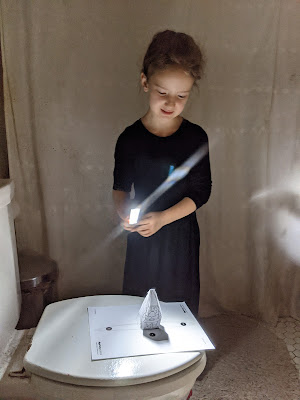
Here she is having so much fun figuring out how to make shadows longer or shorter or pointing in different directions as part of a unit on patterns in the sky. (Please excuse the fact that the pictures are taken in our bathroom, as we needed a dark room for the activity!) 


Science for my 11-year-old: Discovery Education Science Techbook (K-8)
Because we love Mystery Science (above) we were sad that my oldest outgrew it this year; it only goes through 5th grade so we had to find another source for 6th-grade lessons for him. We purchased a one-year subscription to Discovery Education Science Techbook through our free membership with the Homeschool Buyers Co-op for around $60. Science Techbook works in an online format. It was one of the few science options I found that was standards-based. There is a lot of technical vocabulary, tougher concepts, and higher-level skills expected as part of the activities-- all good things but it has been an adjustment from the accessible and super engaging Mystery Science he was used to (see above). Some units are quite long and I know we won't get "through" it all by the end of the year...but that happens sometimes in school as well as homeschool. Every time we finish a concept, I spend way too long trying to remember where to find the assessments, but we are learning our way around the interface and how it is organized. (One other note: since Science Techbook is for K - 8, I dabbled in some of the primary units with my youngest as well just to supplement her science, and I felt it was too much computer, paper-and-pencil, and video time, and it didn't feel age-appropriate and fun for younger kids. So I'd recommend it only for older kids.)

Looking at an Elodea leaf under a microscope as part of a unit on cells

The Core Knowledge Foundation is a non-profit that publishes educational books, materials, and entire units in many school subjects. We pick and choose from the social studies units exclusively (not other subject areas) and especially for my oldest. I scroll down the Core Knowledge web site where you can download curriculum for free, check the box that says "History & Geography," then check the grade level I am interested in and look at the units available. We don't do every unit listed, because there are a lot. This year W chose which topics he was most interested in, including some that happened to be listed under other grade levels. The units are each essentially a textbook, or mini textbook. There is a student reader and a teacher's guide. My son reads a couple of chapters at a time and then we discuss them, using the questions (and provided answers) in the teacher's guide as a basis. There are a few worksheets scattered across each unit that kids can do, but nothing that takes too much time. It's pretty straightforward, standard educational stuff. But each unit includes online resources, sites you can visit to visualize and extend the content from each chapter. There are virtual tours, links to primary sources, museum web sites, and YouTube videos. We find the online resources and activities that go with them really engaging and I find that part is what really makes things stick. We've found the Core Knowledge units to provide a strong, solid understanding of times in history and events that we've studied. 

W made his own illuminated choir book pages as part of a unit on medieval Europe
 
Those I've listed above (reading, writing, math, science, social studies) are the core subject areas that we do most days. Below are a few other areas of study that we do less frequently. 

Phonics for my 6-year-old: Mix of a Couple of Programs
My daughter is a strong reader and a good speller so she's internalized a lot of things that I would have taught consistently and daily in the classroom. So I just do a little focused practice with her about once a week to work with words and focus on some conventions (handwriting, punctuation, spacing). There are two books I bounce between when we do spelling/phonics work. One is Month-by-Month Phonics for First Grade, which has lots of fun activities to work with words and word patterns. The other is Words Their Way. (I wrote a post in more detail about how Words their Way works here.) It's a spelling approach that allows you to find your student's level using this guide. Once you find their level you know which book to purchase full of spelling lists of the types of words they need to work with. We copy a list of words, cut them out and she can sort them in various ways and notice characteristics of the different words and do activities with them.   


Grammar for my 11-year-old: Easy Grammar
This was recommended to me by a homeschool friend when I realized my then-fourth grader didn't know the parts of speech, and it has worked just fine for us. I only purchase one book, the Teacher Edition, because it includes the lesson information (which is very brief) and answer keys as well as the student pages; I copy them for my son to do. We don't do grammar daily, because he's a strong reader and writer and because there aren't many times someone is going to tell him to diagram a sentence in life or ask him to name the object of the preposition. But I think the basics are good to know and the exercises are quick and to the point. So once a week or so, I introduce a new concept and give him a few practice pages to do. It has worked well for us and cost very little time or money. 


Foreign Language: Duolingo and Dinolingo
Last year we tried Rosetta Stone when my son was just starting out with a foreign language (Greek was his choice). Partway through the year he switched to Duolingo and has stuck with it and likes it. It is online, and free! It is intended for ages 13 and up but my 11-year-old has done fine with it. Like all of these online language programs it seems, it doesn't actually teach most new vocabulary explicitly, but adds it into exercises where you have to guess at first, and then repeats it often until you catch on and get it right. 

My daughter had some fun with sign language last year but wanted to work on the same language as her brother so she does Greek now as well. I found Dinolingo as an age-appropriate, inexpensive option for younger kids. It is more visual, consistently using pictures or videos, and it is highly game-based so she loves it. I think she secretly likes doing Greek simply because it feels a little like she is getting away with playing a video game, but she does go around the house counting in Greek so I know some things are sinking in! 

~

So that is what we use for curriculum in each of the different areas in our homeschool. I hope this is helpful for any homeschoolers just starting out, or looking to change. I hope to share how we put it all together in our regular daily routine soon!

April 18, 2021

Why We Love Mystery Science


Did you know the Ancient Greeks referred to the planets as wandering stars? Recently during science time, we watched a short video in which we learned this and some other fascinating facts about the planets including: landers that have been sent to Venus to take photos melt within a couple of hours, Mercury has craters and looks a lot like the moon, Uranus spins on its side, and it takes almost 10 years to get to beautifully blue Neptune! Then we sketched and labeled a picture of each planet and headed out into the backyard. At one end of our yard we placed the sun, and then at specific proportional distances from there placed each of the other planets. My youngest exclaimed, "If the planets were waiting in a line to do something, Neptune would be the boredest!" For part of the activity, I called out a planet and they would run to it as quickly as they could. They weren't reciting "My Very Eager Mother Just Served Us Noodles" to figure out which way to the planet in question; they started to internalize where the planets were with this game. After a bit, they took turns calling them out for each other. When it was W's turn to call, he would sometimes give M hints by referring to how "bored" was the planet in question. The video and the active components were both so fun and effective, and left all of us thinking of the worlds of the planets in new ways. 

The above is just one example of an awesome science session that we regularly have, thanks to the online "open-and-go" lessons from Mystery Science. The company was started by a science teacher in California-- the kids call him "Mystery Doug." They love how he always reminds kids, in his upbeat, friendly tone, to "Stay curious." 

In the classroom, before I found Mystery Science, I used to feel that science was a lot of work to plan for-- to find several age-appropriate, engaging activities to teach a topic and then to gather the resources and plan the time for it-- especially while trying to teach every other subject as well. On the flip side, I think homeschool science, specifically, can run the risk of being helter-skelter, driven solely by fun project ideas-- a baking soda volcano here, a nature sketch there. For our homeschool, I feel Mystery Science solves both these potential issues. We do our share of museum outings and seasonal adventures-- like a couple of recent treks to a vernal pool near us-- and we do just-for-fun projects when a new Kiwi crate arrives or when other inspiration strikes. But Mystery Science lessons are the backbone of our science work, providing cohesive units of study without a lot of extra work for me. I've now taught with Mystery Science at the first-grade, kindergarten, fourth-, and fifth-grade levels, so I feel qualified to say that it's great. Here's why we think so. 

This session was so inspiring, she had to go change into her astronaut costume in the middle of it.

Reasons we Love Mystery Science 

Lessons begin with an engaging story. My son told me recently that the story Doug tells at the beginning always gets him hooked and is his favorite thing about Mystery Science. Here's an example: recently, at the start of a lesson to learn and graph the amounts of fresh water vs. saltwater on earth, we heard the true, mesmerizing story of Jose Alvarenga, who was lost at sea for over a year but survived by eating raw animals he caught with his bare hands and collecting rainwater to drink-- because, as the lesson ensures kids understand, you can't drink saltwater. That's the hook for a lesson that got us thinking of all the ways we use water and what it would be like if we had to worry about how to get it. 

It is interactive. While lessons are online and video-based, they are hardly passive sessions. Amid the introductory information, there are regular "stop and talk" moments for students to share their hypotheses. Then there's a hands-on activity, with discussion and wrap up afterward.  

It regularly takes kids through the scientific process. They have to make predictions, choose variables to test, engineer products with specific constraints, work with a partner often, gather data, and make conclusions. 

Trying to figure out how to get the sun to shine on a town shaded by a mountain (lesson fueled by a story of a real town in Norway)


It is aligned with the standards. Mystery Science lessons are based on the Next Generation Science Standards (NGSS) and their disciplinary core ideas. The way the activities are organized incorporates specific engineering practices. I like knowing that we aren't studying life cycles for the fifth year in a row, and also that the complexity of the ideas covered is age-appropriate. 

It is affordable. We paid less than $70 as a homeschool family for the entire school year (regardless of how many grades worth of material we utilized).

It requires minimal materials. The materials for each lesson I find ingeniously simple; from paper and regular office/school supplies and containers from the recycling bin we have made ramps for marbles, a "universe in a box" showing constellations to be seen in different months of the year, a model of the water cycle, and so much more. I rarely have to buy materials for science. 

We could "see" sound when tuba music came out the speakers.

It is focused on key points. One downfall of elementary science instruction is the temptation to do it all-- gathering every book and resource that is in any way related to the water cycle, for example. Better teaching is more focused, and Mystery Science keeps us focused. Each lesson has a clear focus and it is around this that kids are spurred to discuss, think, model. The objectives of the lesson are always made quite clear. (There is a selection of extras included at the end of each lesson as well for further exploration-- links to other great web sites, short videos, articles, and activities. We delve into more of these some times than others, depending on interest.)  

It provides beautifully simple, creative ways to teach concepts. Directions are clear and concise, given orally and visually, step by step. W was really affected after counting all the color-coded squares on a grid of the earth and graphing (on our wall with post-it notes) to represent how much saltwater there is on earth and how very little fresh water there is in comparison. Similarly, last year he understood the process of weathering and why rocks at the bottom of a mountain might be rounded while those are the top more jagged by shaking a container of sugar cubes and seeing how the shapes of them changed gradually after every few shakes. 


Using warm or cold water above and below, they had to figure out how to make it rain inside the upended plastic cup-- or recreate what happens in the water cycle.

It is age-appropriate. Science is my kindergartner's favorite subject. The kindergarten lessons are perfect for five- and 6-year-olds: they are brief to suit a short attention span, they engage with true stories, appropriate explanations, and probing questions for a kindergartner. There is always movement built in; when we were studying animal defenses, M had to get up and act out what each of several different animals did to defend themselves after watching footage of animals in action. She loves doing real experiments using her own handiwork, making hypotheses, and doing multiple trials. The fifth grade lessons are just as engaging and accessible, but expect a little more of students, from their reasoning to math calculations to having to write down more of their thoughts and data rather than just discussing it. (The lessons are easily adaptable for multiple ages as well. My daughter often tags along with her brother's science lessons and can participate in the activities, if not all of the written work.)  

Kindergarten engineering (how to keep boulders from hitting houses on a hillside)

It includes assessments. There are paper and pencil, printable one-page assessments after each "mystery." For younger grades, the assessment often involves a drawing, while for older students it is usually a few short-answer questions. It directly covers what we learned in the activity and provides documentation for their portfolio.

It is homeschool-friendly. Unlike so many programs and resources that are made specifically for schools or specifically for homeschoolers, Mystery Science is designed to work beautifully in both home and classroom. Some resources out there are so expensive they aren't an option for homeschoolers, but Mystery Science offers a reduced homeschool price. I can enter any number of students, right down to one, to calculate the amount of materials needed. The teacher notes for each session explain anything specific to homeschoolers, but there are never any big changes. Oral directions within the video always give directions for working with groups in a classroom and for working on your own or with a partner at home. (So much in our culture is built on the assumption that school is every child's world, so it's nice to feel noticed and included as a homeschooler in these small ways!)  

Prehistoric food web

It includes a super-fun bonus component: "mini lessons." These are approximately five-minute-long segments on a whole variety of topics. They are just for fun, when you have an extra few minutes here or there, and aren't tied to a particular grade or unit of study. Kids from all over the world can submit questions through the "Ask Doug" feature on the Mystery Science web site (my kids have each submitted a few). Some of these questions get chosen to be answered in the mini lessons. When you have a membership to Mystery Science, the mini lessons are always available. Some mini lessons include an optional small project with very basic materials, but most are just a short video with a few stop and talk moments for a little extra fun and learning. A few we've enjoyed this year: Do masks really stop the coronavirus?, How are video games made?, and Could people ever walk on walls?  


It frees me up to focus my energies and preparation time on other things. I can imagine being a parent or teacher who gets excited to plan the topics of study we do in science and to research great activities to teach those concepts (and I know some of those people), but I'm not one. I do that in other areas, though. So I like having somebody else's great legwork to keep us going in science.  

Force and motion: knock over the old building without wrecking the nearby houses

It encourages kids to question and wonder. I love that these science lessons don't just provide activities to teach science concepts. They espouse values, sometimes explicitly: how important and exciting science is, the value of asking questions, of failing and persevering, the need for collaboration and problem solving. 

Our worm terrarium last fall