Showing posts with label Writing. Show all posts

February 28, 2023

Rodgers and Hammerstein Unit Studies for Kids

This past summer, some old friends invited my daughter and I to join them to see Rodgers and Hammerstein's Cinderella at the North Shore Music Theatre. We did and it was excellent. After that weekend, we realized more than we had before how big a deal musical theater is for our girl. She couldn't stop talking about the costumes, especially Cinderella's and the fairy godmother's rags that transformed into gorgeous ball gowns when they spun around right before our eyes. Then there was the fascination with the way the show portrayed aspects of the story, like the prop "horses" lit up with Christmas lights taking Cinderella to the ball. And there were some plot twists we weren't expecting, like the fact that after a second ball Cinderella intentionally leaves a shoe behind. And most of all, the music. We were Rodgers & Hammerstein newbies before that show and were immediately enchanted by the wonderful songs. Within a couple of weeks M had them all memorized, belting them out throughout the day, humming them constantly, getting them stuck in all of our heads. 

Added up, the experience really lit something in her that honestly has stayed alive ever since. It made us want to get her out in the world to see plays and musicals whenever possible, ...AND it inspired one of the most fun things we've been up to this school year: unit studies on Rodgers and Hammerstein musicals! 

Rodgers and Hammerstein Musical Theater Unit Studies for Kids
 
We started with a Cinderella study, then about a month later we moved onto The Sound of Music, and after that State Fair, and finally The King and I. With each one, we began with simply watching the movie, then moved on to check out different versions, do related activities, go on field trips when possible, and end with some sort of special culminating project. These unit studies have been a high point in her week. Here are the fun activities and lessons we've done that you might want to try with any musical-loving kids in your life. I listed them in roughly the order we did them. 

Unit Study: Rodgers & Hammerstein's Cinderella
  • The Songs: We listened to Spotify playlists of R&H Cinderella songs in the car, both the Julie Andrews version and Broadway versions, over and over...and over and over... There are so many great songs, from "In My Own Little Corner" to "Impossible/It's Possible" to "Lovely Night" and more.
  • Singing: I Googled lyrics to many of the songs, by M's request, and printed them out for her so she could sing along whenever she wanted and learn the trickier parts. (She also discovered for me that if I let her hold my phone, she could read the lyrics at the bottom of the Spotify screen for the song being played.)
  • Other R&H Cinderella Productions: There are so many Cinderella films out there, and we watched two other R&H ones we loved:
    • The 1957 version of R&H's Cinderella on YouTube, which we were delighted to find since it doesn't appear to be available anywhere else to stream. It's black and white, was broadcast live on TV in 1957, when it received the biggest television audience for anything up till that point, and stars Julie Andrews. The YouTube video includes a modern introduction by Julie Andrews, and is definitely worth watching. 
    • We also watched the version with Brandy as Cinderella, which features Whitney Houston as fairy godmother (M's self-declared "favorite fairy godmother") singing "There's Music in You," which is a R&H song pulled out of old files of theirs and unique to this movie. This one has a diverse cast, and the set and props are peppy and colorful. 
  • Online Lessons: We found the Musical Theatre Project online and enjoyed the Rodgers and Hammerstein Cinderella unit lessons there (a legacy left there from Covid quarantine days). The lessons were brief and to the point and full of good energy. We learned a dance to "A Lovely Night," saw brief videos about Richard Rodgers and Oscar Hammerstein, and discussed Cinderella's character traits, among other things.
  • Read Aloud: There are so many picture book versions of Cinderella, from all over the world, and we read a LOT of them. This gave us a chance to discuss a lot of things-- similarities, differences, themes, authors' choices-- in a kid-friendly way. I made sure we discussed early on what a "rags to riches" story is, and also what a "fairy tale," by definition, is. I was a little worried that by spending all this time on Cinderella that I would be teaching her to value love at first sight or salvation in the form of rescue by a handsome prince! But what was neat was the more we learned and the more stories we read, we started to see more and more the deeper, admirable aspects of this timeless tale-- like the feeling of wishing for something deeply. And Cinderella has a lot of special traits beyond her beauty: she is hopeful, kind, resilient, optimistic (hardly ever letting those mean step sisters really get her down), and in most versions she shows forgiveness in the end, despite all her hardship.    

  • Cinderella with a Modern Twist: Since we were becoming such experts in how this tale has been told in different places at different times in different ways, we watched one other movie version of Cinderella that was not Rodgers and Hammerstein. It was a modern version, starring Camila Cabello and featuring Idina Menzel as the stepmother. In it, Cinderella dreams of being a dress designer. This film is a musical, with characters singing a great variety of popular music, from "You Gotta Be" to "Let's Get Loud." My favorites are Cinderella singing "Million to One" as she dreams, and the stepmother and stepsisters singing "Material Girl." This version is so fast-paced and energetic, and just surprising, that's it's really very enjoyable. 
  • Culminating Project: Write your own Cinderella: And as a grand finale, my daughter wrote her own Cinderella story. First we listed the features that so many of the stories had: magic, a mean step family, a hard-working main character, a fairy godmother person (or animal in many cases), a happy ending, and so on. Then M chose which aspects she wanted to include in hers. She was inspired to make the fairy godmother in her version a unicorn, who takes Cinderella (who she renamed with her own name) across a rainbow to the ball. She voice typed the story in Google Docs, we printed it off as a booklet in Word, and she illustrated it with stickers and stamps and stencils!


Cinderella story planning sheet

Voice-typing: a break from the physical effort of writing to let the creativity flow :) 


M's own Cinderella story

Unit Study: Rodgers & Hammerstein's The Sound of Music
  • The Show: We watched The Sound of Music on Disney Plus.
  • Singing the Songs: M was immediately consumed by the story and all the songs; it's so sweet and fun, it would be hard not to be. Again we listened to the soundtrack on Spotify a lot and I printed out lyrics to various songs for her, from "Edelweiss" to "I Have Confidence."
  • Field Trip: We heard stories about the real Maria and the rest of the real von Trapp family on a history tour at the Trapp Family Lodge, which happens to be within easy driving distance from us. While we were there, M and I treated ourselves to lunch out, where we sampled schnitzel-- which is one of Maria's "Favorite Things" in the song of that name.   
Sampling schnitzel

These hills at the Trapp Family Lodge in VT are reminiscent of the Alps...


von Trapp family tree, at the Trapp Family Lodge in Stowe, VT

  • Baking: Continuing with the food theme, we experienced another of the "Favorite Things" for ourselves by baking our own "crisp apple strudel."
"Cream-colored ponies and crisp apple strudels..."
  • Online Articles: We enjoyed looking at the old family photos in this Mental Floss article, and particularly two videos: one of Maria von Trapp teaching Julie Andrews the right way to yodel (really cute and funny) and another of an interview with an elderly Maria von Trapp. 
  • Other R&H Sound of Music Production: We couldn't resist checking out a 2018 made-for-TV version of The Sound of Music starring Carrie Underwood, but (in my opinion) it was a very weak replica and overall pretty underwhelming, so I don't really recommend it... 
  • Violin: My daughter plays violin, so we added "Do Re Mi" to her repertoire with this video.
  • Dancing: We tried to dance the Landler, the Austrian folk dance featured in the film, with this YouTube tutorial.
  • Yodeling: We read a great, short National Geographic article about the origins of yodeling in Switzerland with video demonstration by a native, and then we tried it out ourselves with this simple how-to video on yodeling. I'm not sure we were catching on properly, but we had a lot of laughs making some very strange noises while trying. 
  • Culminating Project: Rewrite "My Favorite Things": For a final project, I had M write her own version of "My Favorite Things." It's the type of song that's just asking to be rewritten, and everyone's version will come out uniquely. (If I still had an elementary school classroom, I would be doing this project with my whole class!) I had M just brainstorm a bunch of little things in life that make her happy, and she came up with everything from her favorite Disney characters to twirly dresses to big square marshmallows from a local bakery. For the stanza about when she's "feeling sad" she came up with dogs jumping on her and her parents saying no. :) We checked out this simple rewrite example, and used this lesson plan to guide us, particularly using the big idea of focusing on the stress pattern of the syllables. Getting her ideas to fit a certain number of syllables, not to mention placing emphasis on parts of words that wouldn't normally have the emphasis in order to match the stress pattern, was a moderate challenge for a musical 7-year-old, and I think her song turned out amazing-- it's a keepsake for sure. 


M's version of "My Favorite Things"

Unit Study: Rodgers & Hammerstein's State Fair 
  • The Show: We watched the 1945 version of State Fair on Amazon Prime. (I don't recommend the 1962 version, available on YouTube, for young kids.) Both my kids enjoyed the comedic elements and it was a simple, though dated, story of the Frake family of Iowa heading to the state fair for the weekend. Mr. Frake is wrapped up in the well being of his prize pig, Mrs. Frake with her award-winning mince meat, while teenage (?) children Margy and Wayne wander around the fair and each has a romantic adventure (that remains chaste in this 1945 version). 
  • The Songs: There are a few fun songs, from "Our State Fair" to "It's a Grand Night for Singing" to "Ioway." Per usual, we listened to the soundtrack and printed off lyrics for my daughter to sing along in the car to her heart's content.    
  • Learning about the Setting: Occasionally when we are studying a certain place in the world, or about to go on a trip, we check out the Smithsonian Channel's Aerial America series. There is an episode for every state. The episodes are less than an hour, and consist of fly-over footage of a place with voiceover narrating interesting facts and history. We watched Aerial America: Iowa and got lots of views of all those farm fields, and even some of the state fair. 
  • Culminating Project: Cooking: We found this old article about a prize-winning mince meat at the Iowa State Fair in the 70s. And we used this recipe to give it a try. I don't think it was anybody's favorite (is it dinner? is it dessert?) but it was fun to try, as the mince meat scenes in the movie are some of the funniest moments.

Had to try out mince meat pie

Unit Study: Rodgers & Hammerstein's The King and I 
  • The Show: We watched the 1956 movie, starring Deborah Kerr and Yul Brynner. I had never seen this movie myself it was impressed with it. It has compelling characters and so many interesting aspects to discuss. It is a story based on a novel, which was based on the memoirs of a real person, Anna Leonowens. 
    • A bit about the facts and history: Anna took a job teaching the children and wives of King Mongkut of Siam in 1862. (I thought the polygamy aspect might be weird for a kid, but it wasn't a focus in the movie, and I just told her that in many Asian cultures at that time it was common for the king to have more than one wife and she accepted that.) It was a time when nearly every country in Southeast Asia was becoming a colony of a European power. King Mongkut was strategic in handling this, bending to certain pressures but managing to maintain Siam's independence-- and apparently Thailand is the only Southeast nation that has never been colonized. He was progressive in some ways, interested in western developments in science and technology, while he was very traditional in others. Anna was an educated woman, a widow, an experienced traveler, and later part of the suffragette movement. The story takes place at the time of the American Civil War, and in part of the film the story of Uncle Tom's Cabin is portrayed through a Siamese ballet. 
  • Discussion Topics: The tension, debates, and friendship the movie portrays between an intelligent, progressive yet traditional monarch, and the modern western woman who arrives at the palace and speaks her mind from the first moment is possibly the best thing about the movie. There were so many interesting topics and themes that we discussed in an age-appropriate way (and a number of them we could have done even more with if my daughter had been older), including:
    • What is slavery? What was Uncle Tom's Cabin (mentioned, and portrayed through a ballet scene in the movie) about? What was the Civil War about?
    • How can the world feel different depending on one's perspective? (There is a great scene showing the world map with a predominant Siam in the middle of it that the prince/heir knows, contrasted with the "real" world map Anna presents when she is teaching, and there is also a moment when she teaches the children about snow and they don't believe her.)
    • The idea of women's roles
    • Should things be done in a traditional way, or a new, "scientific" way?
    • Power-- what should a good king, or other leader, be like?
  • Singing the Songs: This movie has great music and my daughter loved singing the songs as she does every time she watches a new musical, in this case everything from the sweet "Getting to Know You" to the optimistic "Whistle a Happy Tune" to the sweeping-across-the-stage polka "Shall we Dance." 
  • Analyzing the Songs: We took the time to read and analyze some King and I lyrics as well, such as the song "A Puzzlement" which is a solo sung by the king. I asked M what the song was really about and the emotions of the character singing it, and we discussed what certain lines meant.
  • Comparing Stage and Screen: We checked out some video clips and photos from various productions of The King and I
  • Lessons: I found an excellent Lincoln Center teacher's guide for The King and I. Some of it was aimed at older kids so I picked and chose activities that worked for us. For my 7-year-old, I particularly loved these parts of it:
    • An introduction the the American Musical (page 10 of the guide)
    • The first six minutes of this intro to Broadway: The American Musical series, narrated (of course) by Julie Andrews
    • An activity to help us analyze the song "A Puzzlement" sung by the king in the movie (page 10 - 11)
    • The history, which I summarized above, about the real people and place that this movie was based on (page 12 - 19)
    • Learning about the "Book Musical," which Rodgers and Hammerstein first created with Oklahoma (a movie I decided not to watch with my 7-year-old because of the content and amount of innuendo, by the way) and the musical theatre building blocks: music, dance, and theater. We also here learned the names of some of the many jobs involved in making a Broadway show, from choreographer to lyricist to designers, composers, and orchestrators. (page 22 - 26)
  • Culminating Project: Musicalize a Favorite Book: The Musical Moments writing activity, described in brief on page 27 of the Lincoln Center guide, inspired our culminating project for The King and I (and really for all the musicals we've studied): a song-writing mini unit. 
    • First, we reviewed a bunch of musical numbers M already knew, having her name which characters sing them, what type of song they are, how the character is feeling/what they want in the song, and what important moment in the plot or "turning point" it occurs at. We used these examples: 
      • "The Schuyler Sisters" from Hamilton
      • "Part of your World" from The Little Mermaid
      • "I Just Can't Wait to be King" from The Lion King
      • "The Next Right Thing" from Frozen 2
      • "I Have Confidence" from The Sound of Music
      • "My Own Little Corner" from Cinderella
      • "When will my Life Begin?" from Tangled
    • After this review, we chose a story we wanted to try to imagine as a musical. We could have used any (non-musical) movie or even perhaps a picture book, but it was a good opportunity to spend some time with some wonderful chapter books we had recently read together, so I had her choose from among these three: 
      • Beezus and Ramona by Beverly Cleary
      • Clementine by Sara Pennypacker
      • Gooseberry Park by Cynthia Rylant
    • Then I had her list a few moments from the book that she thought would be good to musicalize (i.e. important moments in the plot, or times that show what characters want or strong emotions. The moment could consist of interactions between characters or be just a moment of the character thinking to herself).  
    • For each of the moments, she had to decide: which characters would sing it? What type of song would it be (fast, slow, funny, serious, etc.)? Would there be dancing with it, and if so what type (ballet, hip hop, etc.)? 
    • Finally, she chose one moment and wrote a song to go with it! 
      • If you were so inclined, or for older students, you could write it from scratch, like a poem, but for our purposes I had M choose a song she knew and change the words.  I was ready to offer as resources for this song lists from the Disney and other musicals she knew. But as it turned out, she had an amazing ability to pull a song out of the air that she felt had a beat or tone that matched her book moment she wanted to musicalize. I printed out the song as it was, and then next to the original lines she wrote her own new words. 
      • Together we wrote a song to go with Beezus and Ramona-- a song about how Ramona is always getting into mischief without really intending to, and how her family helps her figure a way out of it somehow, that we imagined being sung by her sister Beezus, to the tune of "Whistle a Happy Tune" (a song from The King and I). 
      • Then, more independently, M wrote a song for Gooseberry Park about Kona the dog's icy adventure across town to find and rescue his squirrel friends. She almost instantly thought of "Rhythm Nation" which she knows from the Camila Cabello modern Cinderella movie and wrote great lines such as "A ve-ry, ve-ry, ve-ry big risk!" in place of "Rhythm, rhythm, rhythm nation!"....and "I have to find you right no-o-o-ow" in place of "We are a part of the rhythm nation." 

A musicalized moment from a favorite young reader chapter book, Gooseberry Park

This unit was so much fun. The best part was when M told me in the midst of the song writing at the end of it that writing time-- which normally requires serious effort on her part and some cajoling on mine-- was "so fun right now."   

A few final notes:
We spent less time overall on State Fair because (in my opinion) it just isn't the timeless, magical work of art that the others are. But we still found some topics to study and had fun with the music.

The Rodgers and Hammerstein site has a list of all their shows and a wealth of information about each one, including photos and video clips, and lists of various productions. It is a great resource worth checking out.  

This unit was a good reminder to me of everything homeschool can be: interest-based, personalized, multidisciplinary, memorable, fun, project-based, hands-on...I want to do more unit studies like this! 

I hope if you try these units you have as much fun with them as we did and that your heart, too, will be blessed with the sound of music. :) 


April 8, 2022

Fan Mail Writing Unit


Who doesn't love getting mail? That was part of the motivation behind a letter-writing mini unit I did with my 11-year-old recently. 

We had just finished a stand-up-comedy unit, and that was fun but quite challenging, so he was ready for something a little more straightforward. He's always talking about his favorite authors and entertainers and what he wishes he could ask them. So I figured it would be a good time to brush up on letter-writing skills and give him a chance to do something he wanted to do anyway. It was a success- both engagement-wise and in the results he's gotten: three letters back from people he admires just this week (less than a month since he sent them out)!  

Here is how the unit went. 

Writing Mini Unit: Letter Writing 
W focused on writing fan mail to some authors and celebrities, but we could have done this letter writing unit on any theme, or even just written to family and friends. 

Length of Time: his daily writing time for about two weeks 

Getting Ready 
I had W brainstorm people he'd like to write to. He used a mind map template I found online, but we could have easily sketched our own. It was a graphic organizer that provided space for him to write names of people, and space to brainstorm a couple of questions or comments to write to each person. I encouraged him to think about why he really wanted to write to each person, and jot down any burning questions or specific appreciations/compliments. 

It was handy he took the time to do this mind mapping to organize his thinking up front; as the unit went on, he referred back to it several times.     


Learning about Types of Letters and Format
Together we first listed some qualities that make a good letter. We covered things like: 
  • include a balance of talking about yourself and asking questions
  • use a friendly tone
  • think about your audience (level of familiarity with them, as well as what they would find funny or interesting)
  • proofread
  • be polite
  • spell out acronyms
  • be clear and coherent
Then we read through this site to help W learn about the difference between a friendly letter (informal) and a formal letter. The site gave some helpful advice about when to use each type and characteristics of each. The most helpful thing was that it showed the format of each with examples. W was planning to write to authors and entertainers he admires, so we decided an informal letter tone worked fine. But we used the format of a formal letter-- Mr./Ms. in the greeting, because he didn't personally know them, and their contact info and ours at the top of the page to increase his chances of getting responses back! 

Write!
He got to work writing and carried on independently every day from that point on. Each time he finished one letter, he would have me read through it just "to make sure it sounds okay." W often would have a great letter, but feel unsure about how to end it. I gave him simple suggestions for how to wrap them up: well wishes like "Have a good spring!" or a call to action like, "I hope to hear back from you soon!", and that sort of thing. He would save the finished letter and begin writing another to the next person on his list till he had finished all six or so letters.  

Finding Addresses and Other Logistics 
Many of W's recipients were authors. We found a site (here) that gave some good tips on finding author addresses in general. First we looked for the author's official web site. There were often specific instructions there on how to write to them, as well as FAQs so he could avoid asking a question that had already been answered. When authors did not have a web site or an address was not given, we wrote to authors in care of their publisher's name and address, which is listed in the front of any of their books. In the end we found a few other ways to reach people: 

One person W wanted to write to was a comedian, so we sent the letter to him in care of his management agency. Fingers crossed. 

Many popular figures have a Facebook page through which you can "message" them, but W wanted to send real letters in hopes of getting a real hard-copy letter back, so we stuck with snail mail options. 

In one case, our letter (in care of a publisher) was returned, so we then emailed the author through the contact form on his web site-- and got an emailed personal response within two days! 

It was a bit of a hunt sometimes but we found a way to contact each person on his list. 

When sending snail mail, it's wise to include a self-addressed, stamped envelope in your letter to increase your chances of getting a letter back. We made sure to stick one of those inside each of W's letters (we even included an SASE with a global stamp on it for an author he wrote to overseas). 


Wait and Hope
We decided it would be fun to finish writing all the letters, then send them all on the same day and see who we heard back from first. A little contest W's idols didn't know they were participating in. 

The speediest response was from Stuart Gibbs, author of the fun Spy School series. W has read all the Spy School books, but especially loved Spy Ski School since he is obsessed with skiing; Mr. Gibbs was kind enough to answer each and every one of W's skiing-specific questions. 


Next we received an email response from awesomely entertaining and semi-local-to-us nonfiction author, Steve Sheinkin. W asked him some writing advice and Sheinkin gave him some. 


Third, and, W says, best so far, was a package all the way from England from Stephen Beisty, author and illustrator of incredibly detailed and informative Cross Section picture books such as Castle and Man-of-War. (He didn't use the SASE we included; he paid 4 pounds in order to send a large envelope and include a photo.) W has been checking his books out of the library for years and keeping them out way too long each time, and he was in awe to see a photo of the artist's actual studio.


W is still waiting and hoping to hear from a few others (i.e., checking the mailbox promptly every day certain that a reply from Lin-Manuel Miranda will be in there). He has been incredibly rewarded by the responses he's gotten so far: Personal letters! Signatures! Photographs! Answers to his questions! Turns out even well known, successful people like to be appreciated. 

Going forward, I might make writing letters to those we admire an annual mini unit for both my kids. We all need more fun mail in our lives.  

February 24, 2022

Our Favorite Homeschool Curriculum (So Far)


We are a secular homeschool family in the midst of our third full year of homeschooling and my kids are at two distinctly different ages (6 and 11). I don't use a single all-in-one curriculum because I don't want to put all my eggs in one basket. I choose what will work best for us in particular areas. Some of the programs and resources we use are things we've liked and stuck with since year one (our math curriculum for example), while in other areas I've made changes along the way, as I've gotten to know my kids, and the options out there, and as we've settled into our own unique homeschool rhythms. We purchase (and find free-- keep reading!) some programs and resources that are good and helpful and give some structure to our days. I also forego purchased curriculum in some areas and leave room to be creative and design our own units. One of the best things about homeschool is that if a program or approach isn't working well, you can always make a change-- even mid-year. 

Below are the programs and approaches we are using in our homeschool this year across academic areas. (If you're curious: my 2019 - 20/first year homeschooling curricula and thoughts are here, and 2020 - 21/year two curricula here.) 

Note: I currently have a 6-year-old/first grader and an 11-year-old/sixth grader. I use the resources listed below for both of them (at their respective levels), except where separate programs are noted.


Our Homeschool Curriculum 2021 - 22

Reading: No Purchased Curriculum or Planned Lessons or Assignments
I do not use a reading program in our homeschool (though I did our first year). Besides the fact that the one I love from my classroom days is really expensive, the fact is that my own two kids already live readerly lives and aren't at a point where they need daily, explicit lessons (here is a post about some tips and sources I used last year to help my daughter learn to read in the first place). They read a variety of things from graphic novels to online news, historical fiction to their latest favorite fiction series. They both pick up a book whenever they get a chance and disappear into it for long periods of time. They talk about what they read and they ask what new vocabulary means. They don't need reminders to read. Because of all this, I've learned I don't need to schedule or assign reading time officially. We read aloud to them both daily, and keep the house well stocked with fresh library books, and they take care of the rest.     


Writing: No Purchased Curriculum
We work on a certain genre of writing at a time in a unit of 6 or 8 weeks. For my youngest, I usually choose what that genre will be; for my oldest he has a lot of say and jointly plans out with me the types of writing he is interested in working on. Within the genre they're focusing on, they always choose their own topic. For example, my son is itching to write historical fiction next. I won't dictate the time period he needs to write about or the type of story it needs to be. But I will do some research so that I can inspire him with good models of historical fiction, and share some tips for doing that type of writing well. I love putting together a unit of study on a particular type of writing, and I don't need to have had experience with the type of writing myself to find good resources and give them a good learning experience. Last year my son had a blast with a unit on writing rap, and almost every year we write some poetry at some point. Every day they can always add to an existing piece or start a new one. For my youngest she is always welcome to draw first and write later or whichever order she prefers (here are some other tips for getting the youngest kids to write in the first place). After working on a genre for a while, they choose a "best" piece they're proudest of and revise it to make it even better. We always find a way to celebrate and share their writing, especially at the end of a unit.    


Math: Primary Mathematics
Primary Mathematics is part of Singapore Math. It is from Singapore (where students perform quite well in math) but there is a U.S. version that we use. It is challenging. It is mastery-based; you work with a concept until they really understand, or have mastered, it. (This is different from a spiraling math program, in which concepts are touched on briefly, repeatedly, and rotated throughout the year. I have used spiraling programs in the classroom and don't find them as effective.) There are a lot of reviews built in-- reviews after the end of a section, and also periodic cumulative reviews. Primary Mathematics encourages the parent/teacher to allow the student to get the answer using a variety of methods as long as they understand the concept. Primary Mathematics is inexpensive. There is a paperback teacher's guide, a textbook, and a workbook for each half of the school year (for example, "6A" for the first half of 6th grade and a "6B" for the second half). There are no colorful illustrations or bells and whistles as it seems many math programs have; instead, lessons and tasks get right to the point. There are only a few simple materials needed for the program (so few that our first year of homeschooling, because of a funny schedule on Wednesdays, my son and I were able to easily have math class in the car once a week). There are plenty of instructions included for simple math games we play, especially at the primary level, but essentially each day is a brief lesson, and then a couple of practice pages for kids to do on their own. My kids are performing well in math and this program is easy for me to work with as the teacher. This is our third year using it.

 
Science for my 6-year-old: Mystery Science (K-5)
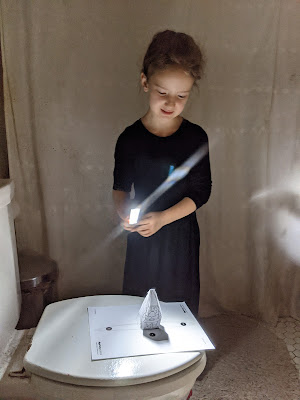
We love Mystery Science. Check out this entire post about why we love it for details. Briefly: it is fun, it is aligned with national science standards, it is very affordable (around $70 for an entire homeschool family for the year), it requires minimal materials, it is online/video-based yet also hands-on. It is super engaging, age-appropriate, and teaches concepts in clever, simple ways that really stick. Science is my daughter's favorite subject. 

Here she is having so much fun figuring out how to make shadows longer or shorter or pointing in different directions as part of a unit on patterns in the sky. (Please excuse the fact that the pictures are taken in our bathroom, as we needed a dark room for the activity!) 


Science for my 11-year-old: Discovery Education Science Techbook (K-8)
Because we love Mystery Science (above) we were sad that my oldest outgrew it this year; it only goes through 5th grade so we had to find another source for 6th-grade lessons for him. We purchased a one-year subscription to Discovery Education Science Techbook through our free membership with the Homeschool Buyers Co-op for around $60. Science Techbook works in an online format. It was one of the few science options I found that was standards-based. There is a lot of technical vocabulary, tougher concepts, and higher-level skills expected as part of the activities-- all good things but it has been an adjustment from the accessible and super engaging Mystery Science he was used to (see above). Some units are quite long and I know we won't get "through" it all by the end of the year...but that happens sometimes in school as well as homeschool. Every time we finish a concept, I spend way too long trying to remember where to find the assessments, but we are learning our way around the interface and how it is organized. (One other note: since Science Techbook is for K - 8, I dabbled in some of the primary units with my youngest as well just to supplement her science, and I felt it was too much computer, paper-and-pencil, and video time, and it didn't feel age-appropriate and fun for younger kids. So I'd recommend it only for older kids.)

Looking at an Elodea leaf under a microscope as part of a unit on cells

The Core Knowledge Foundation is a non-profit that publishes educational books, materials, and entire units in many school subjects. We pick and choose from the social studies units exclusively (not other subject areas) and especially for my oldest. I scroll down the Core Knowledge web site where you can download curriculum for free, check the box that says "History & Geography," then check the grade level I am interested in and look at the units available. We don't do every unit listed, because there are a lot. This year W chose which topics he was most interested in, including some that happened to be listed under other grade levels. The units are each essentially a textbook, or mini textbook. There is a student reader and a teacher's guide. My son reads a couple of chapters at a time and then we discuss them, using the questions (and provided answers) in the teacher's guide as a basis. There are a few worksheets scattered across each unit that kids can do, but nothing that takes too much time. It's pretty straightforward, standard educational stuff. But each unit includes online resources, sites you can visit to visualize and extend the content from each chapter. There are virtual tours, links to primary sources, museum web sites, and YouTube videos. We find the online resources and activities that go with them really engaging and I find that part is what really makes things stick. We've found the Core Knowledge units to provide a strong, solid understanding of times in history and events that we've studied. 

W made his own illuminated choir book pages as part of a unit on medieval Europe
 
Those I've listed above (reading, writing, math, science, social studies) are the core subject areas that we do most days. Below are a few other areas of study that we do less frequently. 

Phonics for my 6-year-old: Mix of a Couple of Programs
My daughter is a strong reader and a good speller so she's internalized a lot of things that I would have taught consistently and daily in the classroom. So I just do a little focused practice with her about once a week to work with words and focus on some conventions (handwriting, punctuation, spacing). There are two books I bounce between when we do spelling/phonics work. One is Month-by-Month Phonics for First Grade, which has lots of fun activities to work with words and word patterns. The other is Words Their Way. (I wrote a post in more detail about how Words their Way works here.) It's a spelling approach that allows you to find your student's level using this guide. Once you find their level you know which book to purchase full of spelling lists of the types of words they need to work with. We copy a list of words, cut them out and she can sort them in various ways and notice characteristics of the different words and do activities with them.   


Grammar for my 11-year-old: Easy Grammar
This was recommended to me by a homeschool friend when I realized my then-fourth grader didn't know the parts of speech, and it has worked just fine for us. I only purchase one book, the Teacher Edition, because it includes the lesson information (which is very brief) and answer keys as well as the student pages; I copy them for my son to do. We don't do grammar daily, because he's a strong reader and writer and because there aren't many times someone is going to tell him to diagram a sentence in life or ask him to name the object of the preposition. But I think the basics are good to know and the exercises are quick and to the point. So once a week or so, I introduce a new concept and give him a few practice pages to do. It has worked well for us and cost very little time or money. 


Foreign Language: Duolingo and Dinolingo
Last year we tried Rosetta Stone when my son was just starting out with a foreign language (Greek was his choice). Partway through the year he switched to Duolingo and has stuck with it and likes it. It is online, and free! It is intended for ages 13 and up but my 11-year-old has done fine with it. Like all of these online language programs it seems, it doesn't actually teach most new vocabulary explicitly, but adds it into exercises where you have to guess at first, and then repeats it often until you catch on and get it right. 

My daughter had some fun with sign language last year but wanted to work on the same language as her brother so she does Greek now as well. I found Dinolingo as an age-appropriate, inexpensive option for younger kids. It is more visual, consistently using pictures or videos, and it is highly game-based so she loves it. I think she secretly likes doing Greek simply because it feels a little like she is getting away with playing a video game, but she does go around the house counting in Greek so I know some things are sinking in! 

~

So that is what we use for curriculum in each of the different areas in our homeschool. I hope this is helpful for any homeschoolers just starting out, or looking to change. I hope to share how we put it all together in our regular daily routine soon!

July 17, 2021

Penpalling with Global Penfriends


My oldest studied Greek as a language this past school year. (At first he used Rosetta Stone, and later, Duolingo. But that's a story for another day.) In looking for ways to enrich that learning, we looked around for ways to connect with the Greek culture and he really liked the idea of having a penpal. Turns out there are a number of sites out there with the aim of connecting international penpals. We found the site Global Penfriends and we've had a good experience with it!

Through Global Penfriends, you can search for penpals by country and by age range. When W searched for kids ages 8 - 12 from Greece, a few profiles popped up. The way the site works is you send a brief message to see if the person would like to connect. After a couple attempts that didn't yield responses, W heard back from a boy his same age from Athens back in April and they have been writing back and forth ever since! At first, W was so excited each time he received a new message and he would sit down immediately to write back. The novelty has worn off and he usually lets a week or so pass between correspondences now, but it has been fun to see their relationship continuing through the summer. Shortly after connecting with the boy from Greece, W received a message from a boy in Germany looking for a penpal with whom to practice his English. W was compelled by some of that boy's similar interests so he has been writing with him as well. He is going on over three months writing with these two different kids he's never met.

They write about the usual penpal topics you might expect of an 11-year-old: favorite sports, instruments they play, video games, school, birthdays, weekend plans, climate, holidays. But there have been some special communications W has really appreciated as well. When W was trying to plan some Greek food to cook this spring, he researched a lot of ideas but couldn't decide, so he asked his Greek penpal, E, about his favorite traditional foods. E's personal opinions greatly influenced W's decisions on what to cook.

His global awareness has grown a bit through having international penpals. 

W comments a lot about how impressed he is with his penpals' English. It makes W smile when they (rarely) write a sentence with the verb tenses a little off or words missing (and the mistakes help him guess in what ways their languages work differently), but the main sentiment is awe that kids his own age from abroad are conversing in a foreign language with ease.

Almost every single time W receives a note and replies, I see him Googling Celsius/Fahrenheit conversions, or getting out the ruler to compare centimeters to inches. He does this not only to understand facts his penpals have told him, but he also chooses to try to write in these terms himself, trying to tell them how cold it was here last winter in Celsius and how much snow we receive in centimeters. Since W can't speak fluent Greek or German, using those systems of measurement is one of the ways he can make an effort to reach across the cultural divide. 

He had to learn what his penpals mean when they talk about how they spend their "holidays," and what his German friend was referring to when he said football was his favorite, and how the 24-hour clock works.

International or not, letter writing or emailing is a chance to practice writing of course. It's also just a nice at-your-own-pace way to practice relationship/conversational skills-- like the balance between sharing stories about yourself and authentically responding or asking questions about the other person. There have been a few times, when W has me check over one of his notes before he sends it, that I've suggested he do a little more of one or the other.

Because we don't actually know the people on the other end of the emails, using Global Penfriends has been a great natural way to talk about and practice internet safety as well:
  • All notifications from Global Penfriends come through my (parent) email address.
  • W corresponds with his penpals through the site and we didn't have to exchange any other contact info or even full names.
  • I read every letter W sends and receives.
  • When one of his penpals shares a link, W knows to ask us whether he can click on it.
  • When he does a Google search to better understand something his penpal has written about (and any time he does online research for any reason), we talk about how to look for trustworthy sites to visit and read. 
Originally we set out to find a penpal to enrich a foreign language study. But it's been a lot more than that. My favorite moment was a few weeks ago when W said, "If I ever go to Greece, it'd be really cool if I could actually meet him." We're a long way from that day, but I like that we've expanded his horizons far enough to think about that. :)