Showing posts with label Grammar. Show all posts

February 24, 2022

Our Favorite Homeschool Curriculum (So Far)


We are a secular homeschool family in the midst of our third full year of homeschooling and my kids are at two distinctly different ages (6 and 11). I don't use a single all-in-one curriculum because I don't want to put all my eggs in one basket. I choose what will work best for us in particular areas. Some of the programs and resources we use are things we've liked and stuck with since year one (our math curriculum for example), while in other areas I've made changes along the way, as I've gotten to know my kids, and the options out there, and as we've settled into our own unique homeschool rhythms. We purchase (and find free-- keep reading!) some programs and resources that are good and helpful and give some structure to our days. I also forego purchased curriculum in some areas and leave room to be creative and design our own units. One of the best things about homeschool is that if a program or approach isn't working well, you can always make a change-- even mid-year. 

Below are the programs and approaches we are using in our homeschool this year across academic areas. (If you're curious: my 2019 - 20/first year homeschooling curricula and thoughts are here, and 2020 - 21/year two curricula here.) 

Note: I currently have a 6-year-old/first grader and an 11-year-old/sixth grader. I use the resources listed below for both of them (at their respective levels), except where separate programs are noted.


Our Homeschool Curriculum 2021 - 22

Reading: No Purchased Curriculum or Planned Lessons or Assignments
I do not use a reading program in our homeschool (though I did our first year). Besides the fact that the one I love from my classroom days is really expensive, the fact is that my own two kids already live readerly lives and aren't at a point where they need daily, explicit lessons (here is a post about some tips and sources I used last year to help my daughter learn to read in the first place). They read a variety of things from graphic novels to online news, historical fiction to their latest favorite fiction series. They both pick up a book whenever they get a chance and disappear into it for long periods of time. They talk about what they read and they ask what new vocabulary means. They don't need reminders to read. Because of all this, I've learned I don't need to schedule or assign reading time officially. We read aloud to them both daily, and keep the house well stocked with fresh library books, and they take care of the rest.     


Writing: No Purchased Curriculum
We work on a certain genre of writing at a time in a unit of 6 or 8 weeks. For my youngest, I usually choose what that genre will be; for my oldest he has a lot of say and jointly plans out with me the types of writing he is interested in working on. Within the genre they're focusing on, they always choose their own topic. For example, my son is itching to write historical fiction next. I won't dictate the time period he needs to write about or the type of story it needs to be. But I will do some research so that I can inspire him with good models of historical fiction, and share some tips for doing that type of writing well. I love putting together a unit of study on a particular type of writing, and I don't need to have had experience with the type of writing myself to find good resources and give them a good learning experience. Last year my son had a blast with a unit on writing rap, and almost every year we write some poetry at some point. Every day they can always add to an existing piece or start a new one. For my youngest she is always welcome to draw first and write later or whichever order she prefers (here are some other tips for getting the youngest kids to write in the first place). After working on a genre for a while, they choose a "best" piece they're proudest of and revise it to make it even better. We always find a way to celebrate and share their writing, especially at the end of a unit.    


Math: Primary Mathematics
Primary Mathematics is part of Singapore Math. It is from Singapore (where students perform quite well in math) but there is a U.S. version that we use. It is challenging. It is mastery-based; you work with a concept until they really understand, or have mastered, it. (This is different from a spiraling math program, in which concepts are touched on briefly, repeatedly, and rotated throughout the year. I have used spiraling programs in the classroom and don't find them as effective.) There are a lot of reviews built in-- reviews after the end of a section, and also periodic cumulative reviews. Primary Mathematics encourages the parent/teacher to allow the student to get the answer using a variety of methods as long as they understand the concept. Primary Mathematics is inexpensive. There is a paperback teacher's guide, a textbook, and a workbook for each half of the school year (for example, "6A" for the first half of 6th grade and a "6B" for the second half). There are no colorful illustrations or bells and whistles as it seems many math programs have; instead, lessons and tasks get right to the point. There are only a few simple materials needed for the program (so few that our first year of homeschooling, because of a funny schedule on Wednesdays, my son and I were able to easily have math class in the car once a week). There are plenty of instructions included for simple math games we play, especially at the primary level, but essentially each day is a brief lesson, and then a couple of practice pages for kids to do on their own. My kids are performing well in math and this program is easy for me to work with as the teacher. This is our third year using it.

 
Science for my 6-year-old: Mystery Science (K-5)
We love Mystery Science. Check out this entire post about why we love it for details. Briefly: it is fun, it is aligned with national science standards, it is very affordable (around $70 for an entire homeschool family for the year), it requires minimal materials, it is online/video-based yet also hands-on. It is super engaging, age-appropriate, and teaches concepts in clever, simple ways that really stick. Science is my daughter's favorite subject. 

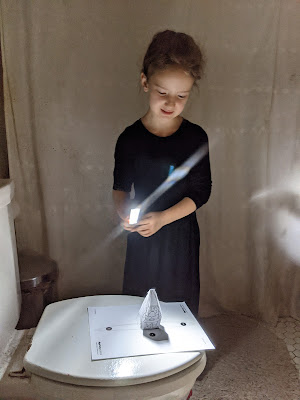
Here she is having so much fun figuring out how to make shadows longer or shorter or pointing in different directions as part of a unit on patterns in the sky. (Please excuse the fact that the pictures are taken in our bathroom, as we needed a dark room for the activity!) 


Science for my 11-year-old: Discovery Education Science Techbook (K-8)
Because we love Mystery Science (above) we were sad that my oldest outgrew it this year; it only goes through 5th grade so we had to find another source for 6th-grade lessons for him. We purchased a one-year subscription to Discovery Education Science Techbook through our free membership with the Homeschool Buyers Co-op for around $60. Science Techbook works in an online format. It was one of the few science options I found that was standards-based. There is a lot of technical vocabulary, tougher concepts, and higher-level skills expected as part of the activities-- all good things but it has been an adjustment from the accessible and super engaging Mystery Science he was used to (see above). Some units are quite long and I know we won't get "through" it all by the end of the year...but that happens sometimes in school as well as homeschool. Every time we finish a concept, I spend way too long trying to remember where to find the assessments, but we are learning our way around the interface and how it is organized. (One other note: since Science Techbook is for K - 8, I dabbled in some of the primary units with my youngest as well just to supplement her science, and I felt it was too much computer, paper-and-pencil, and video time, and it didn't feel age-appropriate and fun for younger kids. So I'd recommend it only for older kids.)

Looking at an Elodea leaf under a microscope as part of a unit on cells

The Core Knowledge Foundation is a non-profit that publishes educational books, materials, and entire units in many school subjects. We pick and choose from the social studies units exclusively (not other subject areas) and especially for my oldest. I scroll down the Core Knowledge web site where you can download curriculum for free, check the box that says "History & Geography," then check the grade level I am interested in and look at the units available. We don't do every unit listed, because there are a lot. This year W chose which topics he was most interested in, including some that happened to be listed under other grade levels. The units are each essentially a textbook, or mini textbook. There is a student reader and a teacher's guide. My son reads a couple of chapters at a time and then we discuss them, using the questions (and provided answers) in the teacher's guide as a basis. There are a few worksheets scattered across each unit that kids can do, but nothing that takes too much time. It's pretty straightforward, standard educational stuff. But each unit includes online resources, sites you can visit to visualize and extend the content from each chapter. There are virtual tours, links to primary sources, museum web sites, and YouTube videos. We find the online resources and activities that go with them really engaging and I find that part is what really makes things stick. We've found the Core Knowledge units to provide a strong, solid understanding of times in history and events that we've studied. 

W made his own illuminated choir book pages as part of a unit on medieval Europe
 
Those I've listed above (reading, writing, math, science, social studies) are the core subject areas that we do most days. Below are a few other areas of study that we do less frequently. 

Phonics for my 6-year-old: Mix of a Couple of Programs
My daughter is a strong reader and a good speller so she's internalized a lot of things that I would have taught consistently and daily in the classroom. So I just do a little focused practice with her about once a week to work with words and focus on some conventions (handwriting, punctuation, spacing). There are two books I bounce between when we do spelling/phonics work. One is Month-by-Month Phonics for First Grade, which has lots of fun activities to work with words and word patterns. The other is Words Their Way. (I wrote a post in more detail about how Words their Way works here.) It's a spelling approach that allows you to find your student's level using this guide. Once you find their level you know which book to purchase full of spelling lists of the types of words they need to work with. We copy a list of words, cut them out and she can sort them in various ways and notice characteristics of the different words and do activities with them.   


Grammar for my 11-year-old: Easy Grammar
This was recommended to me by a homeschool friend when I realized my then-fourth grader didn't know the parts of speech, and it has worked just fine for us. I only purchase one book, the Teacher Edition, because it includes the lesson information (which is very brief) and answer keys as well as the student pages; I copy them for my son to do. We don't do grammar daily, because he's a strong reader and writer and because there aren't many times someone is going to tell him to diagram a sentence in life or ask him to name the object of the preposition. But I think the basics are good to know and the exercises are quick and to the point. So once a week or so, I introduce a new concept and give him a few practice pages to do. It has worked well for us and cost very little time or money. 


Foreign Language: Duolingo and Dinolingo
Last year we tried Rosetta Stone when my son was just starting out with a foreign language (Greek was his choice). Partway through the year he switched to Duolingo and has stuck with it and likes it. It is online, and free! It is intended for ages 13 and up but my 11-year-old has done fine with it. Like all of these online language programs it seems, it doesn't actually teach most new vocabulary explicitly, but adds it into exercises where you have to guess at first, and then repeats it often until you catch on and get it right. 

My daughter had some fun with sign language last year but wanted to work on the same language as her brother so she does Greek now as well. I found Dinolingo as an age-appropriate, inexpensive option for younger kids. It is more visual, consistently using pictures or videos, and it is highly game-based so she loves it. I think she secretly likes doing Greek simply because it feels a little like she is getting away with playing a video game, but she does go around the house counting in Greek so I know some things are sinking in! 

~

So that is what we use for curriculum in each of the different areas in our homeschool. I hope this is helpful for any homeschoolers just starting out, or looking to change. I hope to share how we put it all together in our regular daily routine soon!

September 29, 2020

Finding our New Groove for Year Two: Homeschool Curriculum


We are entering our second year of homeschool and we've all settled in more. In my last post I wrote about our revamped schedule for year two as well as changing the space we use in our house. 

In this post I wanted to share my two cents on curricula. We've made some changes from last year, adding some new subjects and deciding to forgo packaged curriculum in certain areas. Here are my thoughts on the homeschool curricula I bought or planned for each of my children (a kindergartner and a fifth grader) this year.  

Homeschool Curriculum We're Using

Math
I am using Primary Mathematics from Singapore Math with my son this year for the second year because it worked for us last year! It feels like serious, down-to-business math. There are no bells and whistles, and it is cheap. The teacher's guide is written for homeschool (it is called a home instructor's guide). The materials you occasionally need are usually things you already have in the house. It jumps right into concepts, and aims high, which is good because my son catches on pretty quickly in math. The activity suggestions move from concrete (working with actual blocks when introducing volume, for example), to pictorial representations of the same, to abstract (solving equations or word problems).  

Kindergarten: Dimensions Math
We wanted to stick with Singapore Math for my kindergartner, but found that Primary Mathematics doesn't start until the first-grade level, so we tried Dimensions, which is another line from the same company. Dimensions is in full color, with more bells and whistles. There are a good number of materials (game boards and cards and such) that can be downloaded and printed. One thing to note is that Dimensions (unlike Primary Mathematics) is written for use in a classroom. It goes at a slower pace so as to encompass a wide range of abilities. There are many activity suggestions within a lesson to get at the same concept; we don't do them all unless M needs a lot of extra practice on a concept. Most of the games are written for a small group but we can adapt them to play at home, and she loves them. There are so many developmentally appropriate, play-based, hands-on activities. We've used paintbrushes and water and chalk and play dough and flour to practice forming numbers. We've played hopscotch and card games and sorted objects around the house. It is very interactive and dependent on an adult's involvement the entire time (this may be kindergarten-specific, but I'm not sure). There are a couple kindergarten workbook pages each lesson, but they only take about two minutes. The many active components are the bulk of the lesson.  


Reading 
I didn't buy any curriculum for reading. 

Last year I purchased an expensive program that I knew well from my classroom teaching days, that I really believe in. Research on good teaching and on how kids get to be better readers was embedded. The philosophy of all the lessons was excellent. W learned so much and we had some wonderful experiences with it. But it was a bit intense. Too intense to read through and plan for every day, too intense for my son to take it all in some days. It added some unnecessary stress for us both, which was silly because reading was already a major strength of his. Plus, this year, the thought of buying something that expensive, times two kids (plus a similar cost for the same authors' writing programs, times two kids again) was overwhelming. So I did a lot of online research for ideas of what to teach, dug out my guides to best practices for teaching reading, and sketched out my own plans for the year. 

For my 5th grader, I have a plan of several genres we'll spend time reading for a month or two at a time and discussing. (I don't choose specific titles for him, but rather check out a bunch of books within a genre and let him select from those based on interest). He's reading fiction right now and I'm managing to not kill the joy in that with too much teaching, so my plan has been a success so far! I try to spend a few minutes each day before he goes off to read modeling a strategy or tip for being a good reader of fiction. This is usually a thinking/analyzing strategy because that's the part about reading that he doesn't do on his own naturally. I encourage him to jot for about three minutes of his reading time a day in a reading notebook-- about theme or character traits or the author's style, etc. I'm looking forward to helping him delve into fantasy and mythology and reading about particular topics in history and more at other points in the year. 

And with my daughter, who is just beginning to grasp the bits and pieces of what it is to read, reading time is a whole other, exciting story. I didn't purchase curriculum for her either. I hope to share more about this soon.  

Writing 
We're forging ahead on our own without packaged curriculum in this area as well. Same explanation and decision as above, but in writing. I'll share more about our work in writing soon!


Foreign Language
5th only (for now): Rosetta Stone online homeschool subscription 
We decided to experiment with my oldest learning a foreign language this year. When we asked W what language he would be interested in, he said immediately, as I had predicted he might, "Could I do Greek?" Mostly born from his love of the Percy Jackson series, he has learned a lot about Greek mythology so he was intrigued. The pros and cons of different languages were discussed. After he realized that Greek uses a different alphabet, he at first backtracked and thought more about something seemingly easier like Spanish or French. We encouraged him to choose what he was most excited about. Who knows if he will stick with or get real use out of any language he learns. (I don't "use" my six years plus two college semesters of Spanish. But I'm glad I learned it. It helps me have a better sense of the world. And it would come back to me and help me if I moved somewhere with a lot of Spanish speakers.) So we decided to treat a language for now just like any other interest: it's great to see how curious he is about this one right now, and see where that leads. 

As far as program, there were a lot of choices and we chose Rosetta Stone mostly because of name recognition. (There were also back-to-school promotions so I was able to get it for a lot less than it is currently offered for a 12-month subscription.) W has been logging in and using the program a few times a week. It jumps right in, teaching vocabulary and short phrases, and it focuses on listening and speaking right away and primarily. W loves to speak and see if he gets full credit for echoing the pronunciations. He has learned that if he rolls his Rs, he gets higher points. There are also reading and writing components that have recently started (a Greek keyboard comes up on the screen and he clicks the appropriate keys to spell a word). He loves it and feels so pleased with himself for knowing bits and pieces of something so foreign. But every so often, there will be a day where he feels really confused. While Rosetta Stone is billed as something homeschoolers can do independently, and it is, sometimes it really helps if I sit with him and we work through it together for a bit. It introduces things through pictures and listening and speaking. It never provides the English translation. So it's a whole new way to learn. Sometimes he has to really be a detective and it takes a while to figure things out, taking notes to eliminate possibilities of what a word that keeps appearing might mean (often it's not what he first guesses it to mean). 

M is intrigued and likes to watch and is picking up on bits and pieces, so she may yet join in the foreign language adventure this year-- we'll see. Important note, though: we can only have one account on each online subscription, so would need to pay for another entire subscription for a second child to use the program. Also of note: the Rosetta Stone program does not seem to teach the names of letters of the Greek alphabet, so we researched that and learned it ourselves by listening to a YouTube video a bunch of times.  


Grammar
5th only: Easy Grammar
This program has worked well for us since last spring. We do a lesson a few times a week, with an accompanying workbook page for practice. The teacher's guide is the only thing I purchased, as it includes the student pages and is reproducible. The parts of speech and sentence structure were foreign to W, and quite frustrating at first, but he is catching on and loves to impress/stump his dad now by giving him sentences to mark. This program starts with identifying prepositions and prepositional phrases, so once students learn how to do that, it makes identifying the subject(s) of the sentence much easier. This program does not teach diagramming sentences on branches the way I vaguely remember being taught in sixth grade. I thought about trying to teach diagramming the old-fashioned way, but decided that it wasn't the diagramming that was important but rather meaning-- understanding the functions of different parts of a sentence. This program teaches this in a simple, bare bones way.    

Spelling/Word Study
5th only: Words their Way
I am a big fan of Words their Way because it is a small, concrete way to easily personalize for your child and give them exactly the challenge they need. I wrote a post last year with more details on how this program works. This overview book contains spelling inventories and directions on administering them to help you find what level your child is at in his spelling (what types of features in words they are on the cusp of understanding). Once you know the developmental stage they are at (which is not a grade level), there are multiple books available full of curated word lists for the various stages to be used as spelling/vocabulary words for the week. All the words in a list contain a similar feature (such as long a sound) and students have to learn the generalization, or rule, to remember which ones are spelled in which way and why. Kids aren't simply memorizing words, but learning about word meanings, spelling rules, and exceptions to the rules. We work with one of these word lists each week, studying, defining, and doing some activities with the words, and a spelling test at the end of the week. 

Phonics
Kindergarten only: Guidance from Wilson Language approach and Fundations program
The basic idea of the Wilson Language approach is systematic, consistent teaching of the way the English language works. There is an order in which it makes sense to teach letter sounds and later other spelling rules. I had used the Fundations program in my first-grade classroom. For this year I bought the Kindergarten Fundations teacher's guide and a few individual materials I thought were important. I got a poster of Fundations key words for each letter of the alphabet (a, apple, /a/; b, bat, /b/, and so on) and I am glad I did because M is fascinated by it and utilizes it constantly. I also bought a pocket chart in which we can move word cards around to form sentences, and letter cards around to form words. My mother-in-law passed on to me a set of letter cards she had in her attic. I bought a dry-erase board with special lines to help M learn how to form her letters. I made a file-folder and sticky-note version of a magnetic letter board (see picture below). And I already had a supply of dry-erase markers. We add more letters to M's repertoire each week. It's amazing how empowering this is to her and how much she likes to show off her latest letter-sound skills. The program focuses on all the lower-case letters first, because those are what we use most of the time. I like Fundations, but as it turns out, I could have gone without the teacher's guide; my one kid at home is going at a quicker pace than a class of kindergartners would and we often do more than one day's lesson in a session. I probably could have forged my own way with just my pocket chart and white board and by following a general scope and sequence for language learning and we would have been okay. 


Cursive
5th grade only: Can-Do Cursive book from Handwriting Without Tears 
W knows how to write in cursive, but handwriting has always been an area he needs reminders in. This book is just review of the finer points, and he does a practice page a couple times a week. 

Keyboarding
5th grade only: TypingClub 
I wrote recently about our experience with TypingClub as a way to learn how to type efficiently and keyboarding skills in general. We're still using it a few times a week for 15 minutes or so each time and his WPM is increasing! It is online, free, and students can use it mostly independently.  

Science
5th grade: Mystery Science
Kindergarten: Mystery Science 
I am so impressed with Mystery Science. A year-long homeschool subscription is inexpensive; it includes every child in a household, so we don't pay more to utilize both the kindergarten and grade five lessons. They are online-based science lessons, but I think that can give the wrong impression until you've actually done a "mystery" (as each lesson is called) with kids. These are by no means videos to watch passively, though they do include brief video. There are great introductions to topics that hook my kids every time. The videos pose questions and contain lots of stop-and-think moments. They contain well-chosen, appropriate, short footage of animal behavior, or volcanoes, or whatever the topic is being studied. They align with the Next Generation Science Standards. And almost every lesson centers on active, hands-on activities. Science class was never my favorite subject when I was in school, so I love having this company to make science feel fun and accessible. Last week we set up a fifth-grade experiment to test how well mold grows in different conditions (the kids came up with the variables they wanted to test). Tonight my daughter reenacted the defensive animal behaviors she had observed today-- a scared praying mantis is something to see. The lessons are written for classrooms (and I know a lot of classrooms that use them) but they include specific instructions for using them in a homeschool setting as well (very little modification needed). Usually household supplies and the online printables are all the materials you need but occasionally you need to buy something special ahead of time like the red worms we are currently housing for a various observations and experiments this week (eww).  


We currently have pet worms!

Social Studies
I didn't buy any curriculum for social studies because we are making use of free curriculum online-- some school districts put their entire curricula online, so if there is a school you think is doing things well, it's worth checking to see if they have done this. There is a school in Missouri that has an incredible amount of information online. I have found that their social studies units and lessons align with topics we wanted to study this year and seem really well thought-out. These include activity ideas and clickable links to great relevant web sites. I have downloaded these and use them as a guide for social studies. (I feel a little like I am stealing, but these are free and available to the public online...) 

We also may use, as we did last year, some of the Core Knowledge (also free, also downloadable) units as backup or if we end up with extra time this year. These are highly traditional-- essentially mini textbooks for students and discussion ideas for the teacher-- but we certainly gleaned lots of knowledge from them on a few particular topics last year. We also always check out a lot of library books to go with the topics we are studying in social studies.  

Art
For art we do various projects together and try to keep it fun and encouraging. I find ideas everywhere. Last week we made color wheels-- a younger-kid version with primary and secondary colors, and a bigger-kid version that included intermediate colors as well. Here and here are some things we did last year. 


Trying to imitate their llamas' facial expressions

Music
For music, in the past we've checked out venues in person or online, listened to and learned about types of music and specific well-known pieces of music as well as some musicians and musicals. Music comes a little less naturally to me than art, but as with art, I just find ideas everywhere without a master plan for the year (here's a great web site and podcast we just discovered). Each of my kids is taking lessons in and practicing an instrument daily, so I feel that lets me off the hook a little. Here are some things we did and resources we used last year. 


P.E. 
We aren't doing anything formal (though, like everything else, there are homeschool P.E. curricula for sale online). We get outside daily for a good chunk of time late morning as well as after school. We go on lots of family hikes and bike rides on the weekends, as well as the occasional school-day hike; come winter there will be skiing and skating. Last year my son did P.E. at the public school twice a week, but as our local school isn't even open yet this year, we are holding off on that. But my kids are both able to participate in a masked, game-free, shortened soccer season this fall. I have plenty of web sites earmarked that a quick search of homeschool P.E. ideas yielded in case we need a boost of activity, but haven't needed to tap them yet.