March 1, 2021

Parenting for a Growth Mindset


I love to watch my kids solve problems. 

The other day my daughter's teapot was too hot to touch. Ask Mom to pour? Nooooo. She found some nearby gloves to help her manage it. It reminded me of about a year ago when she couldn’t open the flip top on her toothpaste and figured out that a little orange Lego brick separator was all she needed to get the job done. So she kept one stashed in the bathroom for daily utility. We're often impressed by how resourceful and independent she is in little moments like these. 

I get to observe my two kids and the way they learn every day. Like any two siblings, they're different. This time of year, I've been reflecting on their different approaches when they each were learning to ski. 

My son is now, at 10, what I would call an expert skier, both cross-country or downhill, on all sorts of terrain. He is comfortable and confident on skis, and skiing has become part of his identity and something that he, uncharacteristically, likes to show off. But when he was little and learning to ski, whether on the magic carpet, or out on our favorite cross-country ski trails, he whined and fretted a fair amount. When he fell, he sometimes stayed on the ground for a while, grumbling at us/himself/his skis. He was frustrated and didn't know how to manage the fact that it was challenging, and we felt frustrated too sometimes-- with his attitude. 

He was fragile as a learner of that new skill. He taught us we had to tread lightly, being gentle and encouraging, trying to say just the right things at key moments. We tried to remain calm and react to the stumbles as a normal part of learning (or, often, intentionally not react at all), and point out every little bit of progress to build him up. We knew that with practice he would get better and find it more fun (and he did). We kept going out, doing small amounts we thought he could handle to keep it positive. I don't know the exact moment when he switched from feeling frustrated with skiing to feeling super confident. But it is one of our clearest shining examples, and his, of practice and progress over time and how it can dramatically change your relationship with a skill. As a result, to this day, if he's trying to do something new or hard and we see some frustration, there's a good chance one of us will bring up the topic of skiing.

Teaching M, 5, to ski has been an entirely different experience. M goes fairly slowly and falls plenty, but she either laughs or doesn't miss a beat in conversation while she simply gets back up. She generally is not annoyed or surprised by a fall; there's no big emotions that ensue. If she's stuck in an awkward position, we might need to spend a minute discussing where she should put her feet so that she can stand up, but she patiently listens and tries our advice. If she whines we know it really is time to call it a day, because she so rarely does. She is patient and persistent, plugging along at her own speed. When I bit off a little more than I should have distance-wise on a cross-country loop recently and admitted that as the hours wore on and the sun got lower in the sky, she said, "Mommy, you should look at the map better next time," but she didn't melt into a heap or give up; she just kept going, cheerfully. (When we returned home, W openly said something like, "Wow! If I'd skied five miles at her age I wouldn't have been in a good mood afterward!")  

A few years ago, my fellow teachers and I all read as a book study Mindset: The New Psychology of Success by Carol Dweck. My copy has a lot of underlining and scribbled notes in the margins. It made a lot of my observations about how kids are as learners, especially my own children, make sense. The book is based on a lot of research and I strongly recommend it to any parent or teacher. The big idea is that all people have either a growth mindset or a fixed mindset (or something on the spectrum in between). A growth mindset is the belief that you can learn, that you will improve with hard work and practice. A fixed mindset is the belief that your qualities are fixed traits, that we are each born with a certain amount of talent that doesn't change. Each of these have different characteristics and sometimes need to be taught and parented in different ways. 


In learning to ski, my two kids had different mindsets: M had more of a growth mindset, while W showed a fixed mindset. My kids aren't always the way they were then; sometimes it's the reverse. W has grown a lot from the little boy who could have an occasional tantrum on skis, and M has plenty of rough days and stubborn moments. But their varying approaches to learning and working, especially when things are not coming easily, have taught me first-hand about the idea of mindset and the difference it can make. Daily I notice their relationship with challenge, the length of time they stick with something on their own before asking for help, their tolerance for frustration, their willingness to take advice, their self talk. I see mindset when one of them encounters a problem whose solution isn't immediately obvious, or when I set out to present a brand new concept to one of them in math. 

Here are some of the differences discussed in the book that can often be seen with the two mindsets:

Characteristics of a Fixed Mindset
  • Belief in fixed traits and natural/innate ability (I'm good at math, or, I'm a bad artist, etc.)
  • Fixed ability constantly needs to be proven 
  • Afraid of challenge
  • Afraid of not being smart
  • Want to make sure they succeed
  • If things get too challenging, they lose interest
  • Feel smart when flawless 
  • Don't remember the idea of "yet" (either feel they can or can't do something) 
  • Failure can be devastating because it affects identity as being good at this or that
  • Avoid learning from failure and sometimes focus on bolstering self esteem instead ("At least I'm better than so-and-so...," assigning blame, or making excuses) 
  • Need validation of their worth 
Characteristics of a Growth Mindset 
  • Belief in changing qualities 
  • Belief that ability is changeable and can be developed through learning 
  • Enjoy challenge; challenge and interest in something go together 
  • Feel smart when learning 
  • Think of themselves as simply not knowing how to do something yet
  • Failure can be painful, but doesn't define identity
  • Feeling of being more determined when things get worse
  • Value what they are doing regardless of the outcome 
  • Take charge of their own learning and motivation 
  • Ask how they can do things, not whether they can do things 


We all have different interests and things we focus on. There are areas of life in which I have more of a fixed mindset, where I give up pretty quickly and leave it to someone more qualified (high-school science topics and broken appliances come to mind), and other areas where I have a growth mindset, where I am more open-minded and have a habit of reading and delving deeper to improve (parenting, teaching, cooking, to name a few). Most of us are in different places along the fixed-growth mindset spectrum in different areas of life. There are also other aspects of who we are that play into how we tackle situations-- disabilities and individual temperament, for example. But mindset is a big piece of it, and a growth mindset be taught. I want my kids to have a growth mindset attitude toward life, to feel that nothing is beyond them if they work at it. I want them to have perseverance and to understand that worthy enterprises aren't usually easy or immediate. Ever since I read Mindset I have been trying to be aware of the things I do as a parent that could help them along the path of these goals, that might foster or help develop a growth mindset. Here are some strategies I have felt to be effective, and some I was reminded of in rereading my underlining in the final chapters of Mindset. 

Strategies for Fostering or Developing a Growth Mindset in Kids 
  • If they want to do something themselves, let them. This takes patience, so
  • Build time into your routine so you can allow them to spend ten minutes buttoning their own shirt or tying their own shoes in the morning.
  • Let them struggle a bit. Don't jump in too soon. If they are focused and actively trying to figure out that tricky word in their book, let them. If on the other hand they skip over the hard word or toss the book aside, that might be the time to offer a hint or a strategy to keep them going. 
  • Regularly point out and describe specific, concrete ways they have grown and changed, whether it is the songs they now know how to play on an instrument or how legible their handwriting is. Physical evidence of their own growth in the form of work samples, pictures, or videos from the past is powerful to kids.   
  • Celebrate challenge.
  • Use the word and concept of "yet" more often, as it showcases the idea that we are all on a path and our abilities aren't fixed. It makes things feel possible and only a matter of time and learning. (I haven't learned to ride my bike yet, but I am getting there; Someday I'll probably like broccoli.) (There are multiple children's books about this concept-- The Magical Yet; The Power of Yet; I Can't Do that, Yet... I haven't read those-- yet-- but I love the idea behind them.) 
  • Rather than praising their talent or intelligence (You're such a great gymnast/You're so smart), focus on naming and praising their effort and strategies. 
  • When there are achievements to celebrate (trophies, grades, etc.) connect those to the processes that got them there. (You practiced your spelling words every night this week and you got them all right!)  
  • Don't label your kids (i.e. This one's the artist, This one is the scientist).
  • Treat mistakes as expected and as opportunities for learning.
  • Talk about the new things you are always learning, and model not giving up on things easily in your own enterprises.
  • Model seeing your own mistakes honestly, taking feedback, and changing your strategies; tell stories about things that are easier for you now because of your hard work.
  • When they struggle, whether with friends or shyness or with learning a particular skill, share your stories of struggle and how you got through it and how it turned out.  
  • Talk about your own fixed-mindset areas when they present themselves, and how you are working on them. 
  • Give kids regular honest and constructive feedback, both so it will help them improve and because it will cause them to become accustomed to feedback and not see it as negative or as an attack on their character. 
  • Dweck writes, "Research shows that normal young children misbehave every three minutes." Don't let kids feel judgement and punishment during those many moments; see their behaviors instead as part of their normal growth process and as moments to teach. 
  • Support their own chosen interests and learning.
  • If there is talent they admire or idolize, give them tools and help them see the way to get there. 
  • Teach them that connections in their brain get stronger, and brain cells grow, when they learn new things. This gives some literal proof and explanation to the idea that things that are at one point hard can become easy-- and that things always being easy isn't something to celebrate because that indicates they aren't learning. 
  • Structure some dinner-table conversation around the growth mindset: What is a mistake that taught you something today? What did you try hard at today?
  • Read and discuss books with themes of perseverance, hard work, strategy-- and growth mindset. There are many but a few picture-book examples I like are: Rosie Revere, Engineer by Andrea Beaty, Everyone Can Learn to Ride a Bicycle by Chris Raschka, The Dot by Peter H. Reynolds, and The Most Magnificent Thing by Ashley Spires. 
One of the main themes I see in regard to parenting for a growth mindset is, unsurprisingly, that how we talk to kids-- our words and tone, our reactions and interactions-- matter. (And in trying to have the right words and tone, we'll all mess up, but we can have a growth mindset and keep trying and stick with it!) 

We can try to be patient and admiring when they insist on pouring their milk themselves or retrieving something from the top shelf by using a stool. Initiative, problem-solving, confidence, and stick-with-it-ness matter more than spilled milk in the long run. In so many little moments of every day, we have the opportunity to let them try and not to step in too early, to notice the many failed attempts as they inch closer to a goal, and celebrate their efforts when they keep going. I want a struggle with dividing decimals to be seen honestly for what it is, and not as an indicator that they are not good at math (or that math is stupid) and that they might as well give up. We can try to be the type of parents who don't expect new skills or habits to be mastered right away, so kids too will have realistic expectations of themselves and will come to know that progress comes with time and effort. None of us is permanently messy or neat, a good cook or not, a good student or not, a good athlete or not-- it's all a process. We won't all become the best of the best in every area we explore, but we can all improve from where we begin.


February 18, 2021

Art Project: Papier-Mache Bowls


We recently finished up an art project making these papier-mache bowls! I loved to do this when I was younger and it was great to share with my kids. They liked having their hands in the gooey mixture, as well as getting to paint the bowls any way they wanted. It was a days-long process, with several drying stages, but really easy and fun.

I didn’t take any pictures of the process, because my hands were too messy at the time! This is what we did:

Materials Needed:
  • household bowls (to build on and then remove)
  • aluminum foil
  • nonstick cooking spray
  • newspaper-- both whole pieces for work surface and strips for papier-mache
  • flour and water
  • acrylic or tempera paint, brushes
  • Mod Podge 
Steps:
1. Choose a household bowl you like the size and shape of. Cover it as smoothly as possible in aluminum foil, then give the outside of the bowl a spray with nonstick cooking spray (this is so the hardened paper will pop off the bowl easily later).

2. Mix a slurry of flour and water in a bowl in about a 1:1 ratio. Rip some newspaper into long strips.

3. Invert bowls on large pieces of newspaper. Dip a strip of newspaper in the slurry, pull it up through your index and middle fingers to wipe off excess, then drape it across the bowl and smooth it down. Cover the bowl in slightly overlapping strips of newspaper like this all going the same direction until bowl is covered.

4. Turn the bowl 90 degrees and add another layer of newspaper strips the same way. Do more layers as desired (we did a total of 4-6 layers on each bowl). Let dry completely overnight.

5. Cut the overhanging part of the strips off the next day and pop the foil-covered bowls out of the now-hard paper. To smooth the rough paper edges, make more flour-water mixture and dip short strips of newspaper in it in order to lay them over just the edge of the bowl, overlapping all the way around. Let dry overnight.

6. Paint the bowls any way you like with acrylic or tempera paints. Let dry overnight.

7. Paint a coat of Mod Podge to give it a shiny, glazed finish. (We Mod-Podged the outside of the bowl one day, let it dry, then the next day flipped it over and painted the top edge and inside of the bowl.) Let dry completely.  

We haven't decided what to put in our bowls-- they'd have to hold something that's not wet! But they would make a nice gift or decoration. 


February 4, 2021

Ideas for Virtual Playdates


It's midwinter at the height of a pandemic, so, like many people, we're trying to avoid indoor gatherings-- which eliminates traditional playdates. That has been tough. 

Some may think that homeschoolers would be accustomed to limited socialization, but this school year has felt like night and day compared to (the first two-thirds of) last year. Last year we were new homeschoolers, and we were happy and relieved to find how connected the kids still felt. W attended PE twice a week at the school with his old classmates, and participated in every seasonal sport. We took one class for homeschoolers and did frequent after-school things like playdates and dance class. We were pleasantly busy; there were always people to see and places to go. 

The last few months, with none of that happening, is the first time I have worried about socialization and trying to keep my kids from feeling too isolated. 

We're lucky to be able to sometimes meet up outdoors with friends who like to cross-country ski or ice skate, but for the most part other than that, we've focused on finding ways for the kids to have fun with friends and family from home, via Zoom or FaceTime. Given the options right now, they love it. Especially on the days when morale is dragging, I've found it is amazing how much happier my kids are after spending an hour or more face-to-face with a friend, even if it isn't in person (which they frequently reminisce about, and look forward to doing again...). 

My biggest aha with my kids and video calls is that, while there are times we all want to sit down and share a family call, in general the kids do best with their peers when I just get them set up (if needed) and then let them be free to wander around the house and to do whatever they feel like, even if it doesn't seem that they are really doing any particular thing. That might mean two 5-year-olds just peek at each other through their empty Connect 4 boards and giggle. While I as the adult might feel inclined to step in and organize things for them, if they are happy and spending time with someone they like, that's what matters. Kids are amazingly flexible and adaptable and mine always seem to find a way to have fun one way or another when they are given the time and some friendly company on the other end.  

But there are times, on calls with grandparents or newer friends, where I've found it's nice to have a little more structure in the way of a game or activity, at least to get things started. To that end, here's our list of favorite activities for virtual playdates. I hope this list gives some ideas to other parents out there. What ideas have worked well for your family? Please share your other, no doubt better, ideas for getting kids together safely. I would be excited to get a comment :) and we would absolutely love to get more ideas.  

Our Favorite Activities (So Far) for Virtual Playdates

Games 
We don't do online video games (yet) in our house, and I know that's a way kids connect with one another from home these days. So far we've stuck with some old-school games we've found to work well over a video call. Many only require one of the players to actually have the game, while others require no special equipment.
  • Guess Who-- Perfect over FaceTime; just make sure you both have the same version, which was an issue we ran into once...
  • Battleship-- Another that is absolutely perfect for playing remotely, as the whole point is to hide your board and guess the other person's.
  • Connect 4-- Some friends of ours taught us the trick of labeling the columns 1, 2, 3, 4, 5, 6, 7. Then kids (of any age!) can play with anyone, even if their opponent doesn't own the game. The opponent just says which column number to drop their chip in when it's their turn. This one is good for a wide range of kids and for play with grandparents as well (and it's quick so you can play several rounds). M actually played recently for the first time with a friend who owned the game and it was honestly a little more confusing to have two boards and have to try to mirror/stay caught up with one another. We decided it's best for just one person to have the actual board set up on their end. (She also played with a different friend recently where they didn't play the actual game but both just ended up stacking their Connect 4 chips and comparing their walls/towers/patterns, so it's a multi-use game.) 
  • Hangman-- Another good one with grandparents, and adaptable for multiple ages, by using simpler or harder words. 
  • Charades-- We played recently in a group of adult cousins and our kids. It was really simple and fun, especially by googling a simple word generator like this one (with easy, medium, and hard levels to choose from) so that you didn't even have to first brainstorm words to act out, but can jump right in with playing. Teams do not all have to be located in the same house together to guess and act for one another which was fun, because there were more kids than adults so we decided to play adults vs. kids. (We had the kids' team use the "easy" words and the adult team use medium or hard words.) (My sister tells me Pictionary was fun this same way, using an online word generator, so we are looking forward to trying that, too.)
  • Scattergories/Categories-- Choose several categories, and a letter of the alphabet. Set a timer for a certain amount of time. Everyone privately tries to think of and write down examples of each category beginning with the chosen letter. When time is up and answers are compared, you receive a point for any word that other players didn't also think of. Play several rounds with different letters of the alphabet and compare scores. Here is one description of how to play.    
  • Yahtzee-- This is a great game, with a fun mix of chance and strategy. We've learned it can be played over FaceTime easily. We scanned the blank score sheet and emailed it to grandparents. As long as they have that and can find five dice in their house, they are good to go! 
  • Board Game Arena-- We need to further explore this site that a friend introduced us to, but it seems great! It is a free way to be able to play a whole slew of traditional board games and card games online with friend. It provides the interface to play games that wouldn't otherwise work well over a video call. After 30 seconds to create an account on the site, W recently spent an hour playing a few rounds of Kingdomino over Zoom with a friend thousands of miles away and reported that "that was SO fun."  
  • 20 Questions-- no materials needed. 
  • Rubik's Race-- This may fall in the category of games W and his cousin found to play in the early days of quarantine that perhaps seem like less obvious choices to others but they made it work. It's a two-person game where both need to own the game in order to play it virtually. You quickly try to move the pieces around to be the first to make a specified arrangement. It's intense and fast-paced, so not a lot of chit chat on the side with this one. 

Other
Here are some other things, besides specific games or just chatting, that have been fun for the kids over video chat. 
  • Impressions-- I once had the idea that I would get W and his homeschooled cousin together to talk about a book they had both read. I had question prompts ready and everything, but my lofty book discussion became a game of impressions. "Okay, okay, who am I now?..." one of them would say, as they acted out things specific characters from the book said or did (or the types of things these characters might have said and done based on their personalities) and the other guessed.  
  • Dress up-- M enjoys doing this. The funny thing is, kids don't seem to mind abandoning each other for several minutes as they go change or retrieve a prop, and don't seem to mind waiting as the other does the same. It's not the same as being in the same room together, but it's amazing how naturally they do it and go with the flow of it all.
  • Dolls-- Another of M's favorites. It's great when she has gotten a chance to play "Babies" with her cousin. They are on the same wavelength (in contrast to how the rest of this household secretly feels if M asks one of us to play babies with her) and they don't care whether they can see each other the whole time. They chatter at each other and occasionally stop to see or show something on the actual screen that they leave propped somewhere as they are happily engrossed with their own dolls in their own rooms while hearing each other's voices.   
  • Show & Tell-- If there's an adult on the other end, especially one prone to motion sickness, they may get tired of kids running around the house carrying the iPad/phone while on a call. But kids love to show off their room, pet, or newest toy or creation, and seem genuinely interested in seeing each other's things as well.
  • Legos-- This one doesn't seem like it would work well, but from the earliest days of quarantine, W and his cousin have contentedly built Legos together over Facetime. They'll hang out for long moments peacefully building in silence in each other's company, then they'll show things, or ask ideas and be totally engaged in it all. (One of the sweetest things I overheard was when W and his cousin made the (questionable) plan to each build half a boat out of Legos and to put it together when they can get together again.) They seem so focused and satisfied doing Legos over FaceTime, approximating one of the most natural pastimes they'd be doing if they were actually together.
  • Reading-- Kids can read to a grandparent, or take turns reading to each other. 
  • Performance-- FaceTime works great to play or sing a song or do a dance for an audience. 
  • Teach each other something-- Kids can take turns or set up different times to be the teacher, teaching and demonstrating a gymnastics or dance move, or other how-to for a friend. 


Last, but not Least, School-Related Stuff
If you are lucky enough to have some homeschoolers (or remote schoolers) as friends or family, virtual bits of the school day here and there where you can share learning are a fun way to break up the routine.
  • Jeopardy or other learning game-- Quiz kids on a shared topic of study.
  • Book talk about a common book or author or topic-- Could be a discussion you structure and lead, or one you leave to them.
  • Share/Present-- Last spring we had a few "talent shows" for my kids and my niece and nephew when each kid could share or show off any new skill or learning they wanted to All the Grandparents. Our four kids read writing aloud, performed magic tricks, recited things they'd memorized (state capitals), played a piece on an instrument, and did gymnastics routines. Remembering this makes me want to do it again. It was a fun way to bring people together and give the kids all an audience and an ego boost.   
  • Share a lesson-- During normal life there are homeschool classes, and homeschool co-ops where parents come together and take turns teaching groups of homeschoolers on topics of individual expertise. This is not something we've tried this year, but seems like a reasonable thing to do virtually. 


For Adults, Too
My husband and I don't play many games but we have played more in the last nine months than usual. Here are a couple things we've really enjoyed.   
  • Sporcle Virtual Live Trivia-- For $5 per device, a team of people in separate locations (up to ten households) competes against other teams. It's low key and fun. After each question is posed, you get a few minutes in a private "breakout room" with only your team members to discuss your answer and chat. Sign up on their site couldn't be quicker and easier. They have plenty of "all topics" trivia nights, and we've also done a couple of themed trivia nights with particular groups of friends-- and we let W stay up one night to play Harry Potter trivia too.
  • Jackbox Games-- A drawing game called Drawful and a funny game of brainstorming funny responses to questions called Quiplash have been our favorites, but this company has a whole suite of games. Most of these can be played with up to eight people/devices so it's another fun way to get together with friends and family. (W and M are both fans of playing Drawful, and we just keep the "family-friendly" setting checked when playing with kids.)
One of the many unexpected gifts we are thankful for in these strange times is that, in some ways, we see friends and family more, and on shorter notice, than ever before. It's not the same of course, but it can still be a lot of fun. Please share your favorite ideas that we should try next!    

January 29, 2021

Fun for Kids Outside (at Home) in the Middle of Winter


Boy in Woods with Stick

"Exploring" in the woods with a stick in hand is how this boy is happiest. The above photo is a rare moment of calm, though; usually he's using his latest, greatest stick as a club to whack things, or pretending it's a spear/sword/bow. 

Both my kids always end up finding activities to be engrossed in outdoors in all seasons, even on the rare days when they at first say they didn't feel like going out. 

We try to go outside every day even during this season of cold and dark. It's easy to find things to do when there is fresh snow: we head out with the purpose of shoveling steps and porches, or sledding, or building a snow creation. But most of the time we bundle and head out just for the sake of the routine of getting out, even when no specific purpose particularly calls us. While I love our family outings to go cross-country skiing or ice skating, just hanging out in the yard on an average weekday afternoon when it's twenty degrees outside is not always something I personally feel like. But it's always worth just doing. This is a lesson I have had to learn over and over. They find things to do. Outdoors has the power to restore every day, not just on the fair-weather days. Cheeks turn pink, moods lift, conversations are had that wouldn't have been had face-to-face at the kitchen table, treasures are discovered, games invented. Afterward we all feel more ready for whatever is next, more tired-in-a-good-way at the end of the day, more connected with the world around us. 


Here are some of the things my kids have been loving to do outside right now.

Fun for Kids Outside (at Home) in the Middle of Winter:
  • Go sledding. My kids don't even require a sled lately.    
  • Snurf. W's snurfer has provided a lot of entertainment. 

  • Build a snow person or fort or other creation. Compare said creations or build together. 
  • Shovel the steps or porch.   
  • Shovel a path around the perimeter of your yard. We started doing this years ago for our dog, who doesn't like to walk through deep snow. Now he's older and doesn't venture too far regardless, but we've kept up the habit. We all use it, and creating it after a big snow is a satisfying project. 


  • Look for animal tracks and try to follow where they go. Sometimes we take photos of them with Google Lens and try to identify them. They love to imagine the busy nightlife of the animals right in our backyard. Tiny little mouse prints are just as cool to see as deer. 
  • Venture into the woods. W especially loves to go beyond our fenced yard and "explore" in the woods. He loves to check out remnants of an old foundation, find perfect sticks for doing this or that, or play hide and seek in one area for a while. They discover things just by being there. A few weeks ago they discovered little spots like air bubbles on the bark of an evergreen tree behind our garage. When they poked at the spots with a stick, clear, gooey pitch/sap came out, sometimes as much as half a teaspoon. They tried to "collect" it and used it to glue leaves to stumps and things. Hopefully they weren't harming the tree, but they both were so joyful discovering this neat little phenomenon. 
Harvesting pitch


  • Dig a tunnel through a snowbank and try to crawl through. 
  • Bring hot chocolate in a thermos and drink it outdoors. 
  • Throw snowballs at a target-- the swing set, a certain tree, the fence post. 
  • Snow volcano-- usually I don't plan at all for outside time, but one day I brought the supplies out for this snow volcano I'd seen online, and they got a kick out of it. After a while M had fun just spreading around the colorful foam we'd created.
  • Spray colored water on snow. M enjoys putting water and food coloring in a spray bottle and misting the snow banks or snow sculptures. 
  • Take photos of cool things, like these upside-down icicles we found.
  • Go for a walk. While the kids never bore of the yard, some days I make them go for a walk. They search ever-optimistically for dropped antlers, climb the snow banks, and generally continue to act like kids outdoors even when we are covering some distance. 


January 21, 2021

Your Kindergartner is a Writer


Young kids need a lot in the area of language arts: 

They need, of course, to be taught to read and to spend time practicing with books that are just right for them.

They need explicit, sequential lessons in letters and sounds (phonics), to memorize high-frequency words like "the," to learn what a word is and what a sentence is, and basic conventions like capitalization, periods, and spaces between words. 

They need to be read aloud to by a fluent reader who pauses to talk about the story with them. 

And, even as young as kindergarten, they need time to write, time when they come to feel capable as and see themselves as writers. Writing time is not the same as handwriting or phonics or answering questions on paper or filling out worksheets. Writing time is a unique time to make books, stories, poems, and other things like the type of writing they see in the world. 

~


One might say, how can a five- or six-year-old write? If they don't know how to read or spell yet, don't even know what all the letter sounds are, how can they write a word, much less a sentence or story? 

I can tell you, dear reader, that they can (and should). The process and the results have been some of the most satisfying and exciting parts of my professional life-- teaching first graders-- and now, in our homeschool with my own kindergartner. It need not wait until other foundational skills are solid. Writing develops right along with and feeds in and out of those other skills. 

Their spelling will not be correct. It will be phonetic and that is age-appropriate. (Indeed the Common Core Language Standards say that kindergartners should "Spell simple words phonetically, drawing on knowledge of sound-letter relationships" while first graders should also "Spell untaught words phonetically.") They will not leave spaces between words. They will write in all capital letters. They will write backwards and draw all over the page. In the very beginning, they will write random strings of letters that can not be read by you or them, but it has meaning: it shows they understand that letters make a code and that code tells a story. Their earliest attempts, very picture-dependent, or even entirely pictures, are precious pieces. It can be a little scary jumping in and asking them to write so young, and progress can feel slow at first. But with daily, or almost daily, writing time, as well as all those other components of learning our language listed above, they will improve dramatically. 

Kindergarten, Day 1

I have a picture hanging in our kitchen that M made back in the summer. It shows a unicorn and beneath the drawing it says, "UInKNITZ" (It is a unicorn, or more precisely, Unicorn it is). At the time she created that, I was dazzled by the sophistication of her drawing and spelling. And now, just a few months later, as a mid-year kindergartner, she is a writer and she knows it! She is currently working on a multiple-page book about how to build a snowman and has many other awesome and (mostly) legible gems stored away in her folder.


~

So, what to have them write? Out of habit, I use the three Common Core text types as a guide for the types of writing to consider-- opinion, informative/explanatory, and narrative. But don't worry too much about what each of these are (there's a link here describing the writing goals at a kindergarten level if interested) or about how a young kid could possibly write them. For a kindergartner, anything that is factual counts as informative writing, any combination of drawing or writing about an event or about several loosely linked events counts as a narrative, and anything in which they state a preference can be opinion writing. When kids get older, the possibilities for fulfilling these areas are wide-ranging and exciting. But here are some examples of the types of writing you could have the youngest students do. I tend to focus on one genre for six weeks or so, having them create many pieces practicing that type of writing, and then move on to another.

Types of Writing Primary-Aged Students Can Do 

Opinion
  • Toy reviews
  • Book, restaurant, or other reviews
  • Persuasive writing (letters, posters)
  • Favorites: Kids write to express opinions on various topics of their choice (best pet, favorite vegetable, least favorite vegetable, favorite season...).
Narrative
  • Stories from their lives: I frame it as writing about things they did or things that happened to them, stories about one time, often called "small moment" stories.
  • Pattern books: Create a pattern or borrow one from a published book they can read (think: Brown Bear, Brown Bear and other repetitive, even simpler books) and write their own version.
  • Series stories: They write a story about a fictional character, then write more stories about the same character (think Biscuit books or Henry and Mudge as models; best for first grade and up).
  • Fictional stories
Informative/Explanatory   
  • Teaching books: Write about anything they know about-- soccer, trucks, swimming, dolls (can be common knowledge; M wrote one about things to do at the brook).
  • All-about books: Similar to above, just a different way to frame it.
  • How-to books: Write the steps, with illustrations, about how to do literally anything they know how to do (how to swing on the swings, how to build a cup tower...).
  • Alphabet books: Come up with a word for each letter (and possibly a sentence or more as well) and of course, illustrate. Could be on a theme or not.  
  • Question-and-answer books: One page is a question, the next provides the answer (could be on a certain topic of expertise).
  • Simple recipes: List ingredients, write directions of what to do.
  • Labeling/Show-and-Tell: Draw and label specific parts of things they know about. 
Also, Poetry
This is not exactly any of these text types but can be a lot of fun (see this post I did about teaching kids to write poetry).  

There are so many possibilities. The key is to look around at the texts that surround them that they are aware of in the world and pick something they might enjoy trying to create. Find published examples of the type of writing they are going to do. The texts you show them as examples will be (at least) a notch above what they are able to create themselves. But it gives them a clear goal, a picture of what this type of writing they are working on can be and the effect it can have on its reader. Choose one particularly good "mentor text" as an example of the type of writing they will do. This might be just a page or part of a published book, and sometimes the mentor text, for very young kids, needs to be something you write yourself (which won't take you long). Read your mentor piece with them multiple times, in its entirety then in bits and pieces on different days, to get to know it well and what makes it what it is, what makes it good. Keep in mind that no matter what mentor text you choose, the work they do will always be an approximation of that. 

Teaching
After exploring the type of writing they will be doing by reading it, model creating a piece yourself. Model the whole entire process, quickly at first, and then let them jump in with excitement. For the how-to books M has been making, on the first day I acted out coming up with a topic I knew about, planning out what each step would be, and drawing a picture on each page to teach about the steps in my own how-to book. Then I wrote it, or started writing it, quickly, so she got the idea. We also wrote a how-to book together early on ("How to do a Puzzle") to practice. 

After that, on other days, you can give finer tips, one at a time, and tease out aspects of the writing to help it get better and better and to keep them going. Each day she either continues to work on the piece she's in the middle of or she starts a new one. On different days, I've pointed out to her details like the fact that how-to books often number each step, and that the important words are often big and bold, and that all the things being taught in the words need to be in the pictures as well and vice versa, and that how-to books often give tips or warnings (she then came up with a great tip for her own book regarding making sure to check that you have the right kind of snow before trying to build a snowman). No matter what type of writing you are doing with young kids, you are bringing in very basic and important teaching about how to write anything, ever.

Writing time is a time to teach more than mechanics. Teach them to start a new piece when they think they have finished one. Teach them to not allow themselves to "get stuck," and in general teach and reinforce resourcefulness, initiative, and independence. One of the most important things when it comes to young kids and writing is your attitude toward spelling. If you allow it, they will constantly ask you, "How do you spell..." or "Is this spelled right?" This creates a dependence on the grown-up and a writing time when not much gets written. You empower them when you tell them they don't need to ask you; just stretch the word out, say it slowly, and do their best to write down the sounds they hear (model this, too). Then celebrate brave spelling: Wow, that's a big word! I can read exactly what this says! When my daughter says something like, "Is this how you spell Pinocchio: p-u-n-o-c-y-o?" as she did just yesterday, I say, You got all the sounds in that word! I don't lie and tell her she's right, and there are times for just providing the spelling for them (words like "the" and their own names, and during phonics time teaching about particular types of words), but the goal at this stage is hearing every sound and recording it and I am thrilled when she has done that and just keeps writing.  


Helping Young Kids Plan Their Writing
In the beginning of the year, I had M thinking of things she knew about that she could teach others about. She was drawing a picture and labeling it on one piece of paper. Now, she's able to spread a story or teaching book across three or four pieces of paper, with a picture and a sentence on each. But at every stage, even for kindergartners, it's good to teach them to plan as part of writing. They need to, because otherwise, in the process of trying to figure out how to get something on paper, they will forget, or their beautifully articulated idea will get mangled or shortened because of their limited abilities. As kids grow older they will someday learn to make a mind map or other notes before they write. But at the age when getting a word or sentence down is a feat, written notes (even just single-word notes) are not developmentally appropriate. For young kids, I think planning best takes two forms: oral storytelling and drawings. 

Students need to tell their story aloud first, just as they want to write it. They should tell it to their peer, their parent, their teacher-- preferably multiple times so it becomes ingrained and they won't forget when it's time to write it. They can even point to the blank page(s) as they tell their story orally. 

Drawing is also an important first step to writing. They should draw the picture on the page(s) to go with what they plan to write there. The picture will be another reminder (notes, if you will) when they go to do the hard work of writing words. However primitive their drawings may be, they are often more compelling than their written words. After all, drawing is part of the expectation and part of what "writing" is for young students (to mention the standards again, kindergartners are expected to "Use a combination of drawing, dictating, and writing..." to compose their written pieces). Perhaps all this about the importance of primary-aged kids writing and drawing is obvious but I say it because I once heard a veteran first-grade teacher I was acquainted with say at a training that she used drawing as a "carrot"-- her students first had to write, and then as a reward they got to draw. I know she meant well, but I disagree. Drawing is not a carrot for little kids. Drawing is a tool for them and integral part of the process and product.  

Draw first, write later

Revision (Yes, Revision)
Revision feels like a big, fancy word but it is a key part of the writing process that needs to be taught all along, starting at a young age. Revision does not entail the adult correcting mistakes. Revision means student editing (fixing up) as best they can, and choosing small additions or changes to make a piece they already like even better. 

Having taught your child lots of various skills about a particular type of writing, maybe you've collected these on a chart as reminders. From time to time, have them choose one of their best pieces of writing from their folder and go through this list of tips for good writing. The list will include reminders like spaces between words, write an ending or last part, and to teach with both words and pictures on each page. Read through the checklist with them and have them think about whether they have done each thing in that piece of writing. If they haven't done some of those things, is there a way they could add to their writing to improve it? Based on these revisions, what goal or goals do they have for themselves for their next piece of writing? Revising, even in a very simple brief way, helps them be aware of their own learning and growth and teaches them that as a writer, we can always go back and make something a little bit better, even by just adding a word or capital letter here and there. As with everything else in teaching writing to young kids, revision should have age-appropriate expectations and it will not be perfect; in learning what revision is, they will be approximating skills they will use more and more as they get older. 

Share It
Finally, sharing is a must when it comes to little kids and their writing. Whenever they finish a piece, and certainly at the end of a unit of time focused on a particular type of writing, they should share and celebrate that piece with some sort of audience in some way. Maybe it's by giving their writing as a gift, or reading it out loud to someone, or coloring the pictures and adding a fancy cover and putting it on your bookshelf with your other books. Hard work and a finished piece should be recognized and helps to keep them going. 


A few last notes:
Pens vs. Pencils: Either is fine. There is nothing sacred about a pencil, and in fact, there are plenty of arguments out there about why it's maybe better to provide kids pens to use for writing time (such as they don't break or need to be sharpened, kids don't develop an erasing fetish, you get to see and learn from all their mistakes because they are just crossed out, and pens are juicy and colorful and may add a little bit of allure and specialness to writing time). Some teachers have kids use markers. I think any type of writing tool that works and makes you and them happy is okay. 

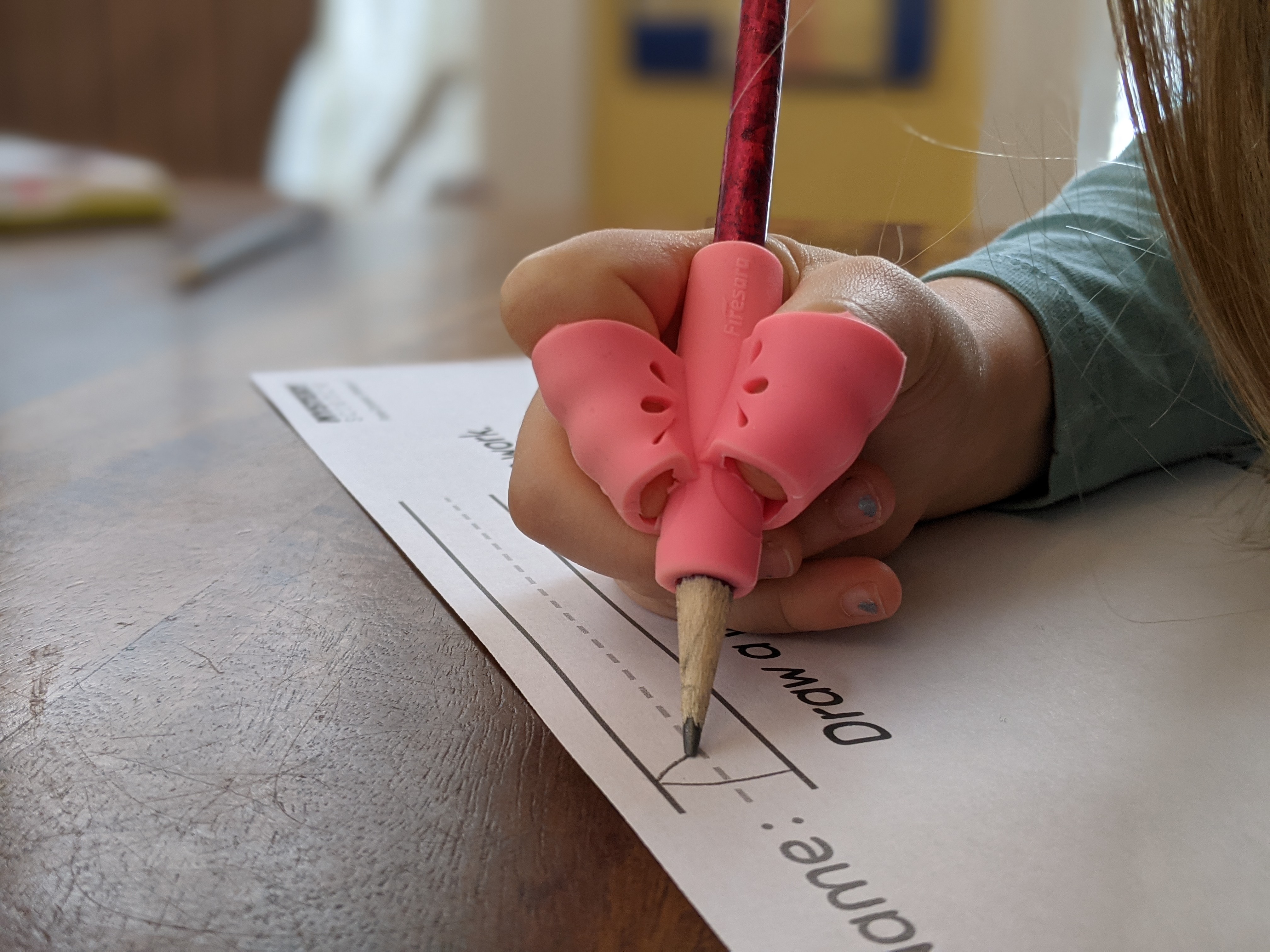
Writing Grip: Kids go from a fisted writing utensil grasp as preschoolers, to a three- or four-finger modified grasp, and eventually to the "correct" tripod grasp. But some develop unique, not-quite-correct grasp habits along the way. I don't think the way they hold a pen is something to stress them or yourself about early on. But it is something to keep an eye on and work on when you think they are ready and before they solidify bad habits that are less comfortable or less efficient. There are lots of occupational therapy web sites out there that describe and depict ways of holding one's pencil and why it matters, and there are also lots of different types of grip tools you can buy, depending on what they need, to help kids learn to hold a pencil the right way (based on the photo below, it seems we have procured most of them in this house). M seemed to be solidly settling into a three-finger pencil grasp (as she shows in most of these pictures), so we've been using a butterfly attachment to her writing tools lately and it seems to work well for her.  


Handwriting: Backwards letters are normal, especially in kindergarten. But keep reinforcing the right way to make those b's, d's, p's, and other letters. There are plenty of tricks out there to help them check and remember which way the letters go and they will remember sooner or later. 


Word Spacing: As mentioned previously, young writers need to learn to leave spaces between words. It's another thing to explicitly teach, and a concrete way that their writing will seem vastly improved once they start doing it. Some things can speed up the process, like giving or letting students make a fun gizmo that they can be taught to place after every word as they write to create that space; for some kids just teaching them to put a finger after each word is enough. (I gave M a jumbo popsicle stick to decorate for this purpose.) You can also model how challenging it is to read a sentencewrittenwithoutspaces compared to the same one written with spaces to help them become aware of this goal and why it matters. (When it comes to editing a story already written, I wouldn't want a kid to have to rewrite a whole page, so I teach them to put a long vertical line between words where a space should have been.)  


Choice: Let them choose their topics to write about. This is time for them to learn to write, to see themselves as a writer, not a time to complete an assignment or fill in the blank. Sure, you as the adult might announce that they will work on writing persuasive letters, but you don't have to decide the topic for them or the recipient. When it comes time to start a new piece, help them brainstorm, and make the practice of drumming up ideas one of the writing habits you are teaching. 

Respect their Age: They can sit, they can stand, they can use a clipboard or a table or a desk (and sometimes they'll do all of these within one session). Keep your lessons and talking brief and to the point and go with their signals for how long the actual time they spend writing should be. Work on building their stamina over time. But as with everything, a kindergartner won't realistically spend the amount of time on task that a fifth grader should. I will share some of my tips for writing time with older kids in a later post.  


Paper: I've read that paper options you provide convey expectations. You want to offer paper that is appropriate for the stage they are at. You don't want to limit them nor overwhelm them. We started the year with M creating her written pieces on a single sheet of blank copy paper. Then she made little booklets on half sheets, with labeled pictures on each page. We progressed to paper with one line on it for text, then two (I found various printable paper options online), and now we are using paper with four or five lines on it-- but always with a picture space too! Sometimes I staple three or four sheets together as a story/book but she often ends up removing or adding a page depending on what she's creating. 

Growth over Time: Just for fun, I am sharing below a little timeline of my daughter's writing samples this year. Every child is different and will need different paper, and different teaching, at different times. You won't always notice growth from one piece to the next, but when you look at their writing over time, you will. 

August: [Teaching about how to make pancakes] Flour. Eggs and butter. Sugar. End I think.

September: [Teaching about birthdays] Party hat. Daddy. Face balloon. Candles. Birthday cake. Birthday celebrating.  

September: [Teaching book about hiking] If you keep walking then you get stronger. 

October: [Personal story] I lost my balance. I went swing, swing, swing, but I held on tight.

November: [Personal story] We went on the biggest bike ride for me. It was really rainy on the trail. 

December: [How-to book about bundling up in winter time] 2. Put your jacket on and zip the zipper. 

January: [How-to book about making a snowman] 2. Roll the first snow ball until it gets very very big.