Young kids need a lot in the area of language arts:
They need, of course, to be taught to read and to spend time practicing with books that are just right for them.
They need explicit, sequential lessons in letters and sounds (phonics), to memorize high-frequency words like "the," to learn what a word is and what a sentence is, and basic conventions like capitalization, periods, and spaces between words.
They need to be
read aloud to by a fluent reader who pauses to talk about the story with them.
And, even as young as kindergarten, they need time to write, time when they come to feel capable as and see themselves as writers. Writing time is not the same as handwriting or phonics or answering questions on paper or filling out worksheets. Writing time is a unique time to make books, stories, poems, and other things like the type of writing they see in the world.
~
One might say, how can a five- or six-year-old write? If they don't know how to read or spell yet, don't even know what all the letter sounds are, how can they write a word, much less a sentence or story?
I can tell you, dear reader, that they can (and should). The process and the results have been some of the most satisfying and exciting parts of my professional life-- teaching first graders-- and now, in our homeschool with my own kindergartner. It need not wait until other foundational skills are solid. Writing develops right along with and feeds in and out of those other skills.
Their spelling will not be correct. It will be phonetic and that is age-appropriate. (Indeed the
Common Core Language Standards say that kindergartners should "Spell simple words phonetically, drawing on knowledge of sound-letter relationships" while first graders should also "Spell untaught words phonetically.") They will not leave spaces between words. They will write in all capital letters. They will write backwards and draw all over the page. In the very beginning, they will write random strings of letters that can not be read by you or them, but it has meaning: it shows they understand that letters make a code and that code tells a story. Their earliest attempts, very picture-dependent, or even entirely pictures, are precious pieces. It can be a little scary jumping in and asking them to write so young, and progress can feel slow at first. But with daily, or almost daily, writing time, as well as all those other components of learning our language listed above, they will improve dramatically.
 |
| Kindergarten, Day 1 |
I have a picture hanging in our kitchen that M made back in the summer. It shows a unicorn and beneath the drawing it says, "UInKNITZ" (It is a unicorn, or more precisely, Unicorn it is). At the time she created that, I was dazzled by the sophistication of her drawing and spelling. And now, just a few months later, as a mid-year kindergartner, she is a writer and she knows it! She is currently working on a multiple-page book about how to build a snowman and has many other awesome and (mostly) legible gems stored away in her folder.
~
So, what to have them write? Out of habit, I use the three Common Core text types as a guide for the types of writing to consider-- opinion, informative/explanatory, and narrative. But don't worry too much about what each of these are (there's a link
here describing the writing goals at a kindergarten level if interested) or about how a young kid could possibly write them. For a kindergartner, anything that is factual counts as informative writing, any combination of drawing or writing about an event or about several loosely linked events counts as a narrative, and anything in which they state a preference can be opinion writing. When kids get older, the possibilities for fulfilling these areas are wide-ranging and exciting. But here are some examples of the types of writing you could have the youngest students do. I tend to focus on one genre for six weeks or so, having them create many pieces practicing that type of writing, and then move on to another.
Types of Writing Primary-Aged Students Can Do
Opinion
- Toy reviews
- Book, restaurant, or other reviews
- Persuasive writing (letters, posters)
- Favorites: Kids write to express opinions on various topics of their choice (best pet, favorite vegetable, least favorite vegetable, favorite season...).
Narrative
- Stories from their lives: I frame it as writing about things they did or things that happened to them, stories about one time, often called "small moment" stories.
- Pattern books: Create a pattern or borrow one from a published book they can read (think: Brown Bear, Brown Bear and other repetitive, even simpler books) and write their own version.
- Series stories: They write a story about a fictional character, then write more stories about the same character (think Biscuit books or Henry and Mudge as models; best for first grade and up).
- Fictional stories
Informative/Explanatory
- Teaching books: Write about anything they know about-- soccer, trucks, swimming, dolls (can be common knowledge; M wrote one about things to do at the brook).
- All-about books: Similar to above, just a different way to frame it.
- How-to books: Write the steps, with illustrations, about how to do literally anything they know how to do (how to swing on the swings, how to build a cup tower...).
- Alphabet books: Come up with a word for each letter (and possibly a sentence or more as well) and of course, illustrate. Could be on a theme or not.
- Question-and-answer books: One page is a question, the next provides the answer (could be on a certain topic of expertise).
- Simple recipes: List ingredients, write directions of what to do.
- Labeling/Show-and-Tell: Draw and label specific parts of things they know about.
Also, Poetry
This is not exactly any of these text types but can be a lot of fun (see
this post I did about teaching kids to write poetry).
There are so many possibilities. The key is to look around at the texts that surround them that they are aware of in the world and pick something they might enjoy trying to create. Find published examples of the type of writing they are going to do. The texts you show them as examples will be (at least) a notch above what they are able to create themselves. But it gives them a clear goal, a picture of what this type of writing they are working on can be and the effect it can have on its reader. Choose one particularly good "mentor text" as an example of the type of writing they will do. This might be just a page or part of a published book, and sometimes the mentor text, for very young kids, needs to be something you write yourself (which won't take you long). Read your mentor piece with them multiple times, in its entirety then in bits and pieces on different days, to get to know it well and what makes it what it is, what makes it good. Keep in mind that no matter what mentor text you choose, the work they do will always be an approximation of that.
Teaching
After exploring the type of writing they will be doing by reading it, model creating a piece yourself. Model the whole entire process, quickly at first, and then let them jump in with excitement. For the how-to books M has been making, on the first day I acted out coming up with a topic I knew about, planning out what each step would be, and drawing a picture on each page to teach about the steps in my own how-to book. Then I wrote it, or started writing it, quickly, so she got the idea. We also wrote a how-to book together early on ("How to do a Puzzle") to practice.
After that, on other days, you can give finer tips, one at a time, and tease out aspects of the writing to help it get better and better and to keep them going. Each day she either continues to work on the piece she's in the middle of or she starts a new one. On different days, I've pointed out to her details like the fact that how-to books often number each step, and that the important words are often big and bold, and that all the things being taught in the words need to be in the pictures as well and vice versa, and that how-to books often give tips or warnings (she then came up with a great tip for her own book regarding making sure to check that you have the right kind of snow before trying to build a snowman). No matter what type of writing you are doing with young kids, you are bringing in very basic and important teaching about how to write anything, ever.
Writing time is a time to teach more than mechanics. Teach them to start a new piece when they think they have finished one. Teach them to not allow themselves to "get stuck," and in general teach and reinforce resourcefulness, initiative, and independence. One of the most important things when it comes to young kids and writing is your attitude toward spelling. If you allow it, they will constantly ask you, "How do you spell..." or "Is this spelled right?" This creates a dependence on the grown-up and a writing time when not much gets written. You empower them when you tell them they don't need to ask you; just stretch the word out, say it slowly, and do their best to write down the sounds they hear (model this, too). Then celebrate brave spelling: Wow, that's a big word! I can read exactly what this says! When my daughter says something like, "Is this how you spell Pinocchio: p-u-n-o-c-y-o?" as she did just yesterday, I say, You got all the sounds in that word! I don't lie and tell her she's right, and there are times for just providing the spelling for them (words like "the" and their own names, and during phonics time teaching about particular types of words), but the goal at this stage is hearing every sound and recording it and I am thrilled when she has done that and just keeps writing.

Helping Young Kids Plan Their Writing
In the beginning of the year, I had M thinking of things she knew about that she could teach others about. She was drawing a picture and labeling it on one piece of paper. Now, she's able to spread a story or teaching book across three or four pieces of paper, with a picture and a sentence on each. But at every stage, even for kindergartners, it's good to teach them to plan as part of writing. They need to, because otherwise, in the process of trying to figure out how to get something on paper, they will forget, or their beautifully articulated idea will get mangled or shortened because of their limited abilities. As kids grow older they will someday learn to make a
mind map or other notes before they write. But at the age when getting a word or sentence down is a feat, written notes (even just single-word notes) are not developmentally appropriate. For young kids, I think planning best takes two forms: oral storytelling and drawings.
Students need to tell their story aloud first, just as they want to write it. They should tell it to their peer, their parent, their teacher-- preferably multiple times so it becomes ingrained and they won't forget when it's time to write it. They can even point to the blank page(s) as they tell their story orally.
Drawing is also an important first step to writing. They should draw the picture on the page(s) to go with what they plan to write there. The picture will be another reminder (notes, if you will) when they go to do the hard work of writing words. However primitive their drawings may be, they are often more compelling than their written words. After all, drawing is part of the expectation and part of what "writing" is for young students (to mention the standards again, kindergartners are expected to "Use a combination of drawing, dictating, and writing..." to compose their written pieces). Perhaps all this about the importance of primary-aged kids writing and drawing is obvious but I say it because I once heard a veteran first-grade teacher I was acquainted with say at a training that she used drawing as a "carrot"-- her students first had to write, and then as a reward they got to draw. I know she meant well, but I disagree. Drawing is not a carrot for little kids. Drawing is a tool for them and integral part of the process and product.
 |
| Draw first, write later |
Revision (Yes, Revision)
Revision feels like a big, fancy word but it is a key part of the writing process that needs to be taught all along, starting at a young age. Revision does not entail the adult correcting mistakes. Revision means student editing (fixing up) as best they can, and choosing small additions or changes to make a piece they already like even better.
Having taught your child lots of various skills about a particular type of writing, maybe you've collected these on a chart as reminders. From time to time, have them choose one of their best pieces of writing from their folder and go through this list of tips for good writing. The list will include reminders like spaces between words, write an ending or last part, and to teach with both words and pictures on each page. Read through the checklist with them and have them think about whether they have done each thing in that piece of writing. If they haven't done some of those things, is there a way they could add to their writing to improve it? Based on these revisions, what goal or goals do they have for themselves for their next piece of writing? Revising, even in a very simple brief way, helps them be aware of their own learning and growth and teaches them that as a writer, we can always go back and make something a little bit better, even by just adding a word or capital letter here and there. As with everything else in teaching writing to young kids, revision should have age-appropriate expectations and it will not be perfect; in learning what revision is, they will be approximating skills they will use more and more as they get older.
Share It
Finally, sharing is a must when it comes to little kids and their writing. Whenever they finish a piece, and certainly at the end of a unit of time focused on a particular type of writing, they should share and celebrate that piece with some sort of audience in some way. Maybe it's by giving their writing as a gift, or reading it out loud to someone, or coloring the pictures and adding a fancy cover and putting it on your bookshelf with your other books. Hard work and a finished piece should be recognized and helps to keep them going.
A few last notes:
Pens vs. Pencils: Either is fine. There is nothing sacred about a pencil, and in fact, there are plenty of arguments out there about why it's maybe better to provide kids pens to use for writing time (such as they don't break or need to be sharpened, kids don't develop an erasing fetish, you get to see and learn from all their mistakes because they are just crossed out, and pens are juicy and colorful and may add a little bit of allure and specialness to writing time). Some teachers have kids use markers. I think any type of writing tool that works and makes you and them happy is okay.
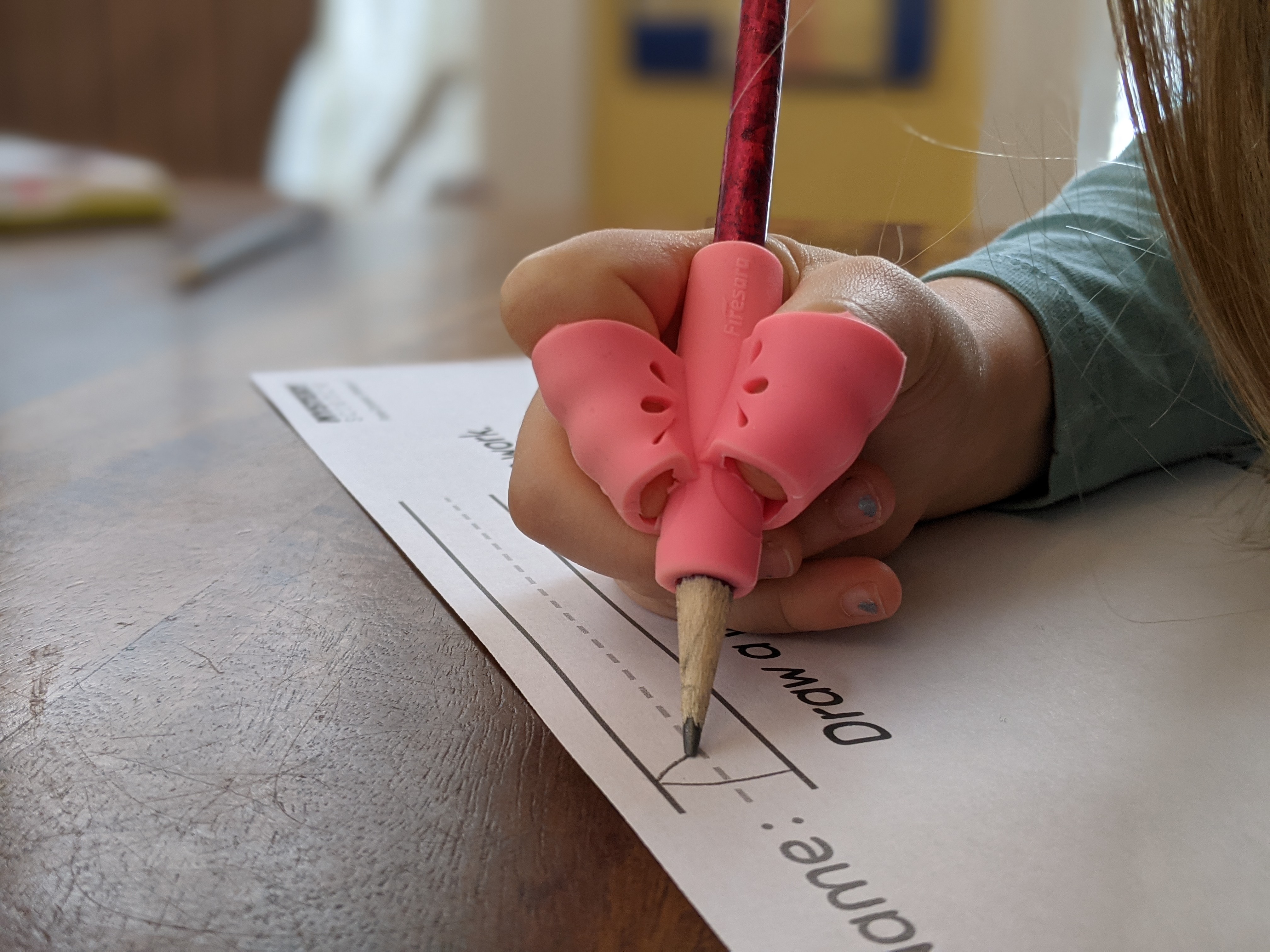
Writing Grip: Kids go from a fisted writing utensil grasp as preschoolers, to a three- or four-finger modified grasp, and eventually to the "correct" tripod grasp. But some develop unique, not-quite-correct grasp habits along the way. I don't think the way they hold a pen is something to stress them or yourself about early on. But it is something to keep an eye on and work on when you think they are ready and before they solidify bad habits that are less comfortable or less efficient. There are lots of occupational therapy web sites out there that describe and depict ways of holding one's pencil and why it matters, and there are also lots of different types of grip tools you can buy, depending on what they need, to help kids learn to hold a pencil the right way (based on the photo below, it seems we have procured most of them in this house). M seemed to be solidly settling into a three-finger pencil grasp (as she shows in most of these pictures), so we've been using a butterfly attachment to her writing tools lately and it seems to work well for her.


Handwriting: Backwards letters are normal, especially in kindergarten. But keep reinforcing the right way to make those b's, d's, p's, and other letters. There are plenty of tricks out there to help them check and remember which way the letters go and they will remember sooner or later.

Word Spacing: As mentioned previously, young writers need to learn to leave spaces between words. It's another thing to explicitly teach, and a concrete way that their writing will seem vastly improved once they start doing it. Some things can speed up the process, like giving or letting students make a fun gizmo that they can be taught to place after every word as they write to create that space; for some kids just teaching them to put a finger after each word is enough. (I gave M a jumbo popsicle stick to decorate for this purpose.) You can also model how challenging it is to read a sentencewrittenwithoutspaces compared to the same one written with spaces to help them become aware of this goal and why it matters. (When it comes to editing a story already written, I wouldn't want a kid to have to rewrite a whole page, so I teach them to put a long vertical line between words where a space should have been.)

Choice: Let them choose their topics to write about. This is time for them to learn to write, to see themselves as a writer, not a time to complete an assignment or fill in the blank. Sure, you as the adult might announce that they will work on writing persuasive letters, but you don't have to decide the topic for them or the recipient. When it comes time to start a new piece, help them brainstorm, and make the practice of drumming up ideas one of the writing habits you are teaching.
Respect their Age: They can sit, they can stand, they can use a clipboard or a table or a desk (and sometimes they'll do all of these within one session). Keep your lessons and talking brief and to the point and go with their signals for how long the actual time they spend writing should be. Work on building their stamina over time. But as with everything, a kindergartner won't realistically spend the amount of time on task that a fifth grader should. I will share some of my tips for writing time with older kids in a later post.
Paper: I've read that paper options you provide convey expectations. You want to offer paper that is appropriate for the stage they are at. You don't want to limit them nor overwhelm them. We started the year with M creating her written pieces on a single sheet of blank copy paper. Then she made little booklets on half sheets, with labeled pictures on each page. We progressed to paper with one line on it for text, then two (I found various printable paper options online), and now we are using paper with four or five lines on it-- but always with a picture space too! Sometimes I staple three or four sheets together as a story/book but she often ends up removing or adding a page depending on what she's creating.
Growth over Time: Just for fun, I am sharing below a little timeline of my daughter's writing samples this year. Every child is different and will need different paper, and different teaching, at different times. You won't always notice growth from one piece to the next, but when you look at their writing over time, you will.
 |
| August: [Teaching about how to make pancakes] Flour. Eggs and butter. Sugar. End I think. |
 |
| September: [Teaching about birthdays] Party hat. Daddy. Face balloon. Candles. Birthday cake. Birthday celebrating. |
 |
| September: [Teaching book about hiking] If you keep walking then you get stronger. |
 |
| October: [Personal story] I lost my balance. I went swing, swing, swing, but I held on tight. |
 |
| November: [Personal story] We went on the biggest bike ride for me. It was really rainy on the trail. |
 |
| December: [How-to book about bundling up in winter time] 2. Put your jacket on and zip the zipper. |
 |
| January: [How-to book about making a snowman] 2. Roll the first snow ball until it gets very very big. |