September 29, 2020

Finding our New Groove for Year Two: Homeschool Curriculum


We are entering our second year of homeschool and we've all settled in more. In my last post I wrote about our revamped schedule for year two as well as changing the space we use in our house. 

In this post I wanted to share my two cents on curricula. We've made some changes from last year, adding some new subjects and deciding to forgo packaged curriculum in certain areas. Here are my thoughts on the homeschool curricula I bought or planned for each of my children (a kindergartner and a fifth grader) this year.  

Homeschool Curriculum We're Using

Math
I am using Primary Mathematics from Singapore Math with my son this year for the second year because it worked for us last year! It feels like serious, down-to-business math. There are no bells and whistles, and it is cheap. The teacher's guide is written for homeschool (it is called a home instructor's guide). The materials you occasionally need are usually things you already have in the house. It jumps right into concepts, and aims high, which is good because my son catches on pretty quickly in math. The activity suggestions move from concrete (working with actual blocks when introducing volume, for example), to pictorial representations of the same, to abstract (solving equations or word problems).  

Kindergarten: Dimensions Math
We wanted to stick with Singapore Math for my kindergartner, but found that Primary Mathematics doesn't start until the first-grade level, so we tried Dimensions, which is another line from the same company. Dimensions is in full color, with more bells and whistles. There are a good number of materials (game boards and cards and such) that can be downloaded and printed. One thing to note is that Dimensions (unlike Primary Mathematics) is written for use in a classroom. It goes at a slower pace so as to encompass a wide range of abilities. There are many activity suggestions within a lesson to get at the same concept; we don't do them all unless M needs a lot of extra practice on a concept. Most of the games are written for a small group but we can adapt them to play at home, and she loves them. There are so many developmentally appropriate, play-based, hands-on activities. We've used paintbrushes and water and chalk and play dough and flour to practice forming numbers. We've played hopscotch and card games and sorted objects around the house. It is very interactive and dependent on an adult's involvement the entire time (this may be kindergarten-specific, but I'm not sure). There are a couple kindergarten workbook pages each lesson, but they only take about two minutes. The many active components are the bulk of the lesson.  


Reading 
I didn't buy any curriculum for reading. 

Last year I purchased an expensive program that I knew well from my classroom teaching days, that I really believe in. Research on good teaching and on how kids get to be better readers was embedded. The philosophy of all the lessons was excellent. W learned so much and we had some wonderful experiences with it. But it was a bit intense. Too intense to read through and plan for every day, too intense for my son to take it all in some days. It added some unnecessary stress for us both, which was silly because reading was already a major strength of his. Plus, this year, the thought of buying something that expensive, times two kids (plus a similar cost for the same authors' writing programs, times two kids again) was overwhelming. So I did a lot of online research for ideas of what to teach, dug out my guides to best practices for teaching reading, and sketched out my own plans for the year. 

For my 5th grader, I have a plan of several genres we'll spend time reading for a month or two at a time and discussing. (I don't choose specific titles for him, but rather check out a bunch of books within a genre and let him select from those based on interest). He's reading fiction right now and I'm managing to not kill the joy in that with too much teaching, so my plan has been a success so far! I try to spend a few minutes each day before he goes off to read modeling a strategy or tip for being a good reader of fiction. This is usually a thinking/analyzing strategy because that's the part about reading that he doesn't do on his own naturally. I encourage him to jot for about three minutes of his reading time a day in a reading notebook-- about theme or character traits or the author's style, etc. I'm looking forward to helping him delve into fantasy and mythology and reading about particular topics in history and more at other points in the year. 

And with my daughter, who is just beginning to grasp the bits and pieces of what it is to read, reading time is a whole other, exciting story. I didn't purchase curriculum for her either. I hope to share more about this soon.  

Writing 
We're forging ahead on our own without packaged curriculum in this area as well. Same explanation and decision as above, but in writing. I'll share more about our work in writing soon!


Foreign Language
5th only (for now): Rosetta Stone online homeschool subscription 
We decided to experiment with my oldest learning a foreign language this year. When we asked W what language he would be interested in, he said immediately, as I had predicted he might, "Could I do Greek?" Mostly born from his love of the Percy Jackson series, he has learned a lot about Greek mythology so he was intrigued. The pros and cons of different languages were discussed. After he realized that Greek uses a different alphabet, he at first backtracked and thought more about something seemingly easier like Spanish or French. We encouraged him to choose what he was most excited about. Who knows if he will stick with or get real use out of any language he learns. (I don't "use" my six years plus two college semesters of Spanish. But I'm glad I learned it. It helps me have a better sense of the world. And it would come back to me and help me if I moved somewhere with a lot of Spanish speakers.) So we decided to treat a language for now just like any other interest: it's great to see how curious he is about this one right now, and see where that leads. 

As far as program, there were a lot of choices and we chose Rosetta Stone mostly because of name recognition. (There were also back-to-school promotions so I was able to get it for a lot less than it is currently offered for a 12-month subscription.) W has been logging in and using the program a few times a week. It jumps right in, teaching vocabulary and short phrases, and it focuses on listening and speaking right away and primarily. W loves to speak and see if he gets full credit for echoing the pronunciations. He has learned that if he rolls his Rs, he gets higher points. There are also reading and writing components that have recently started (a Greek keyboard comes up on the screen and he clicks the appropriate keys to spell a word). He loves it and feels so pleased with himself for knowing bits and pieces of something so foreign. But every so often, there will be a day where he feels really confused. While Rosetta Stone is billed as something homeschoolers can do independently, and it is, sometimes it really helps if I sit with him and we work through it together for a bit. It introduces things through pictures and listening and speaking. It never provides the English translation. So it's a whole new way to learn. Sometimes he has to really be a detective and it takes a while to figure things out, taking notes to eliminate possibilities of what a word that keeps appearing might mean (often it's not what he first guesses it to mean). 

M is intrigued and likes to watch and is picking up on bits and pieces, so she may yet join in the foreign language adventure this year-- we'll see. Important note, though: we can only have one account on each online subscription, so would need to pay for another entire subscription for a second child to use the program. Also of note: the Rosetta Stone program does not seem to teach the names of letters of the Greek alphabet, so we researched that and learned it ourselves by listening to a YouTube video a bunch of times.  


Grammar
5th only: Easy Grammar
This program has worked well for us since last spring. We do a lesson a few times a week, with an accompanying workbook page for practice. The teacher's guide is the only thing I purchased, as it includes the student pages and is reproducible. The parts of speech and sentence structure were foreign to W, and quite frustrating at first, but he is catching on and loves to impress/stump his dad now by giving him sentences to mark. This program starts with identifying prepositions and prepositional phrases, so once students learn how to do that, it makes identifying the subject(s) of the sentence much easier. This program does not teach diagramming sentences on branches the way I vaguely remember being taught in sixth grade. I thought about trying to teach diagramming the old-fashioned way, but decided that it wasn't the diagramming that was important but rather meaning-- understanding the functions of different parts of a sentence. This program teaches this in a simple, bare bones way.    

Spelling/Word Study
5th only: Words their Way
I am a big fan of Words their Way because it is a small, concrete way to easily personalize for your child and give them exactly the challenge they need. I wrote a post last year with more details on how this program works. This overview book contains spelling inventories and directions on administering them to help you find what level your child is at in his spelling (what types of features in words they are on the cusp of understanding). Once you know the developmental stage they are at (which is not a grade level), there are multiple books available full of curated word lists for the various stages to be used as spelling/vocabulary words for the week. All the words in a list contain a similar feature (such as long a sound) and students have to learn the generalization, or rule, to remember which ones are spelled in which way and why. Kids aren't simply memorizing words, but learning about word meanings, spelling rules, and exceptions to the rules. We work with one of these word lists each week, studying, defining, and doing some activities with the words, and a spelling test at the end of the week. 

Phonics
Kindergarten only: Guidance from Wilson Language approach and Fundations program
The basic idea of the Wilson Language approach is systematic, consistent teaching of the way the English language works. There is an order in which it makes sense to teach letter sounds and later other spelling rules. I had used the Fundations program in my first-grade classroom. For this year I bought the Kindergarten Fundations teacher's guide and a few individual materials I thought were important. I got a poster of Fundations key words for each letter of the alphabet (a, apple, /a/; b, bat, /b/, and so on) and I am glad I did because M is fascinated by it and utilizes it constantly. I also bought a pocket chart in which we can move word cards around to form sentences, and letter cards around to form words. My mother-in-law passed on to me a set of letter cards she had in her attic. I bought a dry-erase board with special lines to help M learn how to form her letters. I made a file-folder and sticky-note version of a magnetic letter board (see picture below). And I already had a supply of dry-erase markers. We add more letters to M's repertoire each week. It's amazing how empowering this is to her and how much she likes to show off her latest letter-sound skills. The program focuses on all the lower-case letters first, because those are what we use most of the time. I like Fundations, but as it turns out, I could have gone without the teacher's guide; my one kid at home is going at a quicker pace than a class of kindergartners would and we often do more than one day's lesson in a session. I probably could have forged my own way with just my pocket chart and white board and by following a general scope and sequence for language learning and we would have been okay. 


Cursive
5th grade only: Can-Do Cursive book from Handwriting Without Tears 
W knows how to write in cursive, but handwriting has always been an area he needs reminders in. This book is just review of the finer points, and he does a practice page a couple times a week. 

Keyboarding
5th grade only: TypingClub 
I wrote recently about our experience with TypingClub as a way to learn how to type efficiently and keyboarding skills in general. We're still using it a few times a week for 15 minutes or so each time and his WPM is increasing! It is online, free, and students can use it mostly independently.  

Science
5th grade: Mystery Science
Kindergarten: Mystery Science 
I am so impressed with Mystery Science. A year-long homeschool subscription is inexpensive; it includes every child in a household, so we don't pay more to utilize both the kindergarten and grade five lessons. They are online-based science lessons, but I think that can give the wrong impression until you've actually done a "mystery" (as each lesson is called) with kids. These are by no means videos to watch passively, though they do include brief video. There are great introductions to topics that hook my kids every time. The videos pose questions and contain lots of stop-and-think moments. They contain well-chosen, appropriate, short footage of animal behavior, or volcanoes, or whatever the topic is being studied. They align with the Next Generation Science Standards. And almost every lesson centers on active, hands-on activities. Science class was never my favorite subject when I was in school, so I love having this company to make science feel fun and accessible. Last week we set up a fifth-grade experiment to test how well mold grows in different conditions (the kids came up with the variables they wanted to test). Tonight my daughter reenacted the defensive animal behaviors she had observed today-- a scared praying mantis is something to see. The lessons are written for classrooms (and I know a lot of classrooms that use them) but they include specific instructions for using them in a homeschool setting as well (very little modification needed). Usually household supplies and the online printables are all the materials you need but occasionally you need to buy something special ahead of time like the red worms we are currently housing for a various observations and experiments this week (eww).  


We currently have pet worms!

Social Studies
I didn't buy any curriculum for social studies because we are making use of free curriculum online-- some school districts put their entire curricula online, so if there is a school you think is doing things well, it's worth checking to see if they have done this. There is a school in Missouri that has an incredible amount of information online. I have found that their social studies units and lessons align with topics we wanted to study this year and seem really well thought-out. These include activity ideas and clickable links to great relevant web sites. I have downloaded these and use them as a guide for social studies. (I feel a little like I am stealing, but these are free and available to the public online...) 

We also may use, as we did last year, some of the Core Knowledge (also free, also downloadable) units as backup or if we end up with extra time this year. These are highly traditional-- essentially mini textbooks for students and discussion ideas for the teacher-- but we certainly gleaned lots of knowledge from them on a few particular topics last year. We also always check out a lot of library books to go with the topics we are studying in social studies.  

Art
For art we do various projects together and try to keep it fun and encouraging. I find ideas everywhere. Last week we made color wheels-- a younger-kid version with primary and secondary colors, and a bigger-kid version that included intermediate colors as well. Here and here are some things we did last year. 


Trying to imitate their llamas' facial expressions

Music
For music, in the past we've checked out venues in person or online, listened to and learned about types of music and specific well-known pieces of music as well as some musicians and musicals. Music comes a little less naturally to me than art, but as with art, I just find ideas everywhere without a master plan for the year (here's a great web site and podcast we just discovered). Each of my kids is taking lessons in and practicing an instrument daily, so I feel that lets me off the hook a little. Here are some things we did and resources we used last year. 


P.E. 
We aren't doing anything formal (though, like everything else, there are homeschool P.E. curricula for sale online). We get outside daily for a good chunk of time late morning as well as after school. We go on lots of family hikes and bike rides on the weekends, as well as the occasional school-day hike; come winter there will be skiing and skating. Last year my son did P.E. at the public school twice a week, but as our local school isn't even open yet this year, we are holding off on that. But my kids are both able to participate in a masked, game-free, shortened soccer season this fall. I have plenty of web sites earmarked that a quick search of homeschool P.E. ideas yielded in case we need a boost of activity, but haven't needed to tap them yet. 


September 22, 2020

Finding our New Groove for Year Two: Homeschool Schedule and Space


One thing I've always loved about teaching is that you get a fresh start at the beginning of every year. As I begin our second year of homeschool this year, I feel that same sense of renewal. 

We had a great first year of homeschool last year, but we're in a pretty different place as we start year two. For one, it doesn't feel as surreal to be spending each day with my own children-- though I'll never take that for granted. 

Also, last year my son struggled with several things: in the very beginning he had a rough time with the idea of not being in school with his peers. Last year was one of the first times he was asked to do challenging work that required real effort, and we unfortunately debated a bit about that, but we also worked hard to find strategies to help him focus better. Now that this is more of a way of life for us and he's past the difficulty of the transition, he frequently talks about the perks of homeschooling and how much he likes it. W's not surprised or irritated by the work I ask him to do. He's become so much more confident and responsible and self-driven, and he's proud of that. The good start we've had to year two is in no small part because he has fully adjusted to homeschool. 

Then there's me. Coming from years in a school system and my own education there, it took me a long time to fully realize that at home we often could and should do things differently.  

And the biggest change of all: last year I was homeschooling just one fourth grader; this year both my kids (a kindergartner and now-fifth grader) are home. I am finding myself thankful that I was able to start with one kid and then transition to homeschooling both my kids, especially with their disparate ages. My five-year-old is so excited to "do kindergarten" every day. Just this weekend she worked out a word on a hiking trail sign and then exclaimed, "See, I knew I could do it! I'm doin' kindergarten!!" as she punched the air and marched off ahead of us down the trail. Her spunky energy for learning and growing is contagious, and we're all delighted by the big-kid skills she is soaking up at lightning speed recently, from shoe tying to bike riding to spelling words phonetically.

This year we aren't doing everything differently from last year, but we've made some changes. I've chosen some new curricula (and opted out of buying curriculum in some cases), changed the space in our house that we use, and breathed new air into the routine we follow each day. I'm loving the new groove we are finding together this year and thought I'd share about it.


Schedule

It seems there are as many ways of scheduling the day as there are homeschool families; it all depends on your philosophy. A few weeks ago, I listed some of my own current guiding principles for making a schedule. We went through several revisions of our daily routine last year simply due to changes that came up. Over the summer, I put a ton of thought into what our new schedule would be. One of my big questions had been, how do I teach two kids, at very different ages, while giving them both the attention they need, and without me going crazy? Staggered lesson times has been the answer (see below for details). 

I've been asking the kids their input regularly on what they like about school so far and what they wish was different. I want us all to feel good about the day. I try to convey to them something I learned last year-- we can always change the routine, so they can always tell me if they have ideas of better ways to do things.  

When I made the schedule, I sketched in time frames for everything just to make sure it was feasible (for example, "8:30 - 9:15 math"). Then I removed those exact times before I printed it. My oldest, especially, really likes to know what to expect for the day and looks at it regularly. I didn't want him, or me, being too driven by being "on time" or "behind" or "ahead." I wanted us to keep our priorities straight by focusing instead on learning, finding good stopping points, and completing quality work. It is working. Sometimes we've decided something is just too much/too long and we'll put it on the agenda for the next day, but for the most part, math or anything else is done when it's done each day, and then we move on to the next thing. Our schedule is more about the order and flow of things, and less about where you can find us at any given time. Below is my current "master" version with both kids on it. (I hung on the wall one copy with only W's columns on it and one copy with only M's columns on it, so they each have an individual version they can look at which is a little less busy.) 

Notes: W's columns are color-coded by subject, but M's aren't. I wanted to see when each subject was during the week but didn't have enough colors to do this distinctly for two kids so her columns are unhighlighted just to help them stand apart. Also: we have done other stuff and will do lots more stuff that isn't on this schedule this year-- hikes, field trips, appointments. We aren't locked into this, but it gives us a framework that we follow for the "normal" days. 


What I love about our schedule so far: 
  • Morning gathering time together after breakfast. I got the idea of homeschool "morning time" from homeschool blogs all over the internet, and adapted it for us. The big idea is that this is time for all of us to do shared things together to start the day. It sets the tone for the day. It's easy and accessible for everybody. We've studied some artwork during this time (they are loving spotting the details in the book Can You Find It?). I've read aloud some picture books and portions of nonfiction books (we love The Outside Story which gives a week-by-week poetic synopsis of notable plant and animal happenings outdoors in our part of the world). We've practiced memorizing things that are just important to know or relevant to something we are studying (the first thing we worked on was the months of the year because somehow, my 5th grader was not yet solid on the order of the "-ber" months, and followed that up with learning the "30 days hath September..." poem). I use it as a time to fit in anything I am not getting to otherwise-- a news story I've saved to share with them, a picture or video shared by a friend, a necessary conversation or finishing touch on a project. Start of the day is a nice time for odds and ends and general enrichment. 
  • The bulk of our day is in the morning. We're all most alert in the morning. It feels good to take care of the core subjects-- reading, writing, math-- as well as several other smaller things by lunchtime. 
  • We don't even attempt to do everything every day. Core subjects are four times a week, other things are three or less. I prefer quality over quantity, finishing over being rushed.
  • Staggered learning blocks. Of course, there are parts of the day we do together, like art projects. But for the core subjects my 5- and 10-year-old need different things. So in general, during each core chunk of time, I start off working with my oldest first, spending about ten minutes with him, while my youngest plays. She understands she's not supposed to interrupt during the brief time I am focused on her brother. When I'm done working with him, he goes off to write or do math practice or whatever the work consists of independently (usually into the next room). Then I call M over and work with her for most of the rest of that chunk of work time (which might consist of reading with her, or playing math games, or working on letters and sounds). As a kindergartner she can not work independently for long, and the learning activities she needs to do are mostly interactive and dependent on my presence. When I have a moment, I go check on W briefly and answer any questions he has. She has more playtime during the day this way, which feels right. I get one on one time with both of them this way. Lessons are to the point with my oldest this way and can't drag on and on, which is great for both of us. The overall time my fifth grader is spending on any one subject is greater than my kindergartner, which also feels right. (This might not feel so perfect if my kids were closer in age, but it works for us right now!) 
  • Outside time before lunch every day. We all need fresh air and exercise and I've been making sure we drop all work, whether it's done or not, by a certain point late morning and get outside for a good chunk of time. I hope to keep doing this no matter how cold or wet it may be some days. We plan bigger hikes and big excursions other times, but this is a time to run around, visit the brook, go for a walk, or play a game outside, and it benefits us all. 
  • A nice long lunch time (~an hour) that is realistic and unhurried. This is especially good because several days a week, my husband works from home and lunchtime is a time they love to catch up with him, show him recent accomplishments, or just spend time with him.
  • Brief yoga (or meditation or mindfulness) exercises after lunch to settle and refocus for the last part of the day. We like Mind Yeti (you can access some of their activities for free on their web site as well as their YouTube channel), and sometimes Cosmic Yoga (for yoga or mindfulness), or we just do some poses or activities that we all know. We usually spend no more than five minutes on this, but it's nice that it's becoming a habit. Even if W might grumble about doing it sometimes, he settles in once we start and I feel like it is doing him good to grow a repertoire of these sorts of strategies. Just the other day he told me he had used a breathing activity we had done to help him go to sleep at night. 
  • Our afternoons are slower with more time to dive into things. We do just science OR social studies and then something else-- music, art, or project time (see below). I am enjoying trying a routine where every day all of one week we do science, then every day the next week we do social studies, and so on. It's the same amount of total time I would have scheduled for those subjects anyway, but it's been nice to keep up momentum on one topic all week rather than alternate days as I've done in the past. And it's nice for my planning purposes to not have to switch gears all the time to be ready for one then the other. 
  • Project time! I will post more about this separately, because we are all loving it. Three days a week, the last hour of the school day is devoted to pursuing the kids' own choice of projects and topics. We've been doing some exciting stuff during this time that I can't wait to share about. I also love that project time is the last chunk of the day, because if they are really into it they can keep doing what they are doing as long as they want to, which has happened several times. 


Space 


Last year we had a devoted homeschool space. It was a small spare room upstairs that we didn't use for much other than storage. It worked for us pretty well last year. But, my husband now works from that room several days a week. Also, I couldn't see staying in one room most of the day with two kids, or having them on different floors doing different things while I ran back and forth. 

So we moved out of that space and into the part of our home where we live the most. We have the materials all stored in a central cabinet. Each kid has a cubby that is specifically all of their stuff-- their own best pencils, their own workbooks and writing folder. I have supplies for general use in another  couple of cubbies, and my teaching materials in the top cubbies. Things we use less often or that I want to have more control over (like glitter and the glue gun) and in drawers below out of sight. 

The dining room table is our home base where most of the actual lessons happen. (Our big table comes in handy because a few school things that are in progress can be left out and we still have the other end to eat at.) But the work happens wherever it makes sense-- the table, the floor, the couch, or even outside a few times so far in good weather. We're finding that certain work in certain locations works best, but I like including the kids in those choices and working that out naturally. 

Recently my son described how he loves to do math pages sitting on the couch next to our dog: "...When there's a problem that frustrates me, I just pet him and that calms me down and then I can figure it out." He summarized by saying, "I just love how homeschool is like, so loose, but I feel like I'm learning so much." 

That's become my homeschool motto that I want to live by all year: keep it loose while making sure they are learning a lot.  


In the next post, I'll share about the curricula we are using this year and why we chose what we chose...

August 24, 2020

Keyboarding with TypingClub


When I set out to plan my first year of homeschool last year with a fourth grader, I didn't feel clueless about what had to be taught or learned. I had a sense for the upper grades and was on top of reading, writing, math, and even science and social studies and spelling. But something that was not so much on my radar was the need to learn keyboarding skills...

When W drafted an essay or a story or other piece of writing, I had him write with pen on paper, because I felt it was important to work on his handwriting and his stamina for the physical aspects of writing. But from time to time he would "type up" a finished, polished piece of writing, and it would take forever. I would have him work on it for fifteen- or twenty-minute chunks of time here and there and it felt like it took weeks to get an essay, not to mention something longer, typed. At one point I informally calculated his typing rate and found he was typing somewhere between one and two words per minute (WPM). Yikes. So then I tried to make a little more of a point of finding times for him to type, and I complimented him when it seemed his rate was getting fractionally better. He said he'd been taught about the "home row" in school, so I thought just reminding him of this fundamental principle of efficient typing would be enough. (When I was not much older than he is, my grandmother, one of the first people I knew to own a computer, sat me down one day and told me about keeping my fingers on "A-S-D-F" and "Semi-L-K-J." Because I was so excited about being able to use her computer for any reason, that tip alone was the only keyboarding instruction I needed; I latched onto it and became pretty efficient pretty quickly.) But this single tip for typing was not helping W as much as I remembered it helping me. He wasn't truly basing his fingers anywhere in particular when he typed and he wasn't getting much quicker or developing the right habits simply by typing things more often. It was finally in the spring of his fourth-grade year that I realized that he needed more and I looked into an actual program that could explicitly teach him and give practice in the skills and habits he needed. We found TypingClub, an online program, and have been really happy with it ever since.

I didn't do extensive research, but I found that a lot of teachers online recommended TypingClub and when I did some quick comparisons with other programs, the fact that it was free helped tip the scales in its favor. (I figure we can always try a free service and decide we need more, rather than the other way around.) It truly was free (not just a limited free version that makes you compelled to buy the full version almost immediately). We clicked that we were a homeschool (but maybe it is free for classrooms as well up to a certain number of students) and gave a few bits of info and we had an account. W uses it several times a week for fifteen minutes or so at a time, and his typing has improved a lot-- as well as his attitude and confidence in regard to typing.


When he logs in each time, the home screen shows time spent in typing practice last week, this week, and today. It also shows current average speed, as well as last week's and last month's average speed, in WPM. He chooses any of the levels he's worked his way up to so far (there are more than 100 he can choose from at this point, focusing on specific keys or the whole keyboard). It tells him his speed and accuracy in real time as he types, but those settings can be turned off if distracting. It offers a few different modes for support-- for a while he had a picture of the keyboard toward the bottom of the screen and it lit up the location of each letter as he was to type it (even though even then he wasn't supposed to look at the actual keyboard). After a while, we switched the level of support so now it only shows two hands and lights up the finger that should type each letter, but doesn't show a keyboard or where the key is. Every once in a while a session is interspersed with a one-minute video discussing the importance of posture or looking away from the screen to give your eyes a rest. As he finishes any exercise he chooses, he gets an immediate score and a rating out of five stars (it's kind of like a video game in that way and is very motivating). He likes to try to earn five stars on a level where he had previously only earned three or four, and enjoys revisiting earlier levels when he needs an ego boost.

There are some ads sometimes on the side of the screen (naturally, they are for whatever it is we've been looking to buy recently, so W had a chance to learn the big brother aspect of online research).


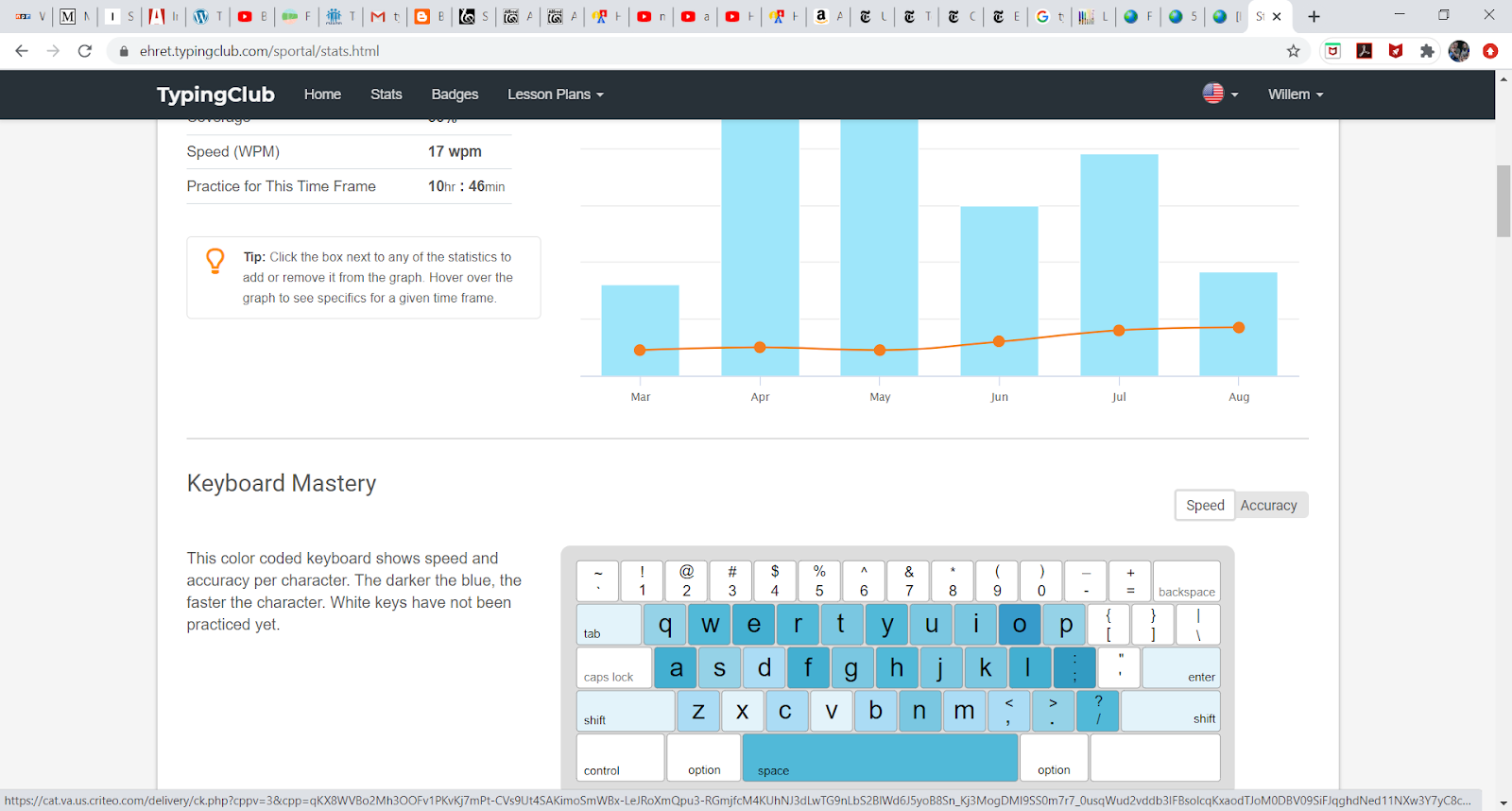
Beyond the screens he sees, if I want to, I can click "Stats" and see a surplus of statistics (more than I really need but it's nice to look at from time to time):
  • How well he has mastered individual keys 
  • How long he's practiced on which exact dates 
  • A graph of progress overview 
  • How fast and accurate each individual finger is 
  • Which character he's fastest (f), slowest (b), most accurate (f), and least accurate (w) at
From time to time, this stats page actually provides a great, concrete opportunity to sit and analyze his learning with him. He likes to pore over it and see the charts of his progress.

One thing the TypingClub lessons say repeatedly to the student is that the one rule is to not look at the keyboard. And yet. It's so hard not to when you are learning. Especially when you've made a mistake and want to be sure to find the correct key. Telling him not to look wasn't enough, so I used a trick I remembered learning in my student-teaching days-- a section of a cardboard box to cover the keyboard but allow student hands to fit beneath it. It feels a little mean, but this way they physically can't see the keyboard until they learn the habit of really not depending on looking. We transformed an old Kiwi Crate box for this purpose, adding fins on each side to raise the level of it off of the keyboard and it has worked great.


We've gotten well beyond the hunt-and-peck stage and I'm thankful for that; he's up to about a 20 WPM average these days. I think we'll keep up some regular keyboarding practice this year-- it certainly doesn't require a lot of dedication of time and I'd like him to get a little more efficient as a fifth grader (I've heard a rule of thumb of a goal of 5 WPM x grade level in school so that's the guideline we're using for now). Being able to type for real makes him feel grown up and he treats it almost like it's a party trick-- "Look, Dad, watch me type without looking!" I am optimistic that this year typing can become a helpful tool in his arsenal rather than a source of frustration.

August 17, 2020

Read Aloud and the Case for Picture Books


A lot of homeschoolers talk about family read aloud: gathering all the kids together-- from toddlers to teenagers-- and sharing great literature. This sounds lovely and I'd become curious about those perfect texts that would engage multiple ages at once.

We have always read to our kids a lot, and at bedtime, religiously. But we've mostly read to them separately, not together. I've got a kindergartner and a fifth grader, so they're at pretty different stages. (My 10-year-old reads to himself plenty all the time, but we still read aloud to him at bedtime-- I'll take it for as long as I can!) There are so many amazing books out there for big kids and it's always fun to choose what he and I will read together next. Currently my husband is reading a book from the 39 Clues series to W, while W and I have just begun The Phantom Tollbooth. While he listens, W likes to draw or color or, most often lately, work on pictures in one of his several Extreme Dot-to-Dot books. When I read to my five-year old daughter, on the other hand, we read High Five or Ladybug magazine or one of the seven hundred picture books we own. M is completely absorbed by the pictures and she sits in my lap or curls up next to me, scrutinizing every page and interjecting with questions.

But having both my kids home for the final months of this past school year helped me realize how valuable it is to find shared learning experiences for them-- things they can both access even with their age difference, even if they get different things out of them. I thought I'd try to make reading together a bit of a routine this summer and make an effort to find great read alouds we could all share. I tried reading a few classic novels aimed at a young audience to both my kids together. Here are a few thoughts on each of the ones we tried.

~ ~ ~

The Velveteen Rabbit, Margery Williams: Written in the 1920s, it's a magical story with a nice message. I think it's nice to read kids some books like this one that are written long ago. It helps give them get a taste for what childhood might have been like before their grandparents were born, and helps them take in language they aren't familiar with. Even with words like "brigands," this one is a story about a stuffed animal after all.

Winnie the Pooh, A.A. Milne: Some sweet humor that you have to be a bigger kid to understand and we found ourselves explaining to M some of the jokes that entire chapters were based on (like the spotted and herbaceous "Backson" that lives in the animals' imaginations after Christopher Robin leaves a note intending to say that he'll be "back soon"). But it is still an extra-lovable story. Some of the situations those friends get themselves into are so funny. The games they play, feelings they have, and "expotitions" they go on are beautifully child-like and relatable.

Mrs. Piggle-Wiggle, Betty MacDonald: This was probably the biggest mutual hit with my kids. It was concrete (and formulaic) enough for my youngest but clever and funny enough for my oldest.

Alice's Adventures in Wonderland, Lewis Carroll: I have to admit we haven't yet finished this strange book. I'd never read it myself, though at many parts I can clearly visualize the Disney movie that I did see as a kid. Some of the strangeness is a hoot (following a rabbit down a hole one day out of boredom), and some is just strange and a little harder to follow.

A Bear Called Paddington, Michael Bond: My son loved Paddington (though he's also seen the very-good movie and it was a rare case where he liked the movie more) but my daughter got bored by the end. Sweet story about a London family taking in a bear who is always sticky with marmalade and gets into various innocent scrapes.

Pippi Longstocking, Astrid Lindgren: The sheer ridiculousness of it is fascinating. Here's a kid who lives on her own, plays with guns, doesn't go to school at all (not even remote or hybrid or homeschool!), who wins over burglars just by being herself, and is never afraid. But Pippi is so bold and fun. Maybe in some ways she embodies the inner wishes of kids-- rolling out cookie dough on the floor and living with a monkey and a pony and not having a bedtime. I'm glad we read it. While reading it, W was often making connections to some other favorite female protagonists I'm glad to say he's known and loved-- Anne (of Green Gables), Ramona, and Junie B.

Homer Price, Robert McCloskey: Like all Robert McCloskey books, it feels so very old-fashioned. W liked it. Each chapter is its own little story, entertaining and less than believable, with situations involving burglars and a pet skunk, a kid left in charge of a restaurant on his own, and prize-winning balls of yarn. There's a picture on every other page. M seems to like it and mostly follow along, but doesn't love it.

~ ~ ~

The only "chapter" books I'd read to M before this summer were things like Frog and Toad, Henry and Mudge, and Mr. Putter and Tabby-- all of which she loves-- but each chapter is its own little story with the same characters and themes over and over, and the whole book can be read in one sitting.

W is always hooked by the novelty of any new story, and likes a good book, no matter what reading level it is. While he consumes big thick books like Rick Riordan's Percy Jackson and the Olympians series, he will also laugh out loud over The Berenstain Bears if one is left lying around. I knew he would enjoy almost anything.

Aside from Winnie-the-Pooh, the longer books we read together this summer were new for all of us. W and I loved them all-- turns out there's a reason they are classics. M liked...some of them. There were certain bizarre details she tuned into in Pippi Longstocking (she demonstrates to us at bedtime many evenings now how Pippi sleeps with her feet on the pillow and her head under the covers). And I think she was engaged for a lot of Winnie-the-Pooh and Mrs. Piggle-Wiggle. But I found I needed to stop often to try to keep M on the same page in the longer, picture-less books (some we listened to as audio books so they may have had pictures but we didn't see them). Sometimes she asked questions, or I would tell her what words meant, or have W share a simple inference when she didn't get what was happening, or we'd explain to her what was so funny when we laughed. I was reminded that, at five, M needs a story that's fairly concrete, especially when she has to visualize it all herself. When she looked bored or wasn't able to answer a basic story question if I asked her one, I thought, what exactly am I gaining here by sharing this "classic" with her at this stage? There were certainly things she got out of some of them. But there were enough things she missed that she didn't fully absorb the magic of these great stories. I remain convinced that it is a small, special niche of novels that really, truly work for the under-six set. (Other five-year-olds may have loved these stories or even more sophisticated ones; every kid is different.) A few months or a year from now M will be at a different stage and the types of books she loves will grow and change. But there's no rush.

Summer outdoor bedtime read aloud with W


All this has renewed my love and belief in quality picture books for all ages.

As a first-grade teacher I would sometimes have parent-teacher conferences in which a parent would worry about the skills of their blossoming child, saying they thought he was using the pictures in books to guess what the words said. Some of these parents would even say they covered up the picture to make their child focus on the words! But there is a reason pictures are in books for young kids: pictures support the text and help with comprehension and word solving (it's a great sign if a beginning reader is using every bit of information on the page and multiple strategies to figure out an unfamiliar word, including looking at the pictures). Pictures also help engage them and get them hooked on books in general, pictures supply detail and richness to the experience and the conversations you can have, and sometimes pictures even (often comically, intentionally) say more, or say something different than, the text. (Think of Mercer Mayer's Little Critter books and how funny they are specifically because of this contradiction between text and illustration.) Pictures in picture books are a big part of the art form, and of the experience of coming to know and love books for young kids. When I was in the classroom I only chose to read one or two novels to my students in a year because there were just so many good picture books I wanted to share and so little time.

I also believe in continuing to read picture books to upper-elementary age kids. Firstly, plenty of older kids still need the support of pictures for reading itself or to aid comprehension. Also, picture books are a nice little package that you can read in one sitting; you can quickly accumulate many stories-- each with its own plot, setting, themes, character traits, conflict, resolution, writer's style-- that are not only pleasant shared experiences, but provide lots of opportunities to discuss, analyze, and compare. (I love the simple concept of reading a Book a Day for older-- even high-school-age-- students for these very reasons.) Beyond those benefits that any good picture book has for bigger kids, some picture books are specifically aimed at kids in 4th, 5th, 6th grade and beyond-- I am thinking of the clever word play of Miss Alaineus, the dark historical fiction Rose Blanche, Dr. Seuss's social commentary in books like The King's Stilts, or the opportunities for interpretation in rich stories like Roxaboxen.

For now, if I want to sit with my two kids and read aloud, picture books are still best for us. I pause a few times while reading-- but not too much-- for discussion. I might direct a higher-level question toward W and a more basic one toward M (though I wouldn't point that fact out to them). (This might include predicting what will happen next at a key point, inferring (why do you think she stomped out the room?), describing what a character is like, noticing details in the illustrations, or talking about what the characters learned.) And I remind myself that hearing stories isn't the only thing they can do and learn from together. Just as worthwhile are things like art projects, the blanket forts they build, the desserts they concoct together to surprise us, and the songs they teach each other on their respective instruments.


~ ~ ~

Multi-Age Picture Books to Read Aloud
Here are just a few favorite picture books that are rich and interesting enough for olders, but still digestible and engaging for youngers. There are so many to choose from!
  • Beatrice's Goat, Page McBrier
  • Toot and Puddle, Holly Hobbie
  • Fireflies, Julie Brinckloe
  • Too Tall Houses, Gianna Marino
  • books by Bill Peet
  • Leo the Late Bloomer, Robert Kraus
  • Tops and Bottoms, Janet Stevens
  • Mirette on the High Wire, Emily Arnold McCully 
  • Strega Nona, Tomie dePaola
  • Christmas Trolls, Jan Brett
  • Violet the Pilot, Steve Breen
  • The Empty Pot, Demi
  • Owl Moon, Jane Yolen
  • Wilfrid Gordon McDonald Partridge, Mem Fox
  • The White-Footed Mouse, Willem Lange
  • Circus Ship and other books by Chris Van Dusen
  • Ish, Peter H. Reynolds 
  • and many more!
What are your recommendations for the best read alouds for multiple ages together, or for any age?

August 10, 2020

Homeschooling: How to Start

School districts are starting this school year in all different ways: all-remote learning, hybrid learning (specific days/parts of the day in-school and some remote), and some offering families a choice among these options. No matter how the school year starts, it could change at any moment depending on assessments of the pandemic. A lot of parents are understandably worried about the disruption in learning that the likely switching among these learning modes may cause. Many families are considering homeschooling right now, scary and unknown though that may be, because they want some control and consistency in their child's education. I get that.

We frequently marvel at the fate or luck that brought us to choose homeschooling over a year ago. Our family's experience last spring when all the children were sent home, and this summer as so many have been on tenterhooks, has been different from most. I decided to homeschool over a year ago because we actively wanted to. I had months to research math programs, think about how the roles of "teacher" and "student" might affect my relationship with my son, and to talk until late at night about what my schedule and approach should be. I'm no homeschool expert but starting any new venture is the hardest and where you find the most obvious kinks, and we're happy to have already survived that part! I look forward to our second full year of homeschooling with optimism and a greater sense of calm than I had last year at this time. If you've decided to go the do-it-yourself route and homeschool, here are some tips from my perspective a year in.


Homeschooling: How to Start

Consider your approach. Think about the big picture. You get to decide. What is your philosophy about what education should be? What do you wish your years of schooling had felt, and what is it you really want for your children? How do they each learn best? Like everything else, you don't have to have this all hammered out in order to start, but it's worth giving thought to and having conversations about. Answers to those questions will inform your overall approach and from there your schedule and day-to-day functioning.

There are several distinct styles of homeschooling with different names that families might choose depending on what they value. For me it comes down to a spectrum between "unschooling" at one extreme and traditional schooling at the other. Unschooling is essentially the idea that life is learning, that kids should be kids and free to follow their interests and learn in an organic way as things come up. Traditional schooling is replicating school at home. Unschooling vs. traditional schooling is a choice between little structure and a lot of structure, between kids having a say in everything about their learning or little, between having no schedule and having a rigid schedule, between seeing the world as your classroom and creating a classroom in your home. In thinking about where you fit along this spectrum, I think one key is to accept that it's reasonable to start where you are comfortable. (It was sort of inevitable that I started with a pretty traditional approach last year, coming from teaching in a public school for years. As I approach year two, I find myself edging a bit more toward the middle of this unschool-traditional school spectrum.) Think about what philosophy feels right for you and your family.

Find out what the homeschooling requirements are in your state. Each state is different. We live in New Hampshire. The main things I have to account for are a letter I send to the superintendent over the summer stating our intention to homeschool, which he signs and returns, and a choice among a few options for an end-of-year evaluation to demonstrate learning. Last year we chose a pencil-and-paper mail-order standardized test because it seemed easiest at that point. That's it. Our neighbor, Vermont, has more detailed requirements in comparison, but they sound doable. The Home School Legal Defense Association (HSLDA) has really helpful overviews by state. To double check and feel you have your bases covered, also visit your state Department of Education's web site (here is New Hampshire's) and find the link for homeschooling or "home education." There you'll find any rules and regulations that exist. Once you've gotten a sense for the things you absolutely must do, you can relax a little. Or at least, you can reassure yourself that any pressure you feel is self-induced.   

Choose a space. Do you want and have an extra space in your home where you can store the books and papers and other school supplies, where you will do school work, and where you will be able to post a few posters or visuals as needed? There are advantages to this. It keeps all the school stuff out of the rest of the house and helps to define school time and free time. OR, on the other hand it's nice to ultimately blur the lines between learning and life. Kids need to do quality work whether they're in a classroom or not, and maybe it's good for them to learn through trial and error that it helps to do certain work at the table rather than on the couch, or in the morning rather than the afternoon. If you do school in the lived-in parts of your home, they can be involved in those choices, and see their impact, and learn more about themselves.

Get a feel for what your child "should" learn this year. Regardless of what you may have heard about the Common Core State Standards (CCSS), they're adopted by over forty states, and give a pretty comprehensive overview of reading, writing, and math by grade. Read through the CCSS for your child's grade (and glance at the grades above and below) and get a feel for the things your child would be learning if they were in school this year. That said, don't get stressed by it or bogged down in the nitty gritty. Save the link to the standards to look over from time to time as a reference. Also, recognize that it's okay if your child is in 4th grade but doing 3rd grade work in some areas and 5th grade work in others. You can provide work that's at whatever stage they are at. I think it's just good to be aware of.

List the subjects to be taught or studied. As far as academics, your child will need to do at least the "three Rs" (reading, writing, and math). Perhaps also science, social studies, spelling and grammar (upper elementary) or phonics (primary grades), art, music, sports or exercise. You could add things left and right because the possibilities in homeschooling are endless: foreign language, cooking, computer coding, dance, knot tying, learning an instrument, or just following your kids' lead based on whatever interests spark. You won't be able to do everything (it's amazing how the time fills up even when you have the whole day), but you will be able to have your kids do and learn things they wouldn't be able to in school and they'll be excited about that and you'll feel good about it. Don't let the possibilities overwhelm you. Start with the basics and add things in from there.


Choose which programs, if any, you will use to help you teach. Once you know the subject areas your child will study, you have to decide where the day-to-day lessons and activities will come from. You can design them yourself from scratch, research online and pull ideas and resources from different places, or a program-- or boxed curriculum-- can do this.

Sometimes "programs" get a bad rap. Maybe people imagine that with a packaged, store-bought curriculum teachers become robots just turning the page each day and parroting what the book says. But good programs are the result of a lot of research and testing. They incorporate good practices as well as the standards, making sure to "hit" all the things within a topic that are important. There is still plenty of room for putting your stamp on learning-- from how you present it to deciding what to use and what to skip. But they can provide peace of mind especially if it's not your area of strength or inspiration.

There are programs out there claiming to provide a year's worth of lessons and activities in every possible area if you just buy the books or subscribe online. You don't need most of it, and homeschooling doesn't have to cost much. For me personally, I feel it's important to have a math program (we've used Singapore Math). I like knowing my bases are covered with all the little skills and the sequence of skills the kids need to get experience with in math. I also appreciate having something to guide us through science. I couldn't dream up all the good, hands-on, inexpensive activities that Mystery Science guides us through even if I spent all my planning time on science. On the other hand, I don't feel a program is necessary for me to teach reading or writing or social studies or art or music in homeschool. But that's just me. Think about in what areas you have more confidence, and in which areas you have less. Shop for programs to help in the latter.

One other note: I find the idea of homeschool "all-in-one" curricula limiting and too risky. How does any company know "all" I want to teach my kids? I like to pick and choose each resource for the subjects I need. There are sites that review homeschool products and curriculum, such as Cathy Duffy Reviews. But I also don't like to limit myself to just homeschool-specific products. I do general searches for the types of curriculum I want and choose what's best as long as it's affordable and will work at home, whether it's marketed for homeschool or not.


Make a curriculum map. This is something my principal first asked my fellow teachers and me to do about ten years ago. At first it just felt like a lot of work. But now it's an ingrained habit that I can't drop. Essentially it entails making a grid (I use a Google Drive Spreadsheet) and mapping out when during the year you will teach/study what. I put the months of the school year across the top and subjects down the left-hand side. Then I plug in bits and pieces where they make sense throughout the year. Include your kids' interests in your planning, even though more interests will come up throughout the year. You could even add an extra-curricular row to keep track of the "extra" things you hope to do with them or make time for the to do on their own. Of course things will change. You'll get behind in some areas or move faster than you thought through others. But it gives you a nice broad picture of the year-- what you've already covered and where you're going. I find myself checking in with it regularly and glad I took the time to think it through before the year started. Here's a blank version of ours from last year:


Make a schedule or a routine. I started with a pretty intense, detailed schedule last year and I'm edging toward a slightly calmer, more doable routine for year two. As I think through which kid can be doing what when, I need to consider start and end times to be able to gauge what's realistic, but then I might erase them from the written routine we go by; I don't want any of us to get focused on exactly what time it is or on being ahead of or behind schedule. Some days math or science may take more or less time, but we'll always read for about the same length of time each day. It's more about accomplishing the goal or finishing the work for the day. Everyone benefits from some amount of routine. Some (kids and adults) in particular work well with predictable routine and clear structure. Think about what works for you and what works for your kids. Would they benefit from a schedule of when each thing should happen or can you let them choose when to do some things? Which things can they do independently and which do they need your time and help on to get started? Some principles I am trying to work into my plan for this year's basic schedule are as follows:

Do what we can together (art and music for sure, and I know many homeschool families do shared science and social studies as well or fun little community-building activities like memorizing a poem or listening to read aloud).

Do core subjects in the morning when energy is high and save the fun stuff (like art projects or whatever is seen as fun and easy) for later in the day.

Build in breaks in your schedule or have a routine of a regular 5-minute break between subjects.

Build in outdoor time before lunch to work up an appetite.

Consider regular mindfulness or yoga or meditation or other quiet time for a few minutes after lunch to refocus and resettle before the rest of the day.

You don't need to do everything every day, but for core subjects four times a week is important. For things like spelling or science, in elementary school three times a week may be enough.


Other tips/reminders/encouragement:

Be a parent first. When there comes a moment to decide whether to do what you think a teacher would or should do or say, and what a caring parent might do (and there will be those moments, every day), always be the parent. There are not hats coming on and off; you are always Mom or Dad to them. If your relationship is struggling, so will everything else about their learning.

Remember you don't need to try to replicate school. Homeschool is not the same as school, or whatever our memory or image of school is. Homeschooling is something beautiful and different. Nothing says math is best done at a desk. It may be best on a clipboard on a couch next to your dog. There are things about the traditional school environment that are not ideal. You can let go of those things. Embrace all the things that are great about kids being at home to learn-- the time you have with them, the ability to take breaks when needed, their developing sense of agency, the right to quiet when they want it. You can make sure you give your kids more help when they need it and more of a challenge when they need it, and give them whatever special tools or structures or visuals you find they need in order to do their best work. They can learn to get along with their siblings rather than be separated from them all day. Kids can be more involved in household chores and family routines because there isn't the daily rush to get out the door. They can spend time learning other things that are important to them or your family. 

You don't have to have it all worked out on day one. You can change the program you chose or your schedule or your rules and expectations or even your overall approach at any given time. The best you can do in the beginning is to come up with a starting point and agree to talk with your kids frequently about how it's going and be flexible enough to make changes as needed.

It might make you feel more sane to make your own plans rather than try to follow someone else's. Getting started may be overwhelming, but ultimately you may find homeschooling more satisfying than trying to follow a (well-meaning) teacher's remote plans or than sending them off to school each day and not knowing much about what happens there.  

This is not impossible. Lots of families who homeschool do it in lots of different ways. Your family situation is probably far from the strangest. There is no one way to do it. You can join online forums and Facebook groups for homeschoolers and you will quickly get a sense that families make this work in all sorts of ways. Some families have their kids do lots of online classes, some do none. Some families school on the weekend and any other hours that one parent is not working while other families school during normal school hours. Some parents split the school week with a nanny or grandparent or their spouse. You don't have to stress if you can't do school from 8 - 3 Monday to Friday. One thing I've become clear on is that lots of families who have valued homeschooling for a long time have been doing wild things to make it work.

Make use of the library and other free resources. Homeschooling doesn't have to cost much. Our libraries aren't open, but the books are available to be borrowed. We can send them an email or submit a request online for the books we want and they will put them outside for us to pick up. There is something like a 40-book limit and I regularly make use of that. Every few weeks or once a month or so, I look over what our needs will be going forward in books-- for leisure, for science or social studies topics, certain genres we might be focusing on in reading or writing-- and I get a bunch of those books out. Also, there are sites/apps such as Epic which offer online books. They offer free trials and fairly inexpensive monthly rates after that. Under one household account, each of my kids has their own interface which suggests books for their interests and age range and has search options. There are even a lot of books that the app will read aloud to my youngest. I know we don't want too many screens, but Epic has been a nice supplement to the library for us.

If you've read this far, you might also be interested in some of the lessons I learned during our first year of homeschool. Good luck!